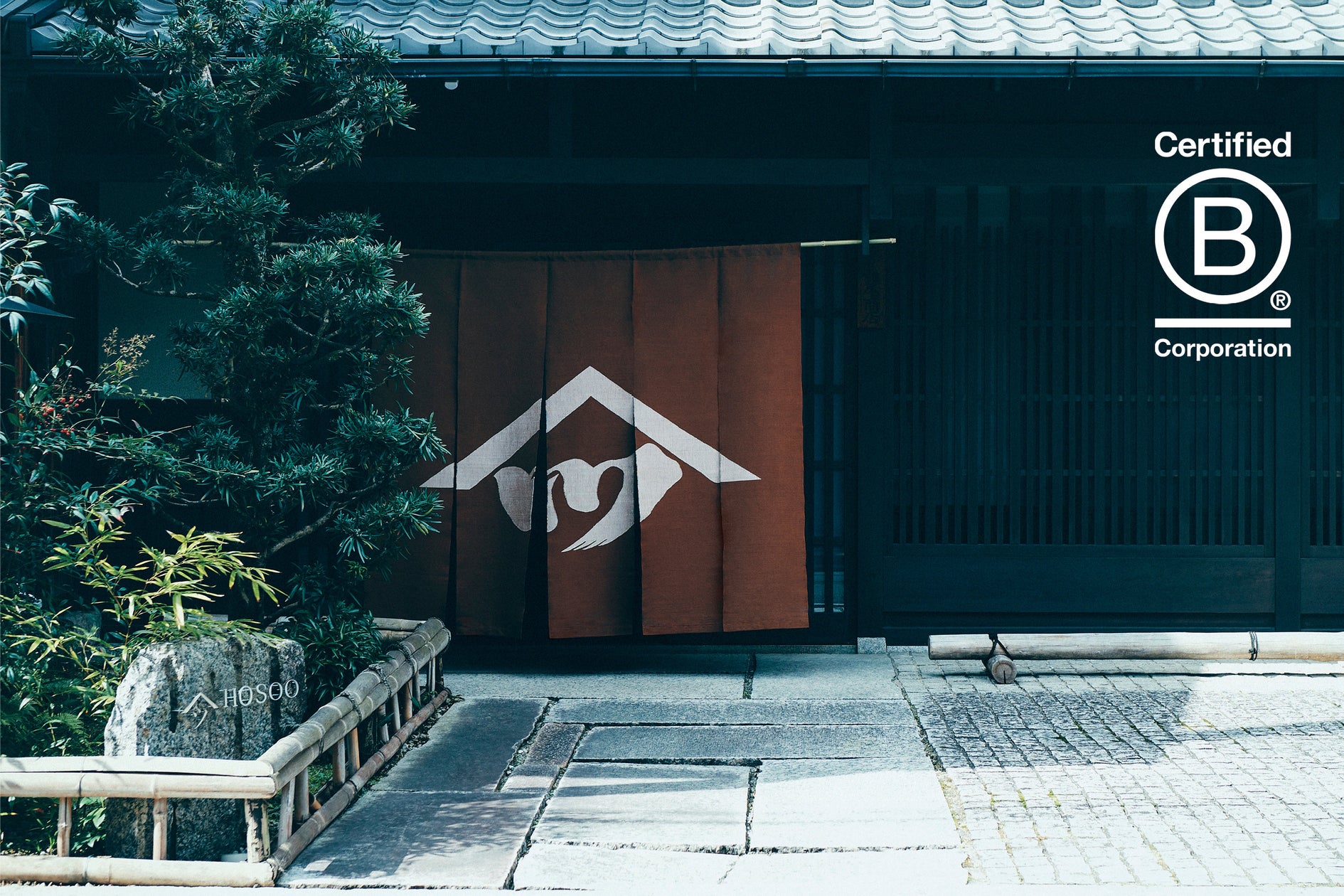
In July 2026, HOSOO Group companies (HOSOO Collective Co., Ltd., HOSOO Co., Ltd., HOSOO Co., Ltd., KYOTO SILK HUB Co., Ltd.) obtained the international certification 'B Corporation (hereinafter referred to as B Corp)'.
The certification score is 109.9. It achieved the highest score* in Japan's manufacturing industry and ranks 6th in the textile manufacturing industry, among others, receiving a world-top-class evaluation.
Since its founding in 1688, HOSOO has continued to manufacture obi (wide sashes), kimono, and textiles as a weaver of Nishijin weaving. Furthermore, through research and practice of ancient dyeing, cultural dissemination through HOSOO GALLERY, and the regeneration of sericulture through KYOTO SILK HUB, the group engages in comprehensive production that confronts the region, culture, technology, and materials. Among these efforts, collaboration with craftsmen and research institutions at home and abroad, continuous investment in regional culture, improvement of supply chain transparency, and efforts towards decarbonization and circular production have been evaluated, leading to the acquisition of this certification.
What we have been weaving for 337 years is not just fabric.
People and people. People and nature. People and culture. Region and society. Tradition and innovation. Past and future.
Weaving these diverse relationships and creating new value.
Using fabric as a medium, we continue to weave harmonious and beautiful relationships. That is the practice that HOSOO has inherited. This B Corp certification is an event where our long years of practice have been recognized by a globally common evaluation criterion.
B Corp is an international certification that evaluates how much value a company generates for regional communities, employees, customers, supply chains, and the global environment, in addition to profit. As an international indicator for integrating social, environmental, and economic value in corporate management, it has spread to 102 countries and 163 industries worldwide. At a time when values are shifting, this international certification is used as a guide for management that transcends existing capitalism, transcending society, industry, and national borders.
We believe that crafts are not just about preserving history but are wisdom and philosophy for creating new relationships with society.
From an economy based on mass production and mass consumption to an economy that values connections with regions, culture, and nature. Delivering value to society that cannot be measured by efficiency alone.
Crafts have the power to show the new way of economy and culture needed for the future. This aligns deeply with the world that B Corp aims for.
Based on the wisdom of Nishijin weaving that has been passed down for 337 years, we will continue to weave the future with the world.
Comment from HOSOO Representative Director Masataka Hosoo
The acquisition of B Corp certification this time is not just an evaluation of HOSOO as a single company, but it also signifies that the very practice of crafts that have been passed down for a long time has been recognized as a value necessary for future society under international evaluation criteria. We are very proud that crafts have been evaluated not just as the preservation of tradition but as a practical solution to challenges faced by the world, such as capitalism, the environment, and regional communities.
Crafts are wisdom that continues to create new value in the relationship between people, nature, society, and time, and nurtures beautiful and harmonious relationships.
Under the philosophy of 'Weaving Relations,' we will continue to challenge new endeavors with various partners at home and abroad, expanding the possibilities of Japanese crafts to the world.
▪ About B Corp Certification
B Corp certification is an international certification system operated by B Lab, a non-profit organization in the United States.
It evaluates how much value a company generates for various stakeholders, including regional communities, employees, customers, supply chains, and the global environment, in addition to profit, from both 'past achievements' and 'future business concepts.' 'B' stands for 'Benefit,' and the ideal is to create public value through corporate activities.
It does not just evaluate 'good products' or donation activities but questions whether a for-profit organization, a company, places the impact on regional communities, employees, customers, supply chains, and the global environment in its management decision-making. At its core is the idea of transforming the existing company view and capitalism that prioritize shareholder benefits, turning business into a force for solving social issues. The evaluation indicators (B Impact Assessment) that become conditions for B Corp certification have high affinity with the SDGs and are also linked to the system constructed with the United Nations Global Compact.
As an international indicator for management that balances profit and impact on society and the environment, it has spread to 102 countries and 163 industries worldwide.
▪ Positioning of Certification Score 109.9
Currently, B Corp certification is held by approximately 10,900 companies in 102 countries worldwide.
It is said that over 300,000 companies worldwide are challenging this certification. Each company must reach the qualification condition of 'passing score 80 or above' after being evaluated and examined in the five domains described below. However, the number of companies is 10,947, and the certification rate is about 3%, making it one of the strictest certifications in the world.
Even companies that have obtained certification are concentrated in the late 80s (median 87-89).
Among the few companies with a score exceeding 100, HOSOO has an extremely high evaluation of 109.9 points, recording the highest score* in Japan's manufacturing industry and ranking 6th among textile manufacturing companies certified worldwide.
▪ About Evaluation Structure
B Corp evaluates and examines based on over 300 evaluation indicators in five domains: 'Governance,' 'Customers,' 'Community,' 'Environment,' and 'Employees.'
The main initiatives for which HOSOO was particularly evaluated are as follows.
1. Impact on Customers
• Dissemination of traditional crafts, culture, and art domestically and internationally
• Continuous and two-way communication with customers
• Creation and promotion of opportunities to experience craft culture
2. Impact on Regional Communities
• Organization building that prioritizes diversity, fairness, and inclusiveness
• Work environment for traditional crafts where young generations can thrive
• Opening of HOSOO GALLERY to the region
• Joint research and educational activities with universities and research institutions
• Continuous collaboration with craftsmen in Kyoto, Nishijin, and various parts of Japan
• Expansion of transactions with overseas brands to revitalize the regional economy
• Continuous investment in sericulture farmers and craftsmen
• Consideration for human rights and the environment throughout the supply chain
3. Impact on the Environment
• Long-term use and maintenance of looms and equipment
• Effective use of leftover threads and end materials
• Construction and renovation utilizing old buildings
• Research and practice of ancient dyeing
• Quantitative evaluation of greenhouse gas emissions based on SBTi
• Introduction of renewable energy and EVs
• Adoption of GOTS-certified silk and RCS-certified materials
4. Impact on Employees
FACT BOX
- Source: PR TIMES
- Category: News
- Organizations: B Lab