Pokakyu, a specialist in Eco-Cute water heater replacements, conducted a survey targeting 200 homeowners regarding the actual awareness and understanding of subsidy programs for water heaters and Eco-Cute systems.
The previous survey (conducted in June 2026) revealed that about 70.0% of respondents were unaware of the subsidy programs available for water heater replacement. The top reason for hesitating to replace was "high initial cost" (38.0%). Those most concerned about expenses are precisely the ones not receiving information about subsidy programs that could reduce their burden.
▼ Previous Survey Reality Check on Water Heaters and Eco-Cute Systems (distributed July 7, 2026)
So why isn't this information reaching people? This time, we dug deeper into the "unawareness" to understand exactly what misconceptions people have about subsidies.
Survey Overview
Survey Name: Reality Check on Subsidies for Water Heaters and Eco-Cute Systems
Target Group: Homeowners
Valid Responses: 200
Method: Online survey (via Lancers)
Survey Period: August 18–20, 2026
Conducted by: VAXAL Inc. (Pokakyu – Eco-Cute Replacement Specialist)
※ When quoting or republishing these results, please credit "Source: Pokakyu, Eco-Cute Replacement Specialist" and include a link to the following URL:
https://vaxal-kyutooki.com/
Survey Summary
50.0% mistakenly believe the "purchaser must personally apply" for subsidies, exceeding the correct answer (40.0%) that "only registered businesses can apply."
Only 23.0% correctly understood who applies for the subsidy.
44.5% said they would first consult a retailer or installer when wanting to use subsidies. Over half do not know the correct procedure.
84.0% find the process "hassle" or "cannot imagine what steps are needed." Among those with experience, this drops to 38.9%.
Detailed Survey Results
[Question 1] How many years has it been since your water heater was installed or replaced?
3–7 years: 25.5%, 10–15 years: 19.5%, less than 3 years: 19.0%, 7–10 years: 18.0%, 15+ years: 10.5%, don't know: 7.5%
Responses came from a broad range of households
Respondents were evenly distributed from less than 3 years to over 15 years, indicating diverse representation. While water heaters typically last 10–15 years, 30.0% of households have used theirs for over 10 years, meaning about 30% are approaching a realistic replacement window.
▼ Reference: How long does an Eco-Cute last? What to know after 10 years and tips to extend its life
[Question 2] Were you aware of subsidy programs available for water heater replacement?
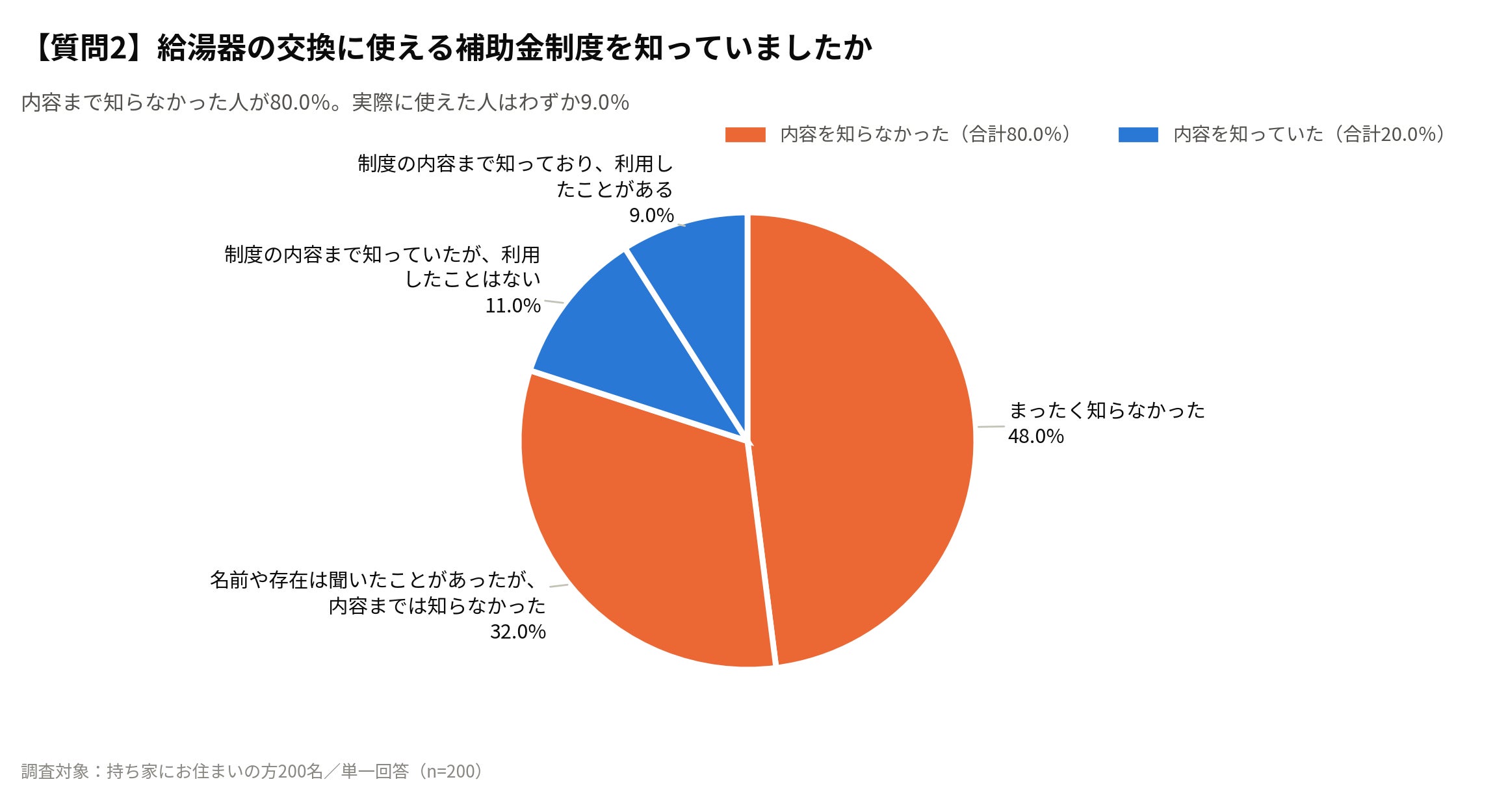
Not aware at all: 48.0%, heard the name but not details: 32.0%, knew details but never used: 11.0%, knew details and used: 9.0%
80% don’t know the details of the program. Only 9% have used it.
Combining "not aware at all" and "heard of it but don’t know details" totals 80.0%, nearly identical to the previous survey’s 70.0%, indicating a persistent information gap.
Notably, only 9.0% have actually used the subsidy. Knowing of a program isn’t enough—without understanding how it works, people can’t use it. Even among households using their heater for over 10 years (those nearing replacement), 93.3% didn’t know the details.
[Question 3] When you want to use a subsidy, what should you do first?
Consult a retailer or installer: 44.5%, contact your local municipality: 28.0%, don’t know what to do: 19.5%, contact the manufacturer: 5.0%, apply yourself via government website: 3.0%
Over half don’t know where to start
Under the 2026 Hot Water Energy-Saving Program, only registered "Hot Water Energy-Saving Businesses" can submit subsidy applications. Therefore, consumers should first consult a registered retailer or installer.
However, only 44.5% identified this correct step. The remaining 55.5% would contact municipal offices (28.0%), manufacturers (5.0%), or feel completely unsure (19.5%).
▼ Reference: Full Explanation of the 2026 Hot Water Energy-Saving Program and Eco-Cute Subsidies
[Question 4] Which of the following do you believe are correct about water heater subsidies? (Multiple answers allowed)
Most believe "I must apply myself"
The most selected option was incorrect: "The purchaser must personally apply to the national or local government" (50.0%), surpassing the correct answer: "Only registered businesses can apply" (40.0%).
Regarding subsidy amounts, only 19.5% correctly knew "under certain conditions, you can receive over 100,000 yen." The remaining 68.5% had no idea how much they could receive. In reality, some cases exceed 100,000 yen, but this is largely unknown.
Only 5.0% answered all questions correctly. Meanwhile, 59.0% selected at least one incorrect statement as "correct."
[Question 5] How do you feel about the procedures required to use subsidies?
Slightly troublesome: 56.0%, cannot imagine what’s needed: 28.0%, not particularly difficult: 14.5%, seems easy: 1.5%
Over 80% feel anxious—but experienced users don’t
Combining "slightly troublesome" (56.0%) and "cannot imagine what’s needed" (28.0%) totals 84.0%. Only 16.0% had a positive view.
However, among those with subsidy experience, this figure drops to 38.9%. This suggests the process isn’t inherently difficult—most fear stems from not knowing what to do.
[Question 6] What concerns do you have about subsidies or replacement? (Open-ended)
About 40.0% of responses expressed concerns about confusing application procedures or unclear systems. Representative comments include:
"I wouldn’t even know if a subsidy exists unless someone tells me. I think this happens a lot."
"I don’t understand the subsidy process and worry I might not be able to apply or get rejected."
"The eligibility criteria and application methods are unclear, and I’m anxious about how much I’ll actually save."
"I’m worried whether I meet the requirements and whether the money will actually be paid."
"I’m concerned about whether the contractor I hire is a registered business, and whether the upfront installation cost is too high."
"I’m worried that if I consult a contractor, they might aggressively sell me other services."
Meanwhile, about 20% expressed concerns about high costs. Notably, only 3 out of 200 respondents (1.5%) mentioned the risk of subsidy budgets being exhausted.
Key Insights from the Survey
This survey reveals a deeper issue than mere "lack of awareness"—a fundamental misunderstanding of how the subsidy system works.
FACT BOX
- Source: PR TIMES
- Category: Survey