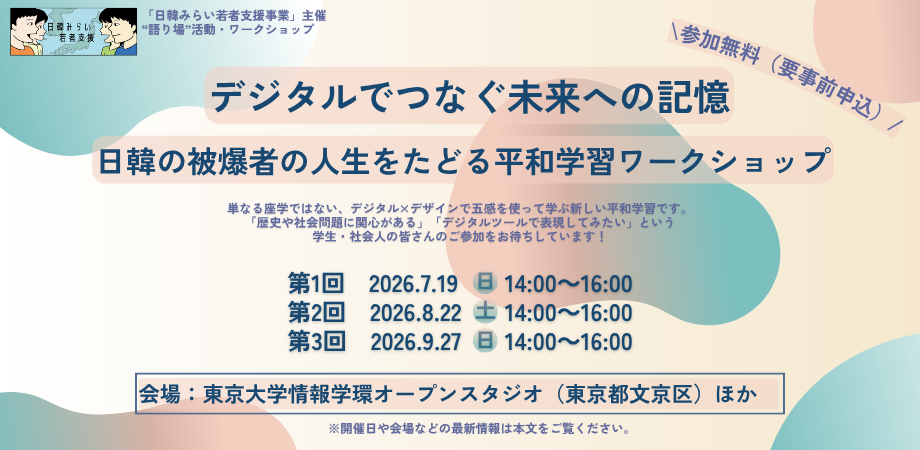
The date 'August 6, 1945' is recorded in history textbooks. Beyond this date lies the real, individual 'lives (stories)' of those who survived wartime and postwar Japan and Korea. This workshop is a three-part lecture series.
The first session features a screening of the documentary film 'Another Hiroshima' by director Park Su-nam, which documents the experiences of Korean atomic bomb survivors, followed by learning about the 'Story Map'—a digital tool that traces the life journeys of Japanese and Korean survivors—to deepen understanding of historical realities.
In the second and third sessions, participants will use cutting-edge digital geospatial platforms to visualize and share the life trajectories of Japanese and Korean survivors as digital stories they create themselves.
This is a new form of peace education that goes beyond traditional lectures, engaging all five senses through digital technology and design. We welcome students and working adults who are interested in history, social issues, or digital expression.
※ Session content is subject to change.
About the 'Katariba' Initiative
The Japan-Korea Future Youth Support program holds learning sessions on different themes each time. While this allows broad exposure, it can make deep understanding of a single topic difficult. The 'Katariba' initiative aims to address this by focusing intensively on one theme across multiple sessions to foster deeper engagement and comprehension.
Each year, participants from previous workshops and study tours form 3–5 groups. Based on their chosen themes, each group combines lectures, field trips, and peer learning in a collaborative format.
'Katariba' is a space where participants are not just passive learners but can freely share their thoughts and feelings as they learn.
Application
Deadline: Application deadline for Session 1: July 17, 2026 (Friday), 17:00 Application deadline for Sessions 2 and 3: August 20, 2026 (Thursday), 17:00 Sessions 2 and 3 will be held in central Tokyo (near Bunkyo Ward). Details will be announced once confirmed. Venue and meeting point information will be sent via email after registration.
Attendance at both Session 2 and Session 3 is原则上 required. If you are unable to attend both days due to personal circumstances, please indicate this during registration.
There will be no archive recordings or distribution of materials after the event.
Register via Peatix
Event Overview
Dates
Session 1: July 19, 2026 (Sunday), 14:00–16:00
Session 2: August 22, 2026 (Saturday), 14:00–16:00
Session 3: September 27, 2026 (Sunday), 14:00–16:00
Format
In-person
The venue for Sessions 2 and 3 (near Bunkyo Ward) will be communicated to registered participants.
Venue Addresses
Session 1:
Open Studio, Graduate School of Interdisciplinary Information Studies, The University of Tokyo
7-3-1 Hongo, Bunkyo-ku, Tokyo 113-0033
1F Basement, Interfaculty Initiative in Information Studies Building, Hongo Campus, The University of Tokyo
Open Google Maps
Sessions 2 and 3:
To be held in central Tokyo (near Bunkyo Ward). Specific location will be shared separately with registrants.
Organizer and Lecturer
Ms. Miyako Murayama (Doctoral Program, Graduate School of Interdisciplinary Information Studies, The University of Tokyo)
Language and Support
Japanese
If you need assistance during participation, please let us know at the time of registration.
Participation Details
Target Audience
Individuals interested in war and atomic bomb history, peace, and Japan-Korea relations
Students and individuals in their 20s–30s are especially welcome
Participation Fee
Free
Capacity
Approximately 20 participants
Session Programs
Session 1: Learn and Understand
Watch the documentary 'Another Hiroshima' by director Park Su-nam, which traces the footsteps of Korean A-bomb survivors, and learn about 'Story Maps' that follow the lives of survivors in Korea and Japan to confront historical truths.
Session 2: Experience and Feel
In small groups, learn how to create 'Story Maps' using advanced digital geospatial platforms.
Session 3: Create and Share
Apply what was learned in Session 2 to collaboratively create original 'Story Maps' in groups. Each group will present their work and share outcomes.
※ Session content is subject to change.
What is a Story Map?
A Story Map is a digital content format that combines maps, photos, videos, and text to trace the narrative of a person or event. By linking place and story, users can understand when and where an event occurred by exploring it directly on a map.
Lecturer Profile: Ms. Miyako Murayama
Currently a doctoral student in the Cultural and Human Informatics course at the Graduate School of Interdisciplinary Information Studies, The University of Tokyo, under Professor Hidehiko Watanabe. Her research focuses on digital archives for peace education, memory transmission among Japanese and Korean A-bomb survivors, and peace education models for high school students. She is also developing accessible Story Map designs for low-vision learners.
Inspired by her participation in the 'Japan-Korea Future Study Tour' in February 2024, she has continued to plan and lead 'Katariba' sessions on 'overseas A-bomb survivors' through the same initiative.
Previously worked as an English teacher at a public high school in Nagano Prefecture until March 2024, actively involved in international exchange during her tenure.
Ground Rules
Address people by the names they prefer.
Avoid discriminatory speech or actions.
Please refrain from photography or recording. Documentation will be handled by the organizing team with participants’ consent.
If you feel uncomfortable or need help, please contact the organizing team without hesitation.
Inquiries
Asia Community Center 21 (ACC21), Certified NPO
An international cooperation NGO that has worked on poverty reduction in Asia since 2005, based on a network of over 100 local NGOs across 12 Asian countries. ACC21 supports street-living children and youth (Philippines), runs the Japan-Korea Future Youth Support Program, and develops human resources for international cooperation. The organization also hosts various events related to poverty issues and field activities in Asia.
Organizing Bodies
● Asia Community Center 21 (ACC21), Certified NPO
An international cooperation NGO that has worked on poverty reduction in Asia since 2005, based on a network of over 100 local NGOs across 12 Asian countries. ACC21 supports street-living children and youth (Philippines), runs the Japan-Korea Future Youth Support Program, and develops human resources for international cooperation. The organization also hosts various events related to poverty issues and field activities in Asia.
Instagram | X (Twitter) | Facebook
● AsiaCommons (NPO Corporation)
AsiaCommons collaborates with citizens, civil organizations, cultural and academic fields, and local governments across Asia to promote grassroots exchange and cooperation. Through events such as introductions, international collaboration, cultural exchanges, and performances, it advances regional and personal international exchange, fostering awareness of personal dignity and intercultural understanding among Japanese and international participants.
FACT BOX
- Source: PR TIMES
- Category: Event