Booost Inc. (Shinagawa-ku, Tokyo; CEO: Kōkon Aoī, hereinafter "the Company"), a sustainability × AI company providing the "Sustainability ERP"*2—the market-leading solution for large enterprises for two consecutive years*1—announces the results of the "Survey on Awareness and Current Status of SSBJ Standard Disclosure Compliance." This survey was conducted by the Japan CFO Association with planning cooperation from the Company, targeting 110 CFOs and operational leaders (heads of finance, accounting, sustainability, IR, and strategic planning departments) from companies currently subject to, or likely to become subject to, the SSBJ standards.
The survey reveals that while SSBJ compliance is increasingly recognized as a critical issue among listed companies, there remains a significant gap in preparedness—particularly in terms of understanding the standards, setting concrete timelines, and establishing CFO-led governance structures (CFOs, along with finance, accounting, strategic planning, IR, and disclosure/internal control departments).
<Survey Summary>
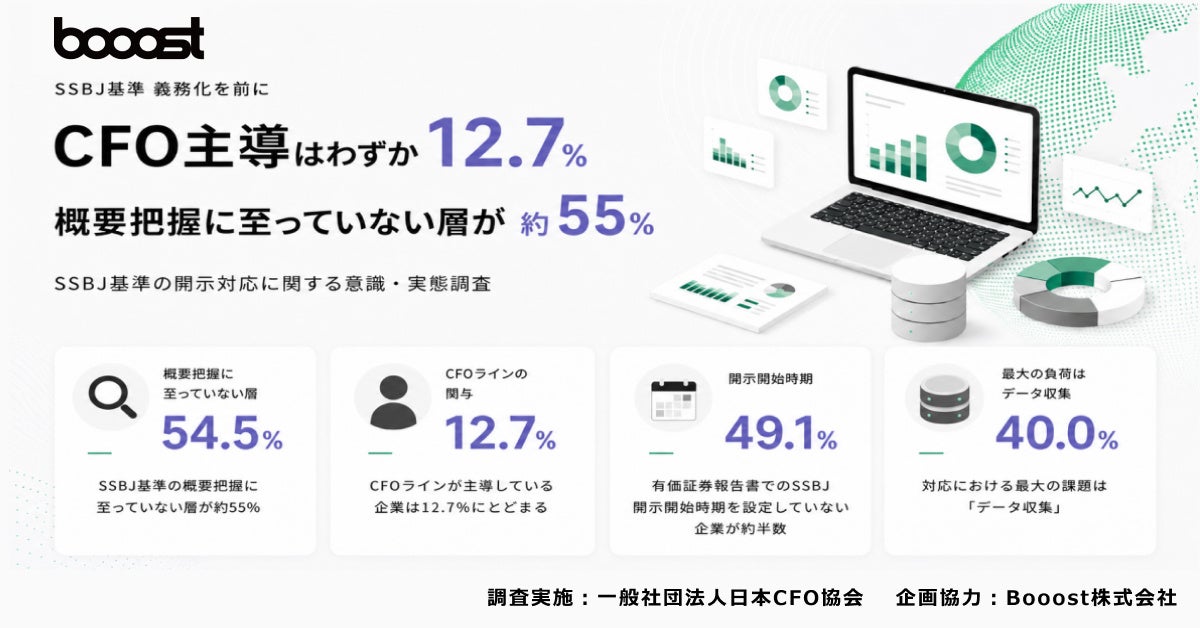
- Approximately 55% of respondents lack a basic understanding of the SSBJ standards.
- While 48.5% of companies recognize SSBJ compliance as a critical issue, only 16.4% have reached board-level policy agreement.
- Only 12.7% of companies are led by CFOs, while sustainability departments lead in 30.9%—the highest share.
- The primary operational challenge is "data collection," with only 6.7% having established disclosure systems across their entire group.
- Less than 20% of companies have built quantitative models linking non-financial KPIs to financial impact.
Background of the Survey
Sustainability disclosures under the SSBJ standards will become mandatory starting in FY2027 for Prime-listed companies with a market capitalization exceeding JPY 3 trillion, with phased mandatory adoption expected for other market cap tiers. As a result, much of the sustainability information previously disclosed voluntarily through integrated reports or sustainability reports will now become legally mandated disclosures in securities reports.
Additionally, efforts are underway to advance the timing of securities report disclosures ahead of shareholder meetings. In March 2025, the Financial Services Agency requested that all listed companies ensure investors can review securities reports prior to shareholder meetings, ideally submitting them at least three weeks in advance. This requires companies to establish systems for earlier calculation and finalization of non-financial data and its financial implications.
<Visualization of Early Securities Report Disclosure>
Furthermore, in light of the revised Corporate Governance Code (2026 edition) published on July 21, 2026, there is growing emphasis on moving beyond formalistic sustainability disclosures. Instead, companies are expected to integrate sustainability information with management and finance to support long-term value creation and meaningful dialogue with capital markets.
Given this context, the Company initiated and proposed this survey in 2026—the de facto "first year of disclosure"—to visualize the current state of SSBJ compliance, identify key challenges, and clarify the roles and governance structures expected of CFO functions.
Survey Overview
Survey Name: "Survey on Awareness and Current Status of SSBJ Standard Disclosure Compliance"
Conducted by: Japan CFO Association Planning Cooperation: Booost Inc.
Target Respondents: CFOs and department heads (finance, accounting, sustainability, IR, strategic planning) from companies currently or potentially subject to SSBJ standards
Valid Responses: 110
Survey Period: March 16, 2026 – April 10, 2026
Method: Web-based questionnaire
Survey Results
1. 54.5% Lack Basic Understanding of SSBJ Standards; Significant Variability in CFO-Line Perceptions of Importance
Understanding of the SSBJ standards shows a clear polarization (see Chart 2). Only 10.6% fully understand the requirements at a level where they can explain them, and combined with the 34.8% who "generally understand (have a basic grasp)," only 45.4% of respondents have adequate comprehension. Conversely, those who "understand only partially" (27.3%), "understand almost nothing" (13.6%), and "do not know/cannot answer" (13.6%) collectively account for 54.5%—a majority lacking even a basic grasp. Despite the standards being finalized, there remains a significant literacy gap among operational leaders.
Regarding the perceived importance of SSBJ compliance within CFO functions, 18.2% consider it "as important as financial reporting (one of the top management priorities)," and 30.3% consider it "important (high priority from enterprise value and capital market perspectives)," totaling 48.5% with high priority (see Chart 3). In contrast, 25.8% view it as "moderate (proceeding in balance with other initiatives)," 13.6% as "low (minimal response sufficient for now)," and 12.1% as "unable to assess importance (insufficient information)." Combined, over half of respondents do not clearly classify SSBJ compliance as "important."
[Implication] Disparities in SSBJ readiness begin at the level of regulatory understanding and importance assessment. Going forward, shared awareness must be established not only within sustainability departments but also across management and finance teams.
2. Only 16.4% Have Board-Level Policy Discussions on SSBJ; CFO-Led Initiatives Represent Just 12.7%
Regarding board or executive-level discussions on SSBJ compliance policies, only 16.4% of companies reported having reached board-level agreement, and another 16.4% are still discussing or reviewing at the executive committee level (see Chart 4). Meanwhile, 36.4% are still at the operational level, and 30.9% have not yet held any concrete discussions—indicating that while operational teams are taking the lead, strategic decision-making and policy formulation at the executive level remain underdeveloped.
As for the departments leading SSBJ compliance, 30.9% are led by sustainability departments—the highest share—while 12.7% reported their leadership structure as "currently unorganized" (see Chart 5). Moreover, in 87.3% of cases, the CFO is not the responsible department. Given the need to link sustainability data with financial reporting and enterprise value, the role and involvement of CFO functions will be a critical issue moving forward.
[Implication] SSBJ compliance should not be driven solely by operational departments. Early involvement of CFO functions and executive leadership, along with clear accountability and decision-making processes, is essential for improving disclosure quality.
3. Nearly 50% Have Not Determined SSBJ Disclosure Timelines; Data Collection Remains the Top Challenge
Regarding the timing of SSBJ disclosures in securities reports, 10.9% plan disclosure in 2026 (including voluntary disclosures), 14.5% in 2027, 10.9% in 2028, and 14.5% in 2029 or later. However, 23.6% remain "undetermined," and 25.5% answered "don't know/not applicable," totaling 49.1% (see Chart 6). Even among companies subject to SSBJ standards, CFOs at many companies
FACT BOX
- Source: PR TIMES
- Category: Survey