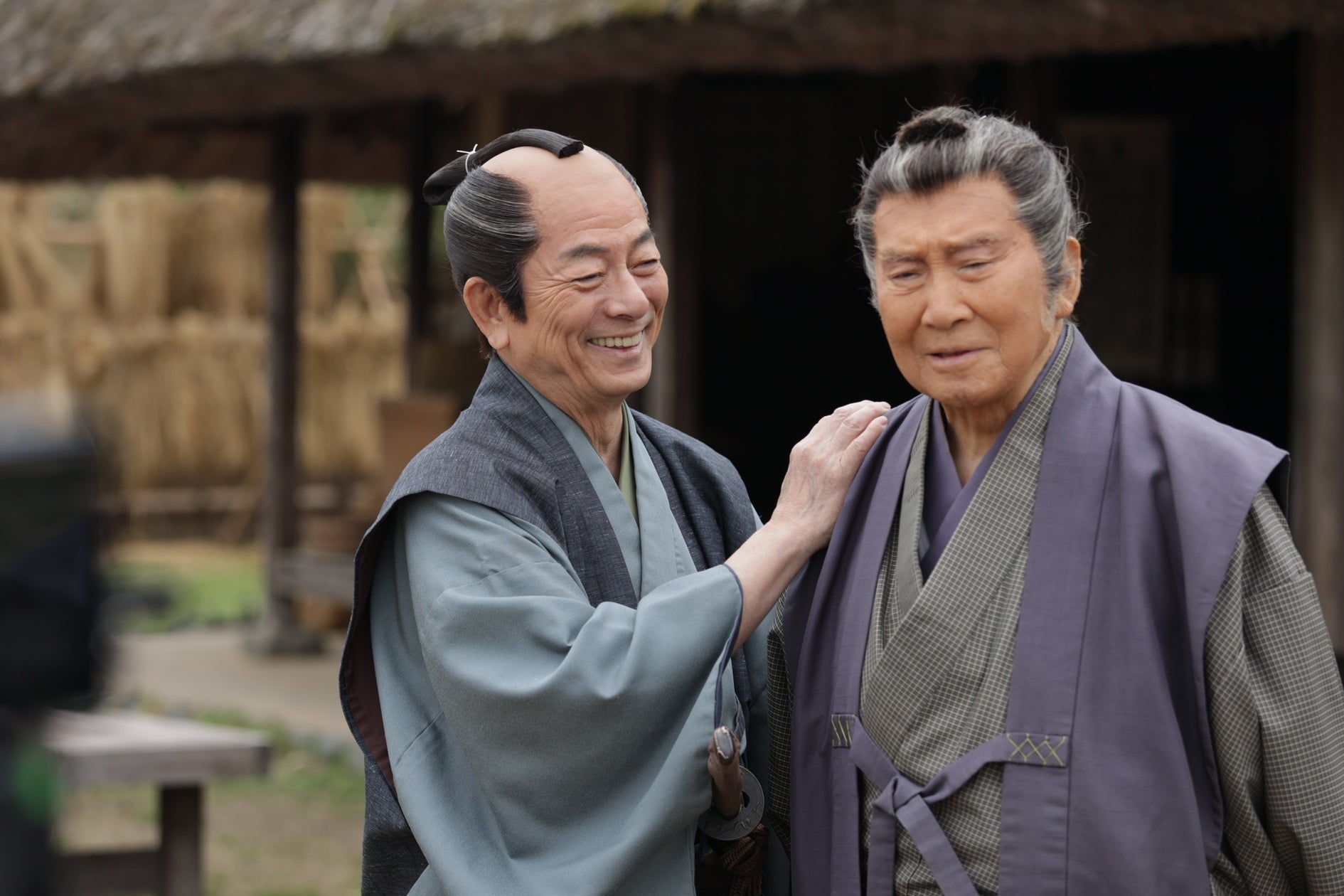
Yutaka Mizutani (left) and Kōtarō Satomi (right) co-starring for the first time in "Muyōan Inkyo Shugyō 10"
Appears as Hanbei's Mentor! Bringing New Charm to "Muyōan" with Profound Lines and Acting!
Based on the short historical novel "Muyōan Inkyo Shugyō" by Naoki Prize-winning author Yasuhisa Ebisawa, this drama is brought to life by the collaboration of Yutaka Mizutani and director Kazuyoshi Yoshikawa! First broadcast in 2017 with Yutaka Mizutani, Ittoku Kishibe, and Rei Dan, this is the 10th installment in the 10th year of BS Asahi's thrilling entertainment period drama "Muyōan Inkyo Shugyō." While previous nine installments have featured talented actors as guests to enrich the story, the 10th installment welcomes the legendary actor Kōtarō Satomi, who has long supported Japanese period dramas, as a guest.
Satomi plays Issai Ito, the head of the Yomeikan, where the protagonist Hanbei (played by Yutaka Mizutani) once studied Yōmeigaku. In a flashback scene triggered by an accidental reunion with Tajima (Kenjiro Nashimoto), who also studied at Yomeikan, Issai Ito, played by Satomi, appears. Glimpses of the pride that supports Hanbei's way of life, a champion of the weak common people, can be seen throughout the scene... Each line deeply resonates with us living in the modern day, and the scene unfolds with profound depth through Satomi's signature weighty performance.
And, remarkably, his first co-starring role with Mizutani is also a highlight.
This interview captures the thoughts of veteran actor Kōtarō Satomi on his appearance in the popular series "Muyōan Inkyo Shugyō" and filming period dramas in Kyoto, which is like returning home for him. We also deliver comments from Yutaka Mizutani, with whom he co-starred for the first time.
This "Muyōan Inkyo Shugyō 10" is also produced in 4K. You can enjoy it as a high-definition and immersive period drama on the BS Asahi 4K channel.
Kōtarō Satomi's Comments
Q: This is your first time co-starring with Yutaka Mizutani, isn't it?
"It must have been over 20 years ago, but I participated in the same golf tournament as Mizutani-san. We exchanged words then, saying, 'Your drama 'AIBOU' is doing well, that's great,' and he replied, 'Thank you. Let's play golf together again.' However, I didn't see him at studios or elsewhere after that, and we hadn't met since that golf tournament. I was looking forward to meeting him this time, and when we met, we hugged and rejoiced in our reunion. Even though we had only met once, it felt like reuniting with an old, close friend. He's a very pleasant person, bright and good. I want people to see us two like this. In my 70 years as an actor, this is the work that has left me with the happiest memories."
Q: "Muyōan" is a popular series that has been running for 10 years. What do you think is the secret to its success?
"Detective dramas and suspense thrillers are watched for their overall story and flow. But period dramas are different. If the lead actor isn't charismatic, no one will watch a period drama. That's how period dramas are. In short, if the hero in the drama isn't appealing, it won't last. That's why it continues for so long, because Mizutani has that appeal. That's why they decide to do it so many times."
Q: What are your thoughts on appearing in "Muyōan"?
"Director Yoshikawa first asked me, 'Kō-chan, will you appear in a work like this?' However, all my scenes were flashbacks. I asked if they could add a little more, and he said, 'Understood, I get what you're saying, Kō-chan. You don't have to say it,' and rewrote the lines, which turned out to be wonderful lines as a human being. I was truly moved. I still remember those lines. It became a very good scene. We shot a scene of about four pages in one take, with only one NG. I felt refreshed even after performing it. The director said, 'It was so-so,' but 'so-so' means not bad (laughs). When Mizutani-san said, 'You memorized these long lines so well,' I was truly happy. In any case, by changing the lines in the script, my role changed completely, and my feelings towards the work also changed drastically."
Q: What were your thoughts on the direction by Kazuyoshi Yoshikawa, whom you've known for a long time?
"I've known the director for decades. He directed 'Mito Kōmon Special' (2015), and it's been since then. We met again after a long time and celebrated our reunion, saying, 'Hey, have you been well?' When I joined Toei, around the time period dramas started to decline in popularity, I was told, 'Go to Tokyo and do modern dramas,' and I appeared in 'Tokubetsu Kidō Sōsatai.' I've known Director Yoshikawa since that time. Every time we meet, I say, 'I'm one year older than you,' and he replies, 'I know, Director,' and we have exchanges like that (laughs)."
Q: What are your feelings about period dramas filmed in Kyoto?
"I don't have any particular feelings about it (laughs). When I joined Toei as a new face, my salary was 8,000 yen at the time, and renting an apartment in Oizumi Gakuen cost at least 4,000 yen. I thought I couldn't live on that. Then I found out that in Kyoto's Uzumasa, there was a dormitory within the studio that provided two meals a day for 3,000 yen. I thought I had to go, so I went to Kyoto. It was purely for survival. At that time, I didn't care if I liked period dramas or not; I came to Kyoto because I had no money (laughs). That era made Kōtarō Satomi, you could say (laughs)."
Q: Period dramas are rarely seen on television now. What are your thoughts on that?
"It's sad. I understand the reality that period dramas can't be made because of production costs, but we were still making them when we were young. Our true feelings as people involved in period dramas are that we hope the times will change somewhere, that something can be done."
Q: You will also be turning 90 in November this year.
"I really want to shout out loud that I'm turning 90 this year. I want people to see a healthy 90-year-old Kōtarō Satomi! That's why I'm so happy. I still play golf twice a week. I walk 18 holes on my own two feet. It's just that the people I used to play with are no longer around, so it's hard to find members (laughs). I also want to keep working. However, I don't want to say, 'Please use Kōtarō Satomi.' I'd be happy to go to sets that are a good match for Kōtarō Satomi, where they specifically want Kōtarō Satomi to appear. After all, it's gratifying and enjoyable when I'm invited. And I want to continue period dramas. I want everyone to know what a real period drama is."
Yutaka Mizutani's Comments
"For me, Kōtarō Satomi-san is a 'menko' person. In the past, period drama stars and professional baseball stars were made into 'menko' (cardboard cutouts). Satomi-san was among the menko I collected as a child. So, I never thought I would have the chance to co-star with someone like him. He's been acquainted with Director Yoshikawa for about 60 years, and it's through that connection that this has been realized. About 20 years ago, I bumped into Satomi-san at a golf course. We had a brief chat then, and this is our reunion since that time. When I said, 'Satomi-san, was that about 20 years ago?' he replied (in a mimicry), 'It was longer ago!' (laughs). I was surprised that Satomi-san remembered. But I thought this time, when we film at Shochiku Studio each time, it feels like the era of good old movies. Watching the movements of Director Yoshikawa and the staff, I feel like this is how things were done in the good old days of Japanese cinema. And then there's Satomi-san? It truly felt like I had time-traveled to that era. His presence this time made me feel that even more."
Main Characters
Hinata Hanbei (Hinata Hanbei) ...... Yutaka Mizutani
A former direct vassal of the Tokugawa shogunate and a bannerman. Since losing his wife to illness, he has lived as a widower, but after his attendant Katsuya recommended Natsu, the daughter of a bannerman, he repeatedly refused, saying "I have abandoned my desires." However, he finally married Natsu and lives happily with her in Muyōan. The issue of succession was resolved by taking Shintaro as his son. Each time, unexpectedly, he confronts great evils that torment the common people of Edo...
Katsuya Hikonosuke (Katsuya Hikonosuke) ...... Ittoku Kishibe
An attendant who has been with Hanbei since childhood. He is currently the attendant to Hanbei's son, Shintaro, but he also takes care of Hanbei in various ways. While possessing the wit and composure to anticipate his master's intentions, he also has a shrewd side that weighs his own gains. He shares a bond with Hanbei that transcends master and servant, and they engage in witty banter born from mutual trust.
Natsu (Natsu) ...... Rei Dan
Daughter of a bannerman. She has been divorced and describes herself as an "active woman." After Katsuya arranged a meeting for her to become Hanbei's second wife, they hit it off, became close, and she finally married Hanbei, whom she admired.
Synopsis
Former bannerman Hanbei (Yutaka Mizutani), who intended to live a quiet life in his old age after abandoning his desires, is now living a more vigorous life after marrying the young Natsu (Rei Dan). His son Shintaro, to whom he has passed on the family headship, has become a metsuke (inspector), and Katsuya serves as the Hinata family's attendant, looking after Shintaro while also working around Hanbei and Natsu's home and enjoying activities like fishing with Hanbei.
One day, Hanbei is reunited with Tajima (Kenjiro Nashimoto), a fellow student with whom he once studied Yōmeigaku. Tajima, a devout believer in Yōmeigaku, had his path to promotion blocked when the shogunate promoted Neo-Confucianism (Shushigaku) and lost his position within the samurai class. His wife also passed away, and he blames himself for not achieving success, leading him to live a harsh life in a tenement house, struggling to even eat with the townspeople.
As Hanbei tries to encourage Tajima and help him recover, he encounters thugs who are demanding exorbitant rent increases and trying to evict Tajima from the tenement house. The residents of the tenement house cheer as Hanbei drives away the rough men, but they lament that the magistrate's office does nothing. They hear that the magistrate of the Northern District is Namiki (Tōru Kayama), with whom Hanbei studied Yōmeigaku.
According to Katsuya, the people pressuring Tajima to move out are land grabbers, and behind the scenes, it's the antique dealer Haguya (Yū Tokui) who is pulling the strings. Haguya, under the guise of an antique shop, buys up popular items in Edo and sells them at high prices, fences stolen goods... and even runs gambling dens to make a profit.
The land grabbers are also targeting the land in Ogawa Village, which Hanbei and his associates are looking after. Hanbei cannot stand by and watch, so he asks Tōbei (Ryōsei Tayama) to investigate Haguya.
Meanwhile, Tsutaya (Hitoshi Katagiri) from Kōshodō visits Hanbei. Tsutaya is taken with a painting of Hanbei he saw in Ogawa Village and asks him to draw illustrations for Yoshiwara Saiken and Kibyōshi (illustrated books). Hanbei recalls seeing Tsutaya with Haguya in Ogawa Village... Feeling suspicious of Tsutaya, Hanbei promptly refuses his offer.
Incidents of residents in the tenement house dying after ingesting poison begin to occur. Hanbei, attending the scene with the head of the Arson and Theft Prevention Bureau, Monzō (Takashi Yamanaka), deduces from the suicide notes left behind that it is not suicide but murder by someone. If so, Tajima is also in danger! Hanbei rushes to Tajima's tenement house...!
Eventually, Tōbei's investigation reveals the series of wicked deeds. And there is a huge mastermind behind it all...! Hanbei devises a plan to punish the evil. What is this plan that even involves Natsu?
Cast
Hinata Hanbei Yutaka Mizutani
Natsu Rei Dan
Tōbei Ryōsei Tayama
Osaki Shinobu Otake
Kyūan Sakichi Sato
Kiyoshiro Matsuda Jun Hashizume
Iku Matsuda Yoshie Ichige
Akemi Natsumi Ogawa
Oseki Manami Hashimoto
Monzo Kimura Takashi Yamanaka
Shintaro Hinata Ito Tanaka
Heizo Hasegawa Takaaki Enoki
Shigesaburo Tsutaya Hitoshi Katagiri
Yasugoro Tajima Kenjiro Nashimoto
Chūemon Haguya Yu Tokui
Yozo Namiki Toru Kayama
Kichigoro Toshio Yamauchi
Harusada Hitotsubashi Matagoro Nakamura
Sadanobu Matsudaira Tetta Sugimoto
Katsuya Hikonosuke Ittoku Kishibe
Issai Ito Kōtarō Satomi
Narration Mari Natsuki
Staff
Original Work Yasuhisa Ebisawa
"Muyōan Inkyo Shugyō" (Bungei Shunju)
Director Kazuyoshi Yoshikawa
Screenplay Akihiro Tsuchihashi
Music Kōji Endō
Executive Producer Kiyoshi Kuwata (TV Asahi)
Producer Wataru Takano (TV Asahi)
Wataru Watanabe (Shochiku)
Yusuke Matsuda (Shochiku)
Co-Producer Kumika Tanaka (BS Asahi)
Production TV Asahi
BS Asahi
Shochiku Co., Ltd.
BS Asahi Broadcast Information
4K Period Drama Special "Muyōan Inkyo Shugyō 10"
September 22, 2026 (Tuesday, Holiday) 7:00 PM - 8:54 PM
Encore Broadcast of All "Muyōan Inkyo Shugyō" Series Begins in August!
"Muyōan Inkyo Shugyō" August 24 (Monday) 7:00 PM - 8:54 PM
"Muyōan Inkyo Shugyō 2" August 25 (Tuesday) 7:00 PM - 9:00 PM
"Muyōan Inkyo Shugyō 3" August 31 (Monday) 7:00 PM - 8:54 PM [4K]
"Muyōan Inkyo Shugyō 4" September 1 (Tuesday) 7:00 PM - 9:00 PM [4K]
"Muyōan Inkyo Shugyō 5" September 7 (Monday) 7:00 PM - 8:54 PM [4K]
"Muyōan Inkyo Shugyō 6" September 8 (Tuesday) 7:00 PM - 9:00 PM [4K]
"Muyōan Inkyo Shugyō 7" September 14 (Monday) 7:00 PM - 8:54 PM [4K]
"Muyōan Inkyo Shugyō 8" September 18 (Friday) 7:00 PM - 8:54 PM [4K]
"Muyōan Inkyo Shugyō 9" September 21 (Monday, Holiday) 7:00 PM - 8:54 PM [4K]
FACT BOX
- Source: PR TIMES
- Category: エンタメ