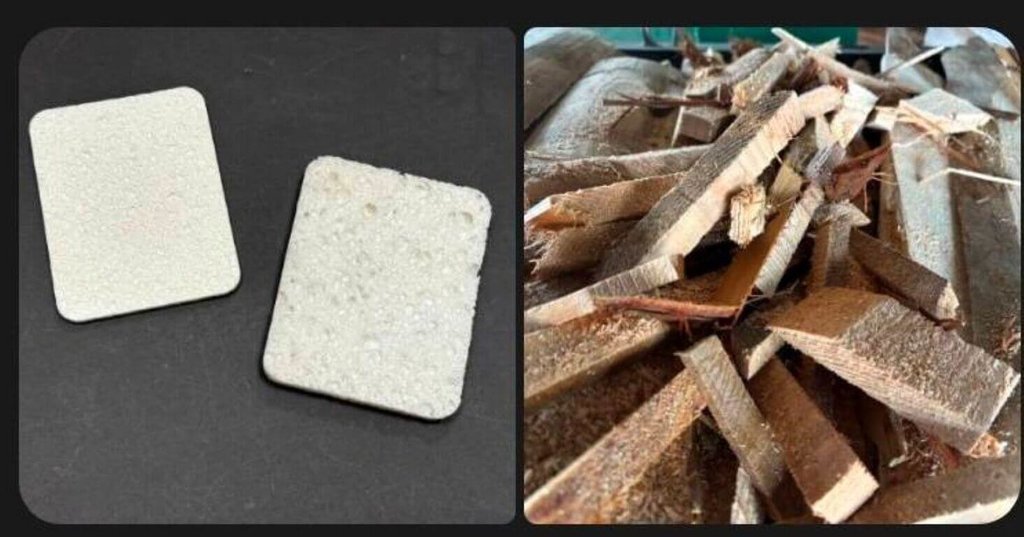
(Central News Agency, Reporter Wang Shufen, Taipei, June 3) The Forestry Research Institute of the Ministry of Agriculture estimates that approximately 700,000 tons of tree trimmings and post-wood-processing forestry residues are generated each year, most of which are burned or buried on site. The institute is researching ways to develop these into green chemicals and eco-friendly packaging materials to achieve ecological sustainability.
The Ministry of Agriculture issued a press release today stating that forestry residues from wood processing, forest thinning, and even routine maintenance pruning of urban forests have long been a headache for forest farmers and related agencies. Traditional methods are mostly direct burning or on-site burial, which wastes resources and increases the environmental burden.
The Forestry Research Institute estimates that Taiwan generates up to 700,000 tons of forestry residues annually, with over 60% currently being processed at low value.
Institute Director Tseng Yen-hsueh stated that burning is not the only option for forestry residues. Taiwan's forestry industry should move towards full resource circular utilization, creating maximum economic value through "hierarchical utilization."
Tseng explained that the process first uses environmentally friendly forestry manufacturing processes to extract high-value green chemicals such as xylitol and lactic acid, which are widely used in the biotechnology and consumer markets. Next, fiber technology is used to produce eco-friendly packaging materials like wood pulp foam. After high-value components are extracted, the remaining residues undergo energy recovery, achieving multi-layered composite economic value.
Deputy Director Wu Meng-ling said the research team conducted in-depth analysis of different types of forestry residues in Taiwan. Through precise and rigorous experimental analysis and verification, they have constructed a comprehensive material properties database. The research data can also serve as a reference for related industries when selecting materials, evaluating suitability and combustion efficiency, and providing a foundation for future by-product development.
The TFRI research team also drew on Japan's experience in handling forestry residues. Japan precisely classifies large quantities of heterogeneous forestry residues, including woody construction waste, and converts them into energy. The team successfully verified the technical hypothesis of reducing collection radius and converting biomass energy locally. They also incorporated extreme climate risk disasters into their model, using stored biomass fuel to continuously provide stable backup energy. (Editor: Wu Su-rou) 1150603
FACT BOX
- Source: CNA (Central News Agency)
- Category: 政策