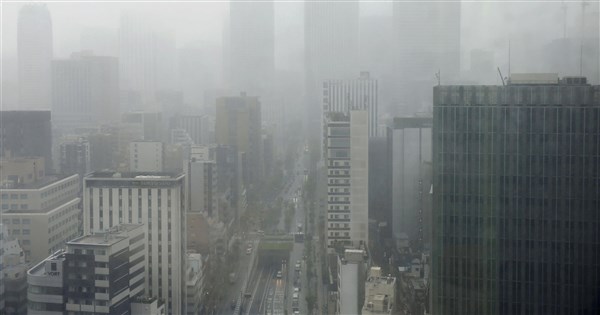
(Central News Agency, Tokyo Special Correspondent Dai Yazhen, June 3) Typhoon Chan-hom swept across Japan's Pacific coast on Wednesday, bringing record-breaking torrential rain from western to eastern Japan. Central Tokyo observed its highest 12-hour rainfall for June on record, leading to temporary flooding of some rivers and prompting warnings in Tokyo and the Kanto region. Although the typhoon is gradually moving away from Honshu, the Japan Meteorological Agency (JMA) warned that strong winds and high waves would continue until Thursday, urging the public to remain vigilant.
According to NHK and the Japan Weather Association, the JMA reported that Typhoon Chan-hom, the sixth of the season, made landfall in southern Wakayama Prefecture in the morning. It then moved eastward along the southern coast of Honshu, reaching a position approximately 190 kilometers east of Choshi City, Chiba Prefecture, by 6:00 p.m., moving east-northeast at a speed of 50 kilometers per hour.
Due to the combined effects of the typhoon and a weather front, heavy rainfall was recorded along Japan's Pacific coast from Tuesday night through Wednesday morning.
Owase City in Mie Prefecture recorded 535.5 millimeters of rain in 24 hours, and Kamikatsu Town in Tokushima Prefecture recorded 436.5 millimeters, both breaking their respective June historical records. Central Tokyo recorded 172.5 millimeters of rain in the 12 hours up to noon on Wednesday, setting a new June record.
The heavy rain caused damage in various locations. The Kusa River in the Kusa River system in Wakayama Prefecture overflowed, prompting authorities to issue the highest-level "Level 5 Flood Special Warning." Additionally, linear rain bands formed in the Izu region of Shizuoka Prefecture and eastern Kanagawa Prefecture, leading to Level 4 danger warnings across southern Kanto and parts of Shizuoka Prefecture. In Tokyo, flood danger warnings were temporarily issued for rivers including the Meguro, Kanda, Zenpukuji, No, and Sen rivers.
According to the Fire and Disaster Management Agency, as of 2:00 p.m. on Wednesday, 23 people had been injured by the typhoon across six prefectures from Okinawa to the Tokai region. One person was seriously injured in Okinawa Prefecture, while the other 22 sustained minor injuries, including 16 in Okinawa, 2 in Kagoshima, and 1 each in Miyazaki, Tokushima, Nara, and Aichi prefectures. Additionally, one minor injury in Shizuoka Prefecture is being investigated for a possible link to the typhoon.
Regarding housing damage, 57 homes have been reported as damaged, including half-collapsed, flooded, and partially damaged structures, primarily in Okinawa, Kagoshima, Tokushima, and Nara prefectures.
The Ministry of Education, Culture, Sports, Science and Technology reported that as of noon on Wednesday, 5,378 elementary, junior high, and high schools across Japan were closed due to the typhoon. Saitama Prefecture had the highest number of closures with 1,152 schools, followed by Chiba Prefecture with 1,123, Ibaraki Prefecture with 827, and Kanagawa Prefecture with 511.
The JMA predicts that Chan-hom will transition into an extratropical cyclone over the ocean east of Japan by Thursday morning, but warned that coastal areas of Tohoku and Kanto should remain on alert for strong winds and high waves for the next day. (Editor: Zhang Zhixuan) 1150603
FACT BOX
- Source: CNA (Central News Agency)
- Category: 事件
- Organizations: NHK