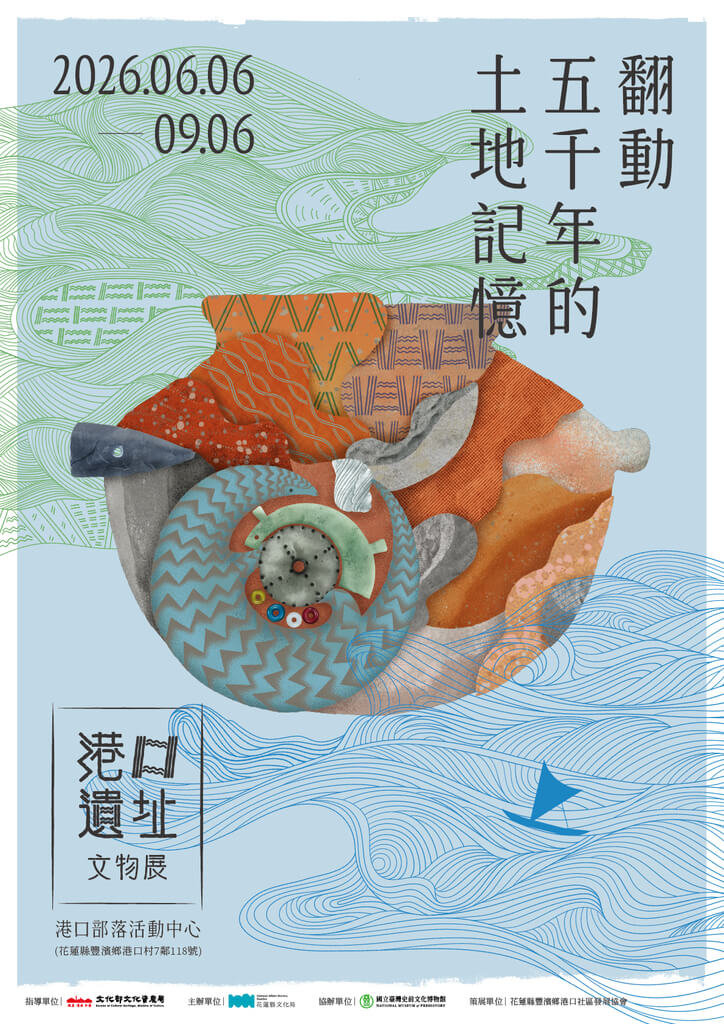
(Central News Agency, reporter Lu Taicheng, Taitung County, June 4) Twenty-five years ago, during the widening of Provincial Highway 11 on the east coast, many prehistoric stone tools and jade artifacts were unearthed. The National Museum of Prehistory is returning these artifacts to the Portong Tribe in Hualien, where they were excavated, for an exhibition starting on the 6th, allowing the artifacts to return to the story of the land.
The National Museum of Prehistory issued a press release today stating that the special exhibition, "Flipping Through Five Thousand Years of Land Memory - Portong Site Artifact Exhibition," curated by the Portong Community Development Association in Fengbin Township, Hualien County, will officially open on the 6th. The exhibition was initiated by members of the Portong Tribe, who borrowed archaeological artifacts from the National Museum of Prehistory and the Hualien County Archaeological Museum.
The museum stated that the Portong Site, located at the mouth of the Xiuguluan River, preserves cultural layers from different periods, including the late Dabenkeng culture, the Eastern Corded Red Pottery culture, the Qilin culture, and the Jingpu culture, making it one of the important sites for studying prehistoric cultural development in eastern Taiwan. The archaeological artifacts exhibited in collaboration with the museum come from excavations conducted during the widening of Highway 11 between 2001 and 2003.
The large number of precious artifacts unearthed, including prehistoric stone tools, jade, pottery, and beads, through archaeological research, tribal historical events, and the reorganization of local memories, carry not only academic research results but also part of the history of this land. They become important clues for understanding the long-term development of the land and allow the stories of people from different eras to meet again in the present.
Furthermore, the museum noted that in recent years, the international museum community has been increasingly focusing on issues such as community participation and shared collections. Museums should not only be preservers of cultural assets but also platforms for promoting the exchange of different perspectives. The most significant aspect of this collaboration is that the tribe is no longer just the subject of the display content but has become the subject of knowledge interpretation and cultural narrative. Through the opening of collection resources and professional support, the museum jointly assists local communities in telling their own land stories.
The museum stated that this exhibition is also the first time artifacts from the National Museum of Prehistory and the Hualien County Archaeological Museum are jointly exhibited at the Portong Tribe. The exhibition will start with a carved pottery shard from the Dabenkeng culture, dating back about 5,000 years, unearthed from the Portong site, guiding the public to understand the diverse aspects of prehistoric cultural development, tribal oral history, and land memory in the Portong area, demonstrating the value of cultural assets in contemporary society. (Editor: Wu Surou) 1150604
FACT BOX
- Source: CNA (Central News Agency)
- Category: 事件
- Dates in source: 1150604