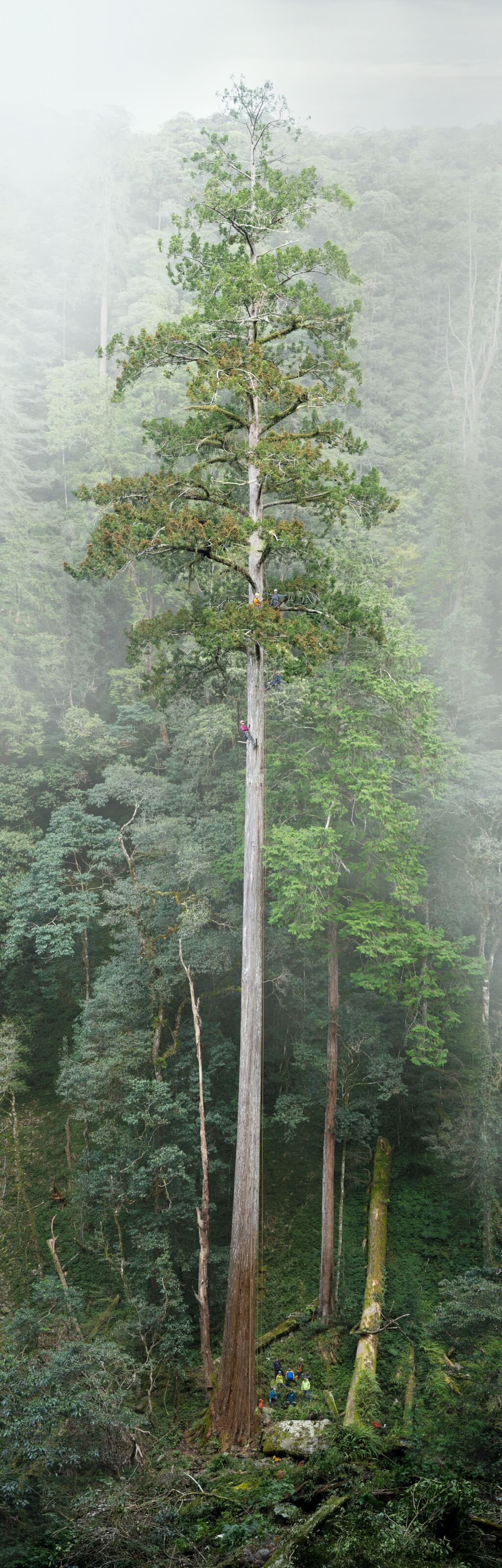
A Taiwanese research team discovered a Taiwan fir (Taiwania cryptomerioides) measuring 84.1 meters in height in 2023 in the upper reaches of the Da'an River in Taichung City, at an elevation of about 2,000 meters. It is not only the tallest known tree in Taiwan but also the tallest known tree in the entire East Asia region. Today, the team shared the search process and research paper, which was published for the first time in the international journal Frontiers in Forests and Global Change.
The Taiwan Science & Technology Media Center held an online press conference this morning for the latest research on "The Quest for Taiwan's Tallest Tree." Hsu Chia-chun, an Associate Researcher at the Taiwan Forestry Research Institute, and Wang Jih-kuei, a professor at National Cheng Kung University, shared how they discovered the giant tree and how the giant tree map can assist in climate change monitoring.
● 'Tree Seekers' venture deep into mountains to find 'Forest Giants'
Hsu said she named the paper after Taiwan, incorporating the name Formosa in parts to convey the meaning of "Beautiful Island." Taiwan is one of the few places in the world that can nurture "giant trees." Since 2014, a team known as the "Taiwan Tree Seekers," including professional tree climbers, ecologists, geologists, and remote sensing experts, has been searching for and documenting these "forest giants" that reach into the clouds.
Hsu stated that the research team found a Taiwan fir 84.1 meters tall in 2023 in the upper reaches of the Da'an River in Taichung City, at an elevation of about 2,000 meters. This is not only the tallest known tree in Taiwan but also the tallest known tree in the entire East Asia region. The paper also introduces that for the Rukai people, this giant fir has a more poetic name: "the tree that hits the moon."
When asked why trees in Taiwan can grow so tall, Hsu explained that it is mainly related to its geographical location and conditions. Taiwan is located on the Tropic of Cancer and has mountainous terrain. The island is crisscrossed with mountains, including over 200 peaks exceeding 3,000 meters, with the highest, Yushan (Jade Mountain), reaching 3,952 meters. The convergence of ocean and mountains easily forms cloud forests, and most giant trees grow in warm, humid forest environments with an average annual temperature of around 13 degrees Celsius. "Taiwan has these conditions," Hsu said.
Hsu noted that about 60% of Taiwan's land area is still covered by forests, estimated to contain about 950 million trees. Although large-scale logging activities between 1912 and 1991 caused many primary forests to disappear, the rugged terrain acted as a natural barrier. Because loggers had difficulty accessing these areas, many ancient forests have been preserved to this day. Finding the tallest tree initially felt like looking for a needle in a haystack, she said.
Hsu said the search for the tallest tree began with a large-scale survey in the Chilan (Qilan) Protected Area, targeting a legendary group of giant trees known as the "Chilan Three Sisters." Local residents had known of the existence of these three giant Taiwan firs for years, but no scientific team had ever conducted precise measurements and complete records. At that time, the tallest of the three was measured at 69.3 meters with a trunk diameter of nearly 3 meters.
● Australia films 'Chilan Three Sisters,' Taiwan's giant trees gain international attention
In 2017, an Australian professional tree-climbing team, "The Tree Projects," visited Taiwan to film the full scope of the "Chilan Three Sisters," bringing Taiwan's giant trees to international attention for the first time.
Hsu said that after surveying the "Chilan Three Sisters," the research team was encouraged to shift their focus to more remote mountainous areas, near the Great Ghost Lake (Dagui Lake) in Wutai Township, Pingtung County, an area considered sacred by indigenous peoples. The team members trekked for four consecutive days with heavy gear to reach the site. However, subsequent explorations made the team realize that it was nearly impossible to determine which tree was the tallest through ground observation alone. Under the cover of multi-layered canopies in primary forests, the human eye is highly prone to misjudgment. Although they successfully climbed a 71.7-meter giant tree at the site, they recognized the need for a more scientific method to survey the entire forest. They were fortunate to collaborate with remote sensing experts from National Cheng Kung University, introducing LiDAR technology.
Wang Jih-kuei, a professor in the Department of Geomatics at National Cheng Kung University, explained that LiDAR is a technology that uses laser scanning to obtain high-precision 3D data. An airborne vehicle emits laser pulses toward the ground, and based on the reflection time of the laser, a detailed 3D terrain model is built, allowing for the measurement of tree heights.
Wang mentioned that Taiwan's terrain is steep and complex, and automatic algorithms often overestimate tree height. For example, trees growing on cliff edges can be better identified by the human eye, which is more reliable than algorithms. Therefore, starting in 2020, the project gradually evolved into a civic action, with hundreds of citizen scientists helping to review optical radar images, allowing the team to eliminate tens of thousands of false positives. The results showed that a staggering 93% of the trees were actually misidentified by the algorithm.
● Citizen scientists help launch Taiwan Giant Tree Map
Hsu said that without the help of citizen scientists, the research team might have spent years traversing mountains and valleys, only to find target trees far shorter than expected. By the end of 2022, the combination of LiDAR and citizen scientists led to the release of the "Taiwan Giant Tree Map," officially marking 941 giant trees over 65 meters tall. It is estimated that there are still 57,065 potential giant tree locations across Taiwan.
Hsu said that during the 2023 Lunar New Year period, the research team used the latest map to pinpoint the most likely candidate for the "tallest tree." The team trekked 20 kilometers upstream along a river, followed by two days of steep uphill climbing to reach the destination. A tree climber ascended to the top of the canopy and measured a height of 84.1 meters. This giant tree was named the "Heaven Sword of the Da'an River," officially becoming the tallest known tree in Taiwan and East Asia. By early 2026, the team had discovered and climbed 10 Taiwan firs exceeding 70 meters in height, with two breaking the 80-meter mark.
Hsu said that based on data from the "Taiwan Giant Tree Map," the research team searched for a "Giant Tree Temple." Near Benye Mountain in Taitung County, they found a one-hectare forest containing 11 giant trees over 65 meters tall. Later, they returned to the Great Ghost Lake area, which they had first surveyed ten years prior, and the scene was even more stunning. About 30 giant Taiwan firs were densely growing in an ancient forest, forming a rare pure stand of Taiwan fir.
Hsu said that in 2024, the research team, along with 15 citizen scientists, conducted a detailed survey of the "Taoshan Sacred Tree" valley, which is home to Taiwan's third tallest tree. The main purpose was to understand how much carbon dioxide this forest can absorb from the atmosphere and store in its trunks.
The results showed that in the Taoshan Sacred Tree valley forest, about 80% of the carbon sink is stored in large trees with a diameter at breast height exceeding 1 meter. Even without including the extensive root systems, the carbon storage amounts to approximately 1,384 metric tons per hectare, approaching the world-class giant tree forests of Tasmania, Australia. The current highest density of tree carbon storage in the world is 1,867 metric tons per hectare in Victoria, Australia.
FACT BOX
- Source: CNA (Central News Agency)
- Category: 事件