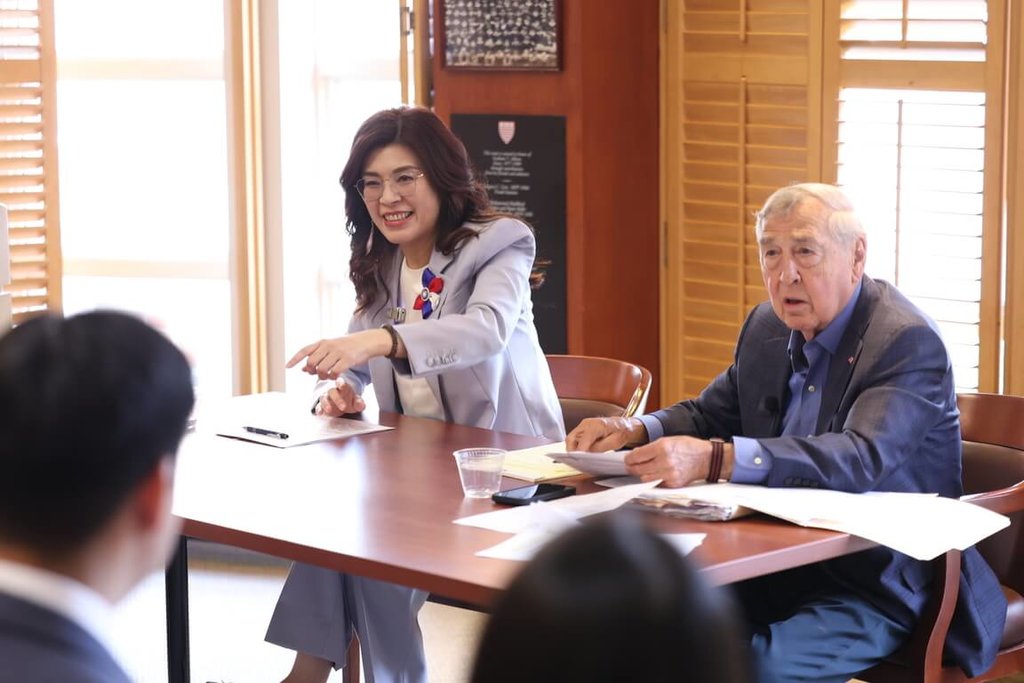
(Central News Agency, Taipei, June 5) Kuomintang (KMT) Chairperson Cheng Li-wen visited Harvard University's John F. Kennedy School of Government and the Fairbank Center for Chinese Studies today. She stated that if the KMT can return to power, she hopes the US, China, and Taiwan can build a cooperative mechanism to transform the 'First Island Chain' into a 'Pacific Peace and Prosperity Chain,' with the US playing a key leadership role.
The KMT issued a press release today stating that Cheng Li-wen, at the invitation of Professor Graham Allison, the founding dean of the Harvard Kennedy School, delivered a keynote speech and held talks with Allison on June 5, Taipei time.
Cheng pointed out that the KMT has always firmly stood on the legal framework of the 'Constitution of the Republic of China' as a 'One-China Constitution.' This not only establishes Taiwan's current proud democracy, rule of law, and freedom but also provides a legal and pragmatic basis for dialogue in cross-strait exchanges.
Cheng noted that the brilliance of the '1992 Consensus' lies in both sides acknowledging that Taiwan and mainland China belong to one China, while preserving space for seeking common ground while reserving differences. As long as Taiwan does not cross the red line of 'legal Taiwan independence,' cross-strait peace and stability can be maintained, which is also the greatest common denominator of interests with the US and the region.
Cheng proposed transforming the Cold War-era 'First Island Chain' into a 'hub of shared prosperity.' This would closely integrate Japan and South Korea's precision high-tech industries, ASEAN's vibrant markets, the manufacturing scale of China's southeastern coast, and Taiwan, which holds a pivotal position controlling global AI and semiconductors, into an interdependent economic and technological community. When the benefits of maintaining peace far outweigh the costs of breaking it, peace becomes a structural inevitability, not a fragile choice.
The KMT stated that on the same day, Cheng also led a delegation to visit the Fairbank Center for Chinese Studies at Harvard University, holding a forum with Center Director Mark Wu and over 20 senior American scholars. The two sides exchanged views on major issues including US-Taiwan relations, the defense budget, energy policy, and cross-strait historical and cultural identity.
Cheng stated that Taiwan needs sufficient deterrence, but it also needs to build a peaceful and stable cross-strait relationship through dialogue and active efforts to avoid war. She pointed out that Taiwan is facing a serious loss of professional military personnel, which is a major security concern.
Cheng indicated that if the KMT returns to power in 2028, in addition to building a 'second generation of national guardian mountain clusters' to drive the comprehensive upgrade of traditional industries, she hopes the US, China, and Taiwan can construct an organic, complementary, and strategic cooperation mechanism. This would transform the Cold War-era 'First Island Chain' into a 'Pacific Peace and Prosperity Chain' tightly interwoven with talent, technology, and markets, with the US playing a key leadership role. (Editor: Lin Xingmeng) 1150605
FACT BOX
- Source: CNA (Central News Agency)
- Category: 政策