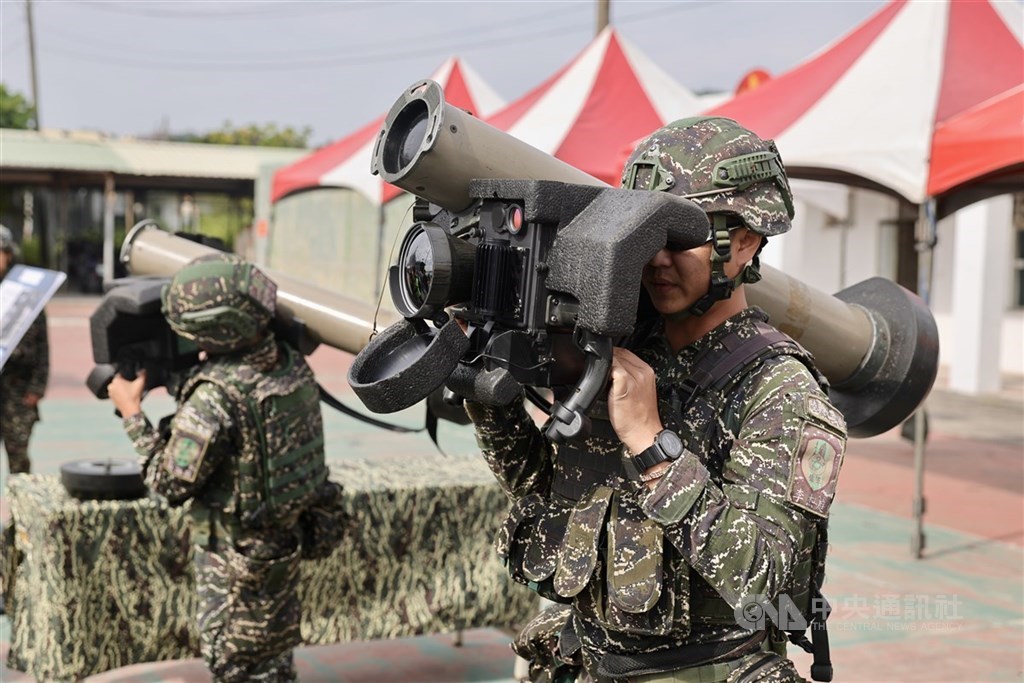
In response to external claims questioning the authenticity of the Army's Javelin missile firing, the Military News Agency released a magnified, frame-by-frame video late last night to clarify the situation. Military expert Li Si-ping stated today that the missile's flight path was entirely within the camera's range, but the image was blurry due to the long distance and hot weather. He emphasized that once the motor burns out, there is no flame, making the small projectile extremely difficult to capture with long-range photography, thus it was not faked.
The controversy began when the Military News Agency posted a short video on Facebook of an FGM-148 Javelin live-fire exercise. In the video, the missile's tail flame extinguishes a few seconds after launch, causing the missile to seemingly "disappear" from the frame, followed immediately by an explosion on the target ship, sparking public debate about its authenticity.
In response, the Military News Agency released another short film on Facebook late last night titled "Pause the video, and you'll see more clearly." The new video freezes the frame, zooms in on a specific area, and uses a red circle to track the missile, now just a tiny bright spot. It clearly reconstructs the entire process of the Javelin missile adopting its "top-attack" mode, first climbing upwards and then accurately smashing down onto the sea target from above.
Li Si-ping, editor-in-chief of "Tip of the Spear" magazine and author of the military book "Tank Deployment 2020," told CNA that the Javelin is a "fire-and-forget" anti-tank missile, characterized by its "top-attack" capability targeting the most vulnerable part of armor, though it can also be used in "direct-fire" mode. Its armor-penetrating principle utilizes a "tandem-charge warhead," which can first detonate the reactive armor on the outside of a target's main armor, then allow a jet stream to penetrate inside to maximize lethality.
Li explained that all Javelin missiles, upon hitting a target, will get close and impact the target just before detonating. Shaped charges generally come in two types: one is the "Explosively Formed Penetrator (EFP)," which has lower penetration but whose effectiveness is less affected by detonation distance; the other is the "High-Explosive Anti-Tank (HEAT)" round, which has high penetration but must maintain an optimal standoff distance for its jet to achieve maximum effect. The Javelin missile is the latter, so it must make contact with the target before detonating and cannot employ an airburst.
Regarding the Javelin's locking mechanism, Li explained that it consists of two main components: the "missile launch tube" and the "Control Launch Unit (CLU)." Before firing, the two must be connected and powered on by the operator. The key to aiming is not "whether there is a heat source, but whether the temperature difference between the target and the background is significant."
He cited an example from the Iraq War where U.S. forces used Javelins to strike buildings, the principle being the temperature difference between the building and its surroundings. If a difference exists, the CLU can achieve an image lock and feed the information into the missile's memory. Once ready, it can be fired. The missile then soft-launches from the tube, activates its rocket motor and infrared seeker, and continuously compares the information provided by the CLU until it hits the target. Reasons for missing a target are usually the sudden disappearance of the thermal signature, such as the target entering a tunnel, a forest, or a drastic change in temperature difference.
As for the recent allegations that the Javelin missile missed and the Army had pre-planted explosives on the target, Li pointed out that the missile's flight path was actually within the military camera's frame, but the distance was long and the temperature was high on that day. After the Javelin's rocket motor burns out, there is no flame, and the hot weather causes a sense of blurriness in the image, naturally affecting the resolution of long-range photography, let alone for a tiny missile.
Li stressed that the public's doubts clearly stem from a lack of understanding of the weapon system, leading them to believe the military faked it. He stated this is a systematic effort to smear them, and while it's one thing for the general public, if the group raising doubts are self-proclaimed veterans or military experts, their sudden claims resemble cognitive warfare. In fact, for years, the military has not been afraid of the media or the public seeing training mishaps or missed targets, because the point of exercises is precisely training.
FACT BOX
- Source: CNA (Central News Agency)
- Category: 事件
- Products / services: FGM-148 Javelin Missile