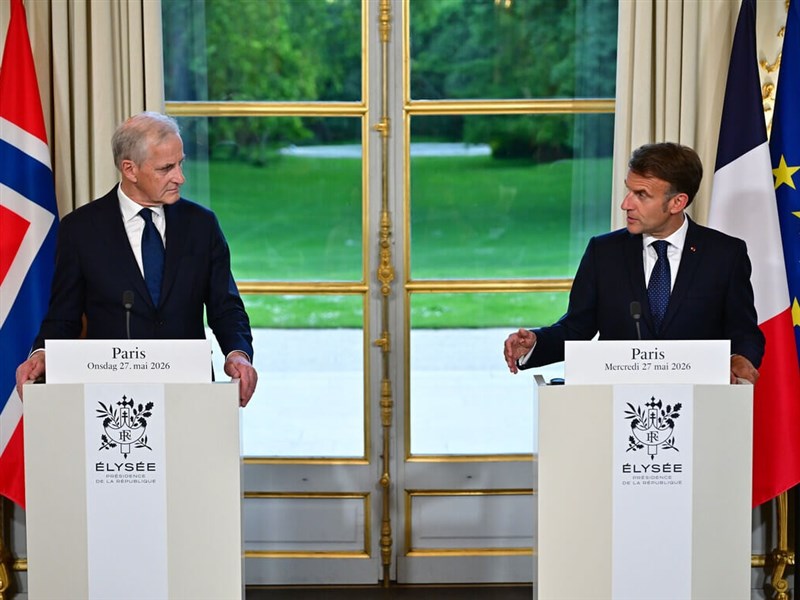
Norway has joined a French-led nuclear deterrence initiative, with the two countries signing the 'Narvik Agreement' and committing to provide mutual military assistance when necessary. Norwegian Prime Minister Jonas Gahr Støre emphasized that the agreement does not change Norway's peacetime position of not deploying nuclear weapons on its soil, but stated that Europe must take greater responsibility for its own security.
According to the Norwegian newspaper VG, Norway and France recently signed the 'Narvik Agreement' at the Élysée Palace in Paris. The agreement was signed by the defense ministers of both countries, with French President Emmanuel Macron and Prime Minister Støre in attendance to witness the event.
A statement from the Norwegian government indicated that the agreement covers commitments to bilateral military assistance, the pre-positioning of French military equipment in Norway, and deepened cooperation in areas such as hybrid warfare, maritime security, cybersecurity, and the defense industry. Concurrently, Norway joins the nuclear deterrence initiative of France and other European nations, whose members include Nordic allies like Sweden and Denmark.
The agreement is named 'Narvik' in reference to WWII history. In May 1940, French forces fought alongside Norway against Nazi Germany in the Narvik area, where about 150 French soldiers were killed.
'This name pays tribute to the soldiers who sacrificed their lives in the Narvik fjord in May 1940, and who handed the Nazis their first defeat,' Macron said at a press conference after the signing. Støre said, 'I am deeply moved that there are places named Narvik in Paris and many other parts of France.'
VG reported that Støre explained Norway's strategic considerations, stating that while France's nuclear weapons have long served only its own interests, its current willingness to discuss with allies how to extend nuclear deterrence to European security is a positive development. 'Europe should, and must, take greater responsibility for its own security. That is the security situation of our time,' he said bluntly. He also revealed that the cooperation had been communicated in advance to the United States and NATO's Supreme Allied Commander Europe, both of whom expressed no opposition.
Macron announced the French nuclear deterrence initiative in March 2026. France currently possesses about 290 nuclear weapons, over 80% of which are submarine-launched. The initial members of the initiative include Belgium, the United Kingdom, the Netherlands, Greece, Poland, Sweden, Germany, and Denmark, making Norway the ninth country to join.
According to an analysis by the Norwegian Broadcasting Corporation (NRK), this is the latest development in what the Norwegian government calls its 'hedging strategy' to expand its multilateral defense network outside of NATO and diversify its dependence on a single ally. In the past six months, Norway has already signed the 'Lunna House Agreement' with the United Kingdom and the 'Hansa Agreement' with Germany, with all three defense pacts including bilateral military assistance clauses.
Støre admitted that a series of uncertain signals from U.S. President Donald Trump regarding NATO was one of the background factors for Norway's acceleration in consolidating its multilateral security network.
However, the report states that the agreement has sparked backlash within Norway. Socialist Left Party (SV) leader Kirsti Bergstø stated bluntly, 'To think that more nuclear weapons can guarantee security is a historical misjudgment. What the world needs is fewer nuclear weapons, not more.'
Green Party (MDG) leader Arild Hermstad criticized, 'Responding to Russia's nuclear blackmail with nuclear escalation will only increase the risk of a catastrophic conflict.' The Red Party (Rødt) described the agreement as 'extremely wrong,' pointing out that France will solely control the nuclear button and will not sacrifice itself for other countries.
FACT BOX
- Source: CNA (Central News Agency)
- Category: 政策