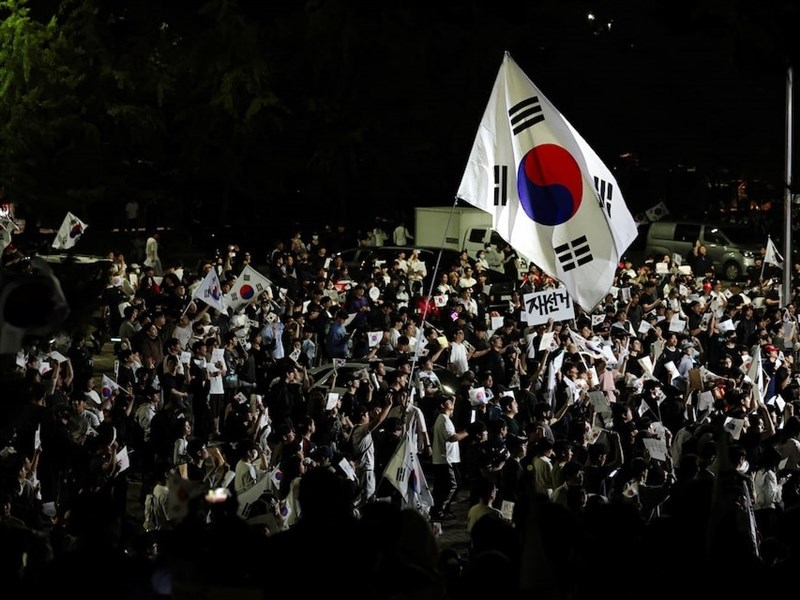
Protests sparked by a ballot shortage in South Korea's local elections have continued, with some citizens calling for a new election as of early this morning. A protestor remaining at the scene said, "Regardless of political affiliation, being unable to vote is an infringement on the civil rights of citizens in a free, democratic society."
The 9th local elections for council members and government heads, along with parliamentary by-elections, were held nationwide on June 3. It was the first national election since Lee Jae-myung took office as president in June 2025, succeeding Yoon Suk-yeol, who was impeached and removed from office by the National Assembly in late 2024 for a failed attempt to declare martial law.
The ruling liberal Democratic Party, led by Lee Jae-myung, won a majority of seats in the mayoral, gubernatorial, and council elections, but failed to capture the critical Seoul mayorship.
On June 3, a total of 50 polling stations across the country were affected by ballot shortages, with over 30 of them in the capital, Seoul. The incident caused public outrage, and Rho Tae-ak, chairman of the National Election Commission (NEC), resigned on June 5.
Yonhap News Agency cited informal police estimates that about 10,000 people gathered last night at the SK Olympic Handball Stadium in Seoul, the vote-counting location for the local elections.
According to an Agence France-Presse (AFP) reporter on the scene, at least 1,000 protestors remained as of 2 a.m. today, with many young people holding large national flags and chanting slogans like "New election, new election."
Young volunteers distributed mineral water, coffee, and chocolate. Some demonstrators brought their pets, while others sat on picnic mats, holding flags and keeping a vigil through the night.
"Regardless of political affiliation, being unable to vote is an infringement on the civil rights of citizens in a free, democratic society," a passionate 31-year-old Seo Jin-hee (transliterated) told AFP.
The NEC explained that it only printed ballots for 50% of eligible voters because a surge in early voting in recent elections had led to a large number of unused ballots.
It is believed that some voters left without being able to cast their ballots after the polling stations ran out.
A 29-year-old protestor, Park Soun-wok (transliterated), said the NEC's explanation "basically runs counter to the general understanding of ordinary people."
"It doesn't matter at all whether the candidate I support was elected or not," he told AFP. "In any case, I think this election must be held again."
The chaos on election day even led to a polling station in Seoul being surrounded by citizens for over 35 hours, preventing authorities from transporting the ballot box for counting.
Analysts point out that the NEC, as a constitutional body, has long had limited external oversight and suffers from insufficient internal discipline and review mechanisms.
"The NEC's blunder this time is, by any standard, unacceptable," political commentator Park Sang-byung (transliterated) told AFP.
"When election integrity is undermined, the foundations of democracy are shaken," he said. "The urgent task is to demand accountability and strengthen checks and balances."
FACT BOX
- Source: CNA (Central News Agency)
- Category: 事件