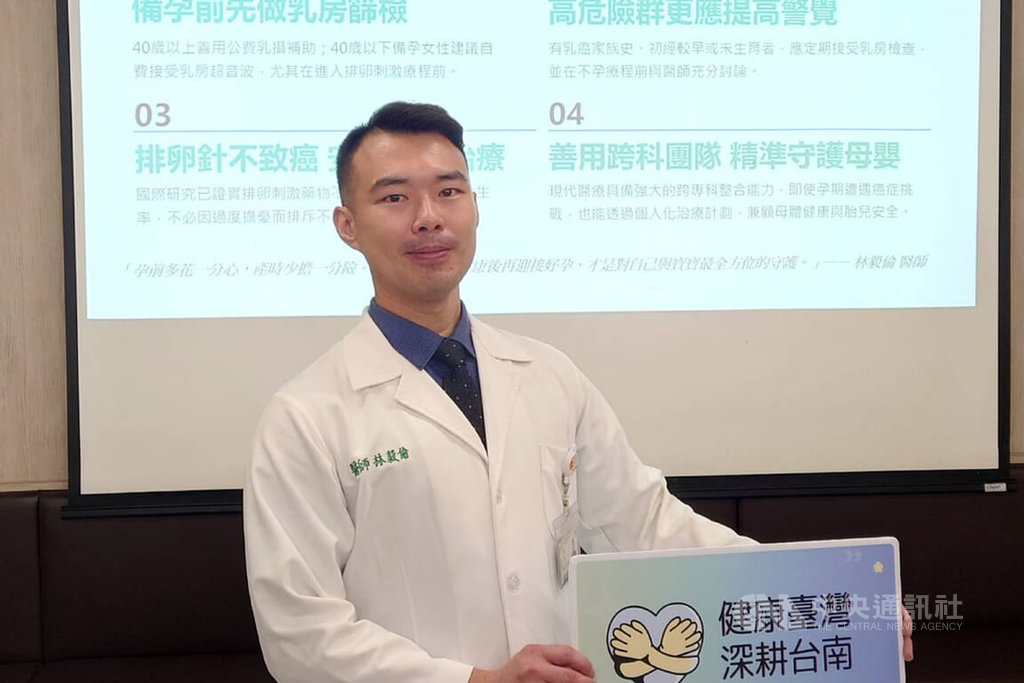
(Central News Agency, Reporter Yang Sirui, Tainan, 9th) A 45-year-old woman in Tainan successfully became pregnant after undergoing IVF treatment, but was diagnosed with breast cancer at the 5th week of pregnancy. The medical team at Chi Mei Hospital planned a personalized treatment course of 'surgery during pregnancy, chemotherapy after delivery,' helping the patient give birth to a healthy baby girl, with no signs of cancer recurrence after 2 years of follow-up.
Dr. Lin Yi-lun, an attending physician in the Department of Obstetrics and Gynecology's Reproductive Medicine Division at Chi Mei Hospital, stated at an in-hospital health education seminar today that this patient did not give up her dream of becoming a mother at age 45 and decided to undergo IVF treatment. She successfully became pregnant after the first implantation of her own embryo, which, according to medical statistics, is a remarkably rare success rate.
Dr. Lin stated that the patient discovered a hard lump in her right breast that was rapidly enlarging at the 5th week of pregnancy. A biopsy confirmed it was invasive mucinous breast cancer, instantly plunging the family's atmosphere from the joy of expecting a new life into despair. If she chose to terminate the pregnancy to treat the cancer first, the possibility of becoming pregnant again in the future would be extremely low, and the patient had a very strong desire to prioritize saving the fetus.
Dr. Lin said that considering the patient was an elderly primigravida, and fetal assessment indicated a risk of growth restriction, undergoing chemotherapy during pregnancy could increase the risk of placental insufficiency or even premature birth. However, delaying cancer treatment raised concerns about affecting the mother's health. After discussion by the hospital's cross-specialty medical team, they decided on a personalized treatment plan of 'surgery during pregnancy, chemotherapy after delivery.'
He stated that the patient successfully underwent a right total mastectomy and sentinel lymph node biopsy at the 18th week of pregnancy. The mother and fetus were stable after the surgery, and the pregnancy was closely monitored. At the 36th week, she safely delivered a healthy baby girl weighing 1870 grams via cesarean section. Two weeks after delivery, she began chemotherapy and hormone therapy. After 2 years of follow-up, the patient's cancer markers are normal with no signs of recurrence, and the baby girl's growth and development are fully in line with health standards.
Dr. Lin pointed out that according to statistics from the Health Promotion Administration, breast cancer ranks first in cancer incidence among women in Taiwan, with over 17,000 new cases annually, and is showing a trend of affecting younger women. This overlaps with the current societal trend of advanced maternal age. Some women undergoing infertility treatments are entering the peak age for breast cancer, causing anxiety among many women preparing for pregnancy, even raising concerns like 'Do ovulation induction injections cause breast cancer?'
He stated that according to the latest guidelines from the Taiwan Society for Reproductive Medicine, ovulation stimulation drugs do not increase the overall incidence of invasive breast cancer. Infertility treatments are safe under professional medical evaluation, and there is no need for excessive panic. Instead, attention should be paid to proactively conducting breast health checks before preparing for pregnancy or starting infertility treatments.
Dr. Lin explained that during pregnancy, due to drastic hormonal changes, the breasts naturally enlarge, which can often mask the symptoms of early-stage breast cancer lumps, leading to the lesion being overlooked. Confirming breast health before pregnancy not only helps reduce the stress of facing a breast cancer diagnosis and treatment during pregnancy but also makes the journey to pregnancy safer and more secure. (Editor: Zhang Mingkun) 1150609
FACT BOX
- Source: CNA (Central News Agency)
- Category: Taiwan