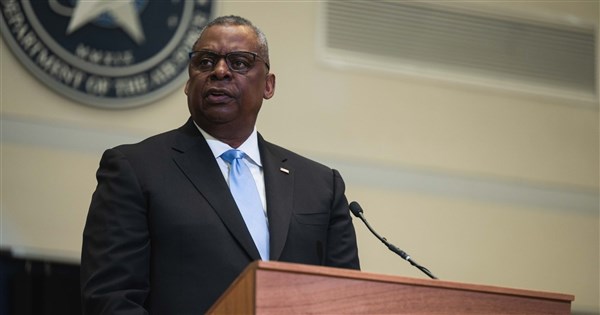
(Central News Agency, Taipei, June 9, Combined Foreign Reports) Former US Secretary of Defense Lloyd J. Austin said in an interview that based on the outcomes of recent US-China high-level summits, the risk of short-term conflict escalation in the Taiwan Strait has decreased, and he assessed that Chinese President Xi Jinping has no intention of using military force to take Taiwan.
Austin, who led the Pentagon during the Biden administration and is now co-founder and CEO of the advisory firm Clarion Strategies, shared his views on global geopolitical issues including the Middle East situation, NATO defense, and Taiwan Strait security in an interview with Bloomberg TV.
Addressing concerns that US involvement in the Middle East conflict could expose vulnerabilities and increase the risk of a Chinese invasion of Taiwan, Austin pointed to the outcomes of the high-level summit held in May, suggesting that the risk of short-term escalation in the Taiwan Strait may have decreased.
However, he emphasized that there are still many issues in US-China relations that require continued effort.
Expressing his personal view, Austin stated: "I don't think Chinese President Xi Jinping wants to use military force to take Taiwan." He believes that if Xi can achieve his goals through pressure and demonstrating military capability, he would prefer that approach.
Austin issued a stern warning: "If a conflict were to break out in or around the Taiwan Strait, the impact on the global economy would be far greater than what we have seen in the Strait of Hormuz."
Regarding the Middle East, when asked about President Trump's call for a ceasefire between Israel and Iran, Austin said all parties hope for the full implementation of a ceasefire agreement to facilitate subsequent negotiations and the reopening of the Strait of Hormuz, which is crucial not only for the US but for the global economy.
When asked about military options to reopen the Strait of Hormuz, Austin acknowledged that the US Navy certainly has the capability to open and maintain the waterway, but the cost of bearing this burden alone over the long term would be extremely high.
Therefore, he advocated for international cooperation involving allies and partners, as ensuring freedom of navigation in international waters and airspace under international law serves the interests of every country in the world.
Regarding European defense and the future of NATO, Austin expressed optimism about the trend of European countries increasing their defense spending.
He noted that many European countries have significantly increased their military spending, even far exceeding the target of 2% of GDP, although it will take time for the defense industrial base to ramp up production capacity.
He emphasized that NATO is the most successful military alliance in human history, and transatlantic cooperation serves the common interests of both the US and Europe. (Editor: Li Peishan) 1150609
FACT BOX
- Source: CNA (Central News Agency)
- Category: Taiwan
- Organizations: Clarion Strategies