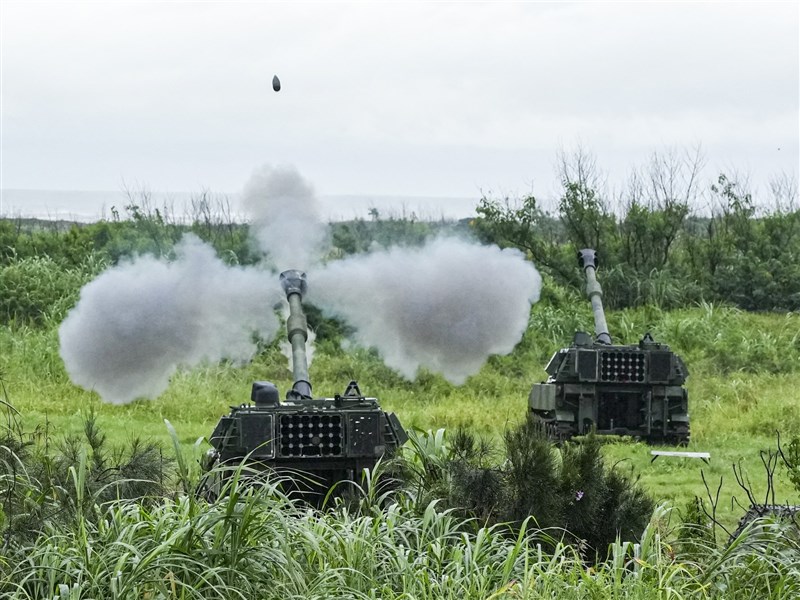
(CNA, Taichung, 9th) The Army's Tenth Army Corps conducted a heavy artillery firing exercise today on the north and south banks of the Dajia River estuary in Taichung. The drill simulated an attempted invasion of the central region by PLA amphibious forces. Undeterred by heavy rain, soldiers kicked off the exercise with the Thunder 2000 multiple rocket system, marking its first live-fire in a tactical environment in seven years. This was followed by M109A2 self-propelled howitzers, with the combined roar of heavy artillery echoing along the riverbank.
The Army's Tenth Army Corps today conducted a heavy artillery and new weapon replacement validation firing. The exercise integrated units including the 58th Artillery Command, the 234th Brigade, and the 586th Brigade, carrying out live firing of multiple weapons such as the Thunder 2000, M109A2 and M110A2 self-propelled howitzers, 155mm howitzers, 120mm mortars, and TOW missile vehicles (2A, 2B). In the morning, the Army invited the media to cover the live firing of the Thunder 2000 and M109A2 self-propelled howitzers.
Although heavy rain poured down at the Dajia River estuary in the morning, soldiers braved the downpour to carry out pre-firing preparations. Personnel from the National Chung-Shan Institute of Science and Technology (NCSIST) also assisted with pre-launch checks of the Thunder 2000 multiple rocket system. The scheduled firing time was delayed due to weather, ammunition checks, and poor visibility in the target area.
The firing exercise began at 8:24 a.m. with the Thunder 2000 multiple rocket system. Three Thunder 2000 launchers each fired their load of 60 MK15 training rockets one by one, with each vehicle taking about 30 seconds to launch all 60 rockets. The first two Thunder 2000 vehicles successfully launched all their 60 MK15 training rockets.
However, as the third Thunder 2000 system fired its seventh rocket, the rocket's tail flame disappeared immediately after launch. The rocket flew a short distance before falling not far in front of the launch vehicle.
After completing their firing, the Thunder 2000 systems withdrew, and the M109A2 self-propelled howitzers began their live-fire mission, targeting a sea area 9 kilometers away.
From the media observation area, three M109A2 firing positions were visible, with 7, 7, and 6 M109A2s in each position respectively. In the first round, each gun from each position fired one 155mm round in turn. In the second round, each position fired one round in a volley. The third round saw all positions firing a volley simultaneously, the thundering sound of cannons echoing across the riverbank.
Regarding the malfunction of the rocket from the third Thunder 2000 system, Colonel Weng Yi-ming, Chief of Staff of the 58th Artillery Command, said in an interview that the rocket ignited and exited the pod correctly, but there may have been a problem with the second-stage motor ignition. NCSIST personnel are analyzing the issue. He added that the exercise used MK15 training rockets, which contain no high explosives, and the rocket fell in a safe area over 400 meters away.
The Army's Tenth Army Corps stated that this firing exercise simulated an enemy amphibious force attempting to invade the central region. A total of 372 rounds of 6 different types were fired. The drill was conducted simultaneously from 8 positions across a wide 20-kilometer front. Through realistic training, it validated the effectiveness of joint firepower and the kill chain, simulating the delay and attrition of an enemy advancing on Dajia Beach.
FACT BOX
- Source: CNA (Central News Agency)
- Category: 事件