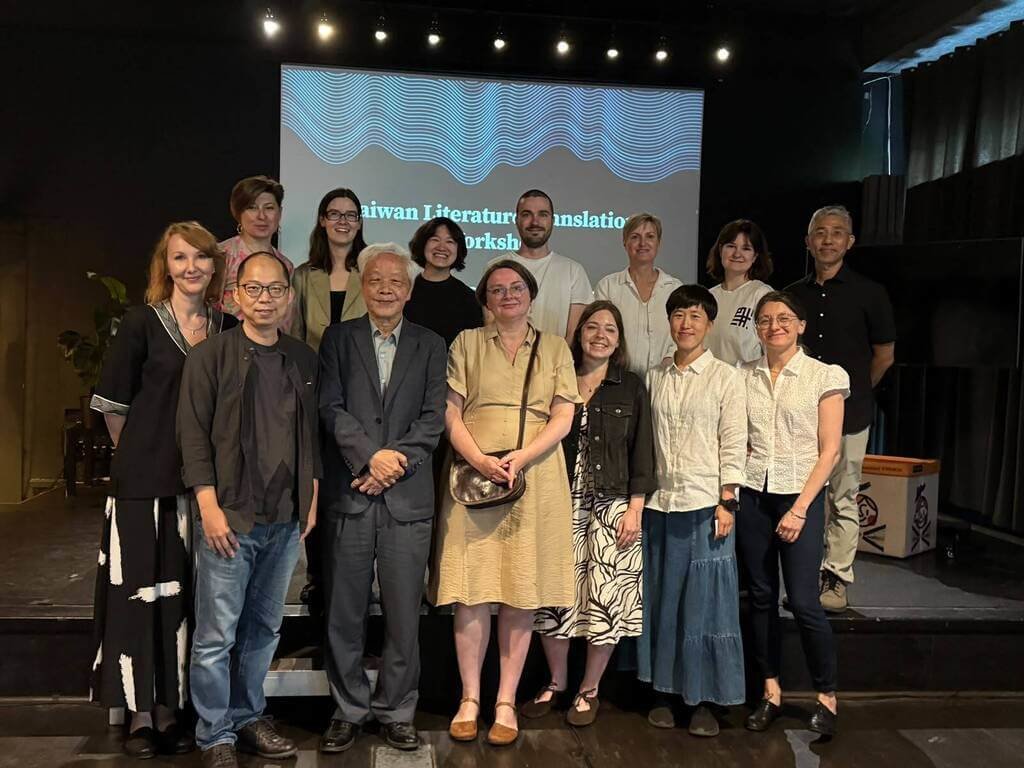
(CNA reporter Chiu Tso-yin, Taipei, 10th) How should profanity in Taiwanese literary works be translated? Polish translator Maria Jarosz, who has translated novels like 'The Butcher's Wife' and 'Children of the Salt Pans' into Polish, stated that the key is not the literal meaning, but how to preserve the original work's literary power in another language.
The National Museum of Taiwan Literature (NMTL) issued a press release today stating that the 'Taiwan Literature Translation Workshop,' organized by the NMTL, was held on the 8th and 9th during the 'Month of Authors' Reading' festival in Poland. The event invited Taiwanese literature translators, sinologists, and publishers from countries including the Czech Republic, Poland, Ukraine, the Netherlands, and Sweden to share their views on Taiwanese literary works and their translation journeys, and to exchange ideas with Taiwanese writers Hsiang Yang, Tung Wei-ger, and Huang Chong-kai.
Professor Maciej Gaca of the Faculty of Cultural Studies at Nicolaus Copernicus University in Toruń, Poland, stated at the meeting that translation is not just a linguistic conversion but an important way for the historical experiences and lifestyles of a society to be understood by others.
Maciej Szatkowski, a long-time researcher of Taiwanese literature, used theatrical texts as an example, stating that Taiwanese works often interweave Mandarin, Taiwanese, Japanese, and local linguistic sensibilities, requiring translators to balance both linguistic layers and stage performance.
Ukrainian translator Oleksandra Bespala shared that for many Ukrainian readers, Taiwanese literature is still a relatively unfamiliar cultural field, so every translation carries the significance of 'pioneering a path.' Taiwanese works often involve backgrounds such as colonialism, post-war politics, the White Terror, democratization, and ethnic languages, so translators must also help readers understand their historical and cultural context.
Maria Jarosz, who translated 'The Butcher's Wife' and 'Children of the Salt Pans' into Polish, spoke on 'How to Translate Profanity in Taiwanese Literature,' pointing out that the key to translation lies not in the literal meaning, but in understanding the emotion, tone, and character relationships of a sentence within the text. The most important job for a translator is to allow the work to retain its original literary power in another language.
The NMTL continues to organize promotional work for Taiwanese literature. On the 12th, it will hold a book launch in Madrid, Spain, for the Spanish anthologies 'Contemporary Taiwanese Fiction' and 'Contemporary Taiwanese Poetry' from the LiFT (Literature from Taiwan) series. In October, it will travel to the UK, France, and the Netherlands to hold launch events for the 'Humanities Across Millennia—Where Literature and Research Meet Series,' published in cooperation with the National Science and Technology Council. (Editor: Wu Su-jou) 1150610
FACT BOX
- Source: CNA (Central News Agency)
- Category: 事件