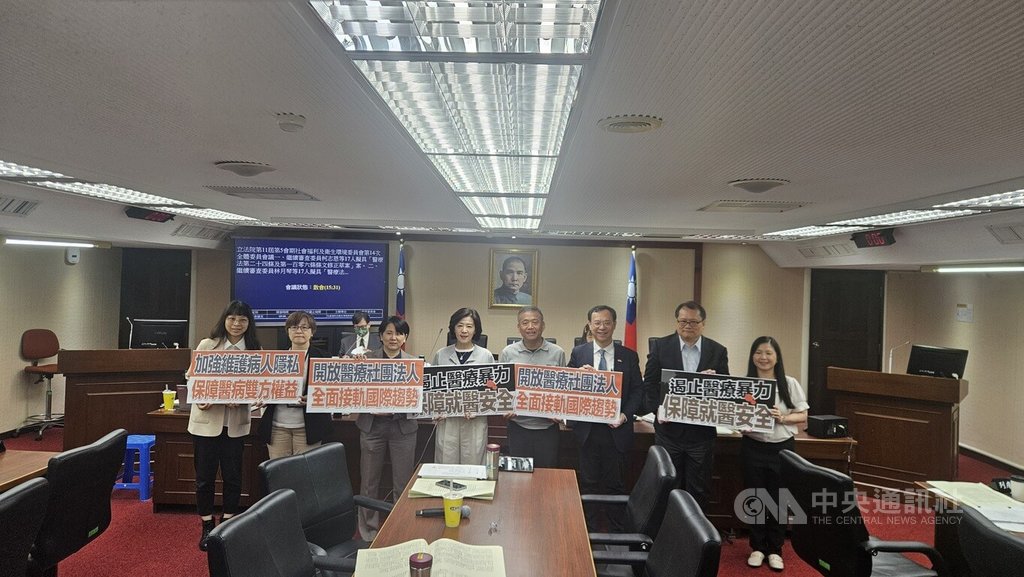
(Central News Agency, Reporter Zeng Yining, Taipei, 10th) The Social Welfare and Environmental Hygiene Committee of the Legislative Yuan today completed the initial review of the draft amendment to some articles of the Medical Care Act. It passed provisions allowing legal entities to become members of medical社团法人 (medical social organizations) and adding that physicians may conduct medical advertising for the medical institution where they are registered for practice. Other related clauses, such as those on medical violence and privacy, were retained for cross-caucus negotiation.
The Social Welfare and Environmental Hygiene Committee of the Legislative Yuan today invited Minister of Health and Welfare Shih Chung-liang to attend and continue reviewing the draft amendment to some articles of the Medical Care Act. The content of the draft amendment covers regulations related to medical violence, medical institution case records and privacy, tax exemptions for medical personnel in remote areas, medical appraisal, medical advertising, and medical社团法人.
Article 49 of the Medical Care Act originally stipulated that a legal entity "may not" be a member of a medical社团法人. The clause passed in today's initial review amends this to state that a legal entity "may" be a member of a medical社团法人, and the transfer of membership and its shares requires permission from the central competent authority. The regulations for management matters such as qualification conditions will be determined by the central competent authority in consultation with relevant agencies.
In response to the amendment of the preceding article, Articles 50 and 53 were also revised. The initially reviewed and passed clauses stipulate that for a medical社团法人 with legal entity members, the number of directors is limited to 6 to 15. Furthermore, when a medical社团法人 with legal entity members distributes surplus, it must allocate 10% for improving employee welfare, patient rights, and the quality and environment of medical care. The allocated amount must be executed within two years.
Regarding medical advertising, Constitutional Interpretation No. 17 of 2023 pointed out that prohibiting physicians from conducting medical advertising violates the intent of Article 11 of the Constitution, which guarantees freedom of speech. The clauses passed in today's initial review stipulate that entities other than medical institutions or physicians may not conduct medical advertising, and physicians are limited to advertising for the medical institution where they are registered for practice.
Additionally, the committee passed a附带决议 (ancillary resolution) stating that when government agencies request copies of medical records from medical institutions according to the Medical Care Act, they should, as much as possible, request them in digital form to reduce the manpower burden on medical institutions and minimize paper waste.
Most of the clauses reviewed today were retained for cross-caucus negotiation. After the meeting, Shih Chung-liang told the media that regarding medical violence, there is already a consensus on the direction of the amendment, but the wording of the text needs to be more precise.
He said that regarding medical privacy, because the Executive Yuan has instructed the Ministry of Justice to review relevant articles in the Criminal Code, to avoid conflicts between the Medical Care Act and the amended Criminal Code, it is suggested to first handle the administrative penalties. The parts involving criminal penalties will be discussed after the Criminal Code amendment is finalized.
Regarding the opening up of legal entities to become members of medical社团法人, legislators from the Kuomintang, including Li Yanxiu, Lu Xianyi, and Su Qingquan, as well as legislators from the Democratic Progressive Party, including Liu Jianguo and Wang Zhengxu, each proposed relaxation measures. Wang Zhengxu pointed out the hope to introduce long-term, stable capital to help regional hospitals improve medical quality, but also expressed concern about the intervention of short-term speculative capital, suggesting that regulation is needed.
Lu Xianyi expressed the hope that this would allow struggling small and medium-sized medical社团法人 to introduce stable capital. He noted that for regional hospitals in agricultural counties, the most likely investors are local enterprises deeply rooted in the area and willing to give back to the local community, but many of these local enterprises are not publicly listed companies.
Liu Yueping, Director-General of the Department of Medical Affairs of the Ministry of Health and Welfare, stated that the ministry supports the direction of relaxation, but for the stability of medical institutions, there will still be certain restrictions on the legal entities that become members. (Editor: Su Longqi) 1150610
FACT BOX
- Source: CNA (Central News Agency)
- Category: Taiwan