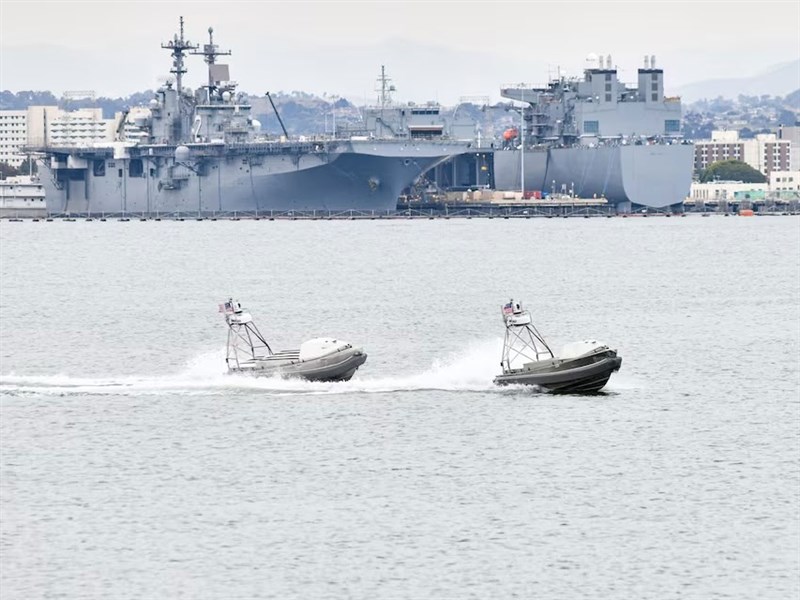
(Central News Agency, Washington, 9th – Combined Foreign Reports) A US Army Apache attack helicopter was shot down yesterday near the Strait of Hormuz. The US military immediately launched a search and rescue operation for the two crew members, culminating in an unprecedented maritime rescue by a Navy unmanned surface vessel (USV).
According to combined reports from the Wall Street Journal (WSJ) and Reuters, the United States has accused Iran of shooting down the Apache helicopter. US Central Command (CENTCOM) spokesperson Tim Hawkins stated that as darkness fell, the crew members were in the water for about two hours. A senior US official described their escape from the downed helicopter as a miraculous moment.
CENTCOM said that MQ-9 Reaper drones and fighter jets provided air cover, after which the crew was rescued by a remotely operated USV.
The Saronic 'Corsair' USV, approximately 7.3 meters long, can travel over 1,000 miles (approx. 1,609 km) and carry a payload of 1,000 lbs (approx. 454 kg). It transported the crew to safer waters. Hawkins said the crew was then picked up from the USV's deck by a rescue helicopter.
This mission, the first of its kind for a US Navy USV, has brought Task Force 59 into the spotlight. Established in 2021, Task Force 59 is the US Navy's first unit dedicated to unmanned systems. It is based in Bahrain and falls under the US Naval Forces Central Command (NAVCENT), which oversees US naval operations in the Middle East.
Since its inception, Task Force 59 has been testing and deploying an expanding fleet of maritime unmanned vehicles in the Middle East. This reflects the Pentagon's increasing commitment to developing autonomous vessels as cost-effective and rapidly deployable assets, though the concept has faced significant setbacks and technical challenges.
Here are five key points about maritime unmanned vehicles:
1. The US operates both surface and underwater unmanned vehicles, designed for different missions and purposes.
2. Surface USVs vary in size. Smaller ones are about 5-meter-long speedboats, like the Global Autonomous Reconnaissance Craft (GARC), used for port, coastline, and vessel reconnaissance. Larger boats, like L3Harris's Arabian Fox MAST-13, perform surveillance, assist in target locking, and serve as maritime communication relays.
3. The US Navy operates various classes of underwater unmanned vehicles, including large, medium, and small, each suited for different missions and depths. Large underwater vehicles can autonomously travel thousands of kilometers, while smaller ones are used for shorter-range tasks like mine detection. Most systems in this field are classified, and publicly known systems often disappear from public view quickly.
4. Maritime unmanned vehicles have diverse uses. Many are designed for surveillance and tracking of adversaries, or for mine countermeasures. Some are designed for offensive or combat-related missions. CENTCOM told Reuters that a USV was used for this rescue but did not specify the model. One possible scenario is that a large USV arrived on scene, and the crew then boarded it.
5. Some maritime unmanned vehicles have achieved notable success. Ukraine's Magura V5, while not a US asset, is the most combat-proven maritime USV. It has sunk multiple Russian warships and shot down a Russian helicopter in December 2024, marking the first instance of a maritime USV destroying an aircraft. (Compiled by Lu Yingzi) 1150610
FACT BOX
- Source: CNA (Central News Agency)
- Category: Event
- Products / services: Arabian Fox MAST-13 / Magura V5