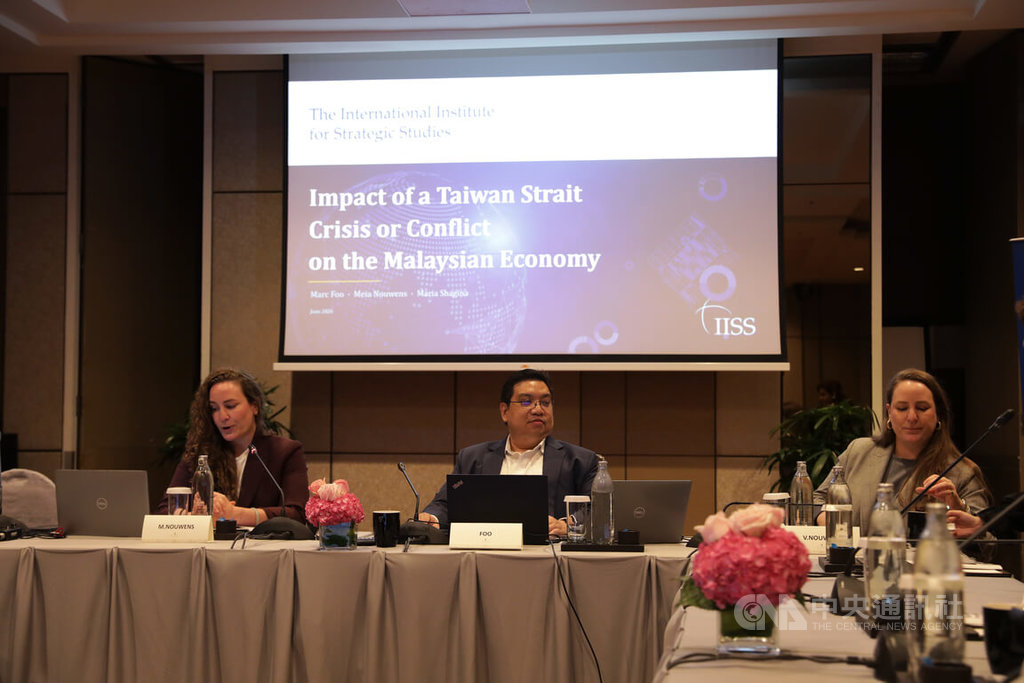
(Central News Agency, Kuala Lumpur, 10th) The British think tank, the International Institute for Strategic Studies (IISS), today released a report titled "The Impact of a Taiwan Strait Crisis or Conflict on the Malaysian Economy: Possible Scenarios." The IISS analysis indicates that the global economic shock triggered by a Taiwan Strait conflict scenario would be akin to starting World War III.
The IISS released this study at the Shangri-La Hotel in Kuala Lumpur this afternoon. The report attempts to estimate the minimum and maximum potential costs to the Malaysian economy under two hypothetical but highly plausible Taiwan Strait situations: a "crisis" scenario and a "conflict" scenario.
The report points out that even if the analysis period is only one year, the economic costs of these two scenarios could far exceed the macroeconomic losses suffered by neutral countries during World War I and World War II.
The IISS research results show that the impact of a Taiwan Strait crisis or conflict on regional economies like Malaysia would far exceed the impact of the COVID-19 pandemic.
The report mentions that even if countries adopt a neutral stance, they cannot avoid negative economic impacts. The impact will be particularly severe for countries with high economic linkages to the main parties involved in the Taiwan Strait crisis and with relatively open economic systems.
The IISS report indicates that the electronics and electrical machinery industries, as well as the tourism and travel industry, will be the hardest hit. Under a one-year crisis scenario, the number of unemployed could increase by hundreds of thousands; if it escalates into a conflict, the number of unemployed could rise to millions.
The report notes that despite ongoing differences between Malaysia and China over the South China Sea issue, Malaysia has maintained stable bilateral relations in recent years through "quiet, firm diplomacy" to preserve diplomatic maneuvering space.
In terms of response strategies, the IISS believes that small and medium-sized Southeast Asian countries like Malaysia should not adopt a passive attitude towards a potential Taiwan Strait crisis. Instead, they should actively play a diplomatic role by leveraging their relationships with both the United States and China to reduce the risk of such a situation occurring.
Furthermore, the report suggests that how Southeast Asian economies can deepen regional supply chains and interdependence to reduce reliance on major powers will be an important topic for future in-depth research.
The IISS also points out that the Malaysian government and businesses should further assess the potential impact on energy security if a Taiwan Strait crisis or conflict expands and spills over to regional and cross-regional levels.
The report emphasizes that due to intensified great power competition and the increased focus on the link between national security and the economy after the COVID-19 pandemic, the connection between national security sectors and the business community has become increasingly close in many countries.
However, Southeast Asian countries, including Malaysia, can further strengthen coordination between the two to jointly address the significant risks that a Taiwan Strait crisis may bring.
The report also warns that governments and businesses must consider a "polycrisis," a scenario where a Taiwan Strait crisis or conflict occurs simultaneously with other global shocks. If this scenario materializes, the impact on the Malaysian economy could be even more severe.
FACT BOX
- Source: CNA (Central News Agency)
- Category: Survey