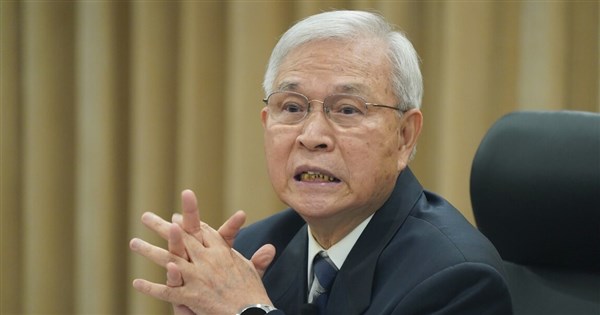
(CNA, by reporter Pan Tze-yu, Taipei, 10th) The Directorate-General of Budget, Accounting and Statistics announced that the Consumer Price Index (CPI) for May saw a growth rate exceeding 2%, sparking public concern about inflation and focusing attention on the necessity of a preventive interest rate hike. Central Bank Governor Yang Chin-long stated that due to the longer-than-expected conflict in the Middle East, the central bank might revise its CPI forecast upward. However, he noted that as of now, Taiwan does not have imported inflation.
Regarding whether a preventive rate hike is necessary, Yang said that the prerequisite for such a move is a general prediction that inflation will continue to rise over the next six months to a year, and that inflation expectations have taken hold. However, current observations suggest that inflation expectations are not severe.
Yang attended the Finance Committee of the Legislative Yuan today, where Taiwan's inflation situation and the central bank's monetary policy direction were under scrutiny.
KMT Legislator Lee Yen-hsiu pointed out that the central bank's decision to raise the interest rate by half a code (0.125 percentage points) in March 2024 surprised the market. Looking back, she asked if he felt the preventive measure was effective. Yang replied, 'From the perspective of the situation at that time, I believe the preventive rate hike was the right move.'
Lee followed up, asking whether it is better for the central bank to take preventive action beforehand or to act afterward, given that rising international energy prices due to the Middle East conflict are already affecting Taiwan.
Yang explained that a preventive rate hike is necessary when it can be predicted that inflation will continue to rise over the next six months to a year, and inflation expectations form and subsequently push inflation up. In such a scenario, a preventive hike is a must. However, if inflation rises and then quickly falls, the policy effect of a preventive hike would not be very good.
Yang further noted that the current wave of inflation is primarily driven by supply-side factors. He views the Taiwan government's supply-side policy response as quite successful, because monetary policy is less effective against supply-driven inflation.
KMT Legislator Yen Kuan-heng questioned whether keeping interest rates unchanged while energy prices are high weakens the function of using the exchange rate to mitigate imported inflation, given that a strong New Taiwan dollar helps combat it.
Yang stated that because the Middle East conflict has lasted longer than expected, the central bank might revise its full-year CPI forecast upward in June. However, he reiterated that, for now, Taiwan does not have a problem with imported inflation, nor is it experiencing heightened inflation expectations. (Editor: Pan Yi-ching) 1150610
FACT BOX
- Source: CNA (Central News Agency)
- Category: 政策