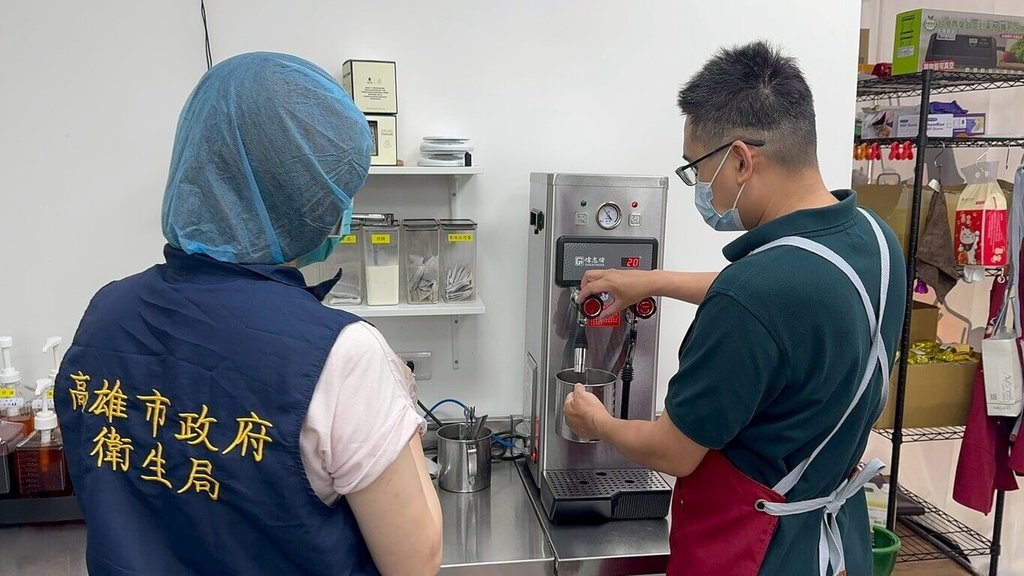
(Central News Agency, reporter Tsai Meng-yu, Kaohsiung, 10th) Amid recent hot and humid weather, the Kaohsiung City Health Bureau announced today that it conducted inspections on 164 freshly prepared beverages, ice products, and ingredients within its jurisdiction from January to May this year. Among them, two cases were penalized according to law, one for exceeding coliform bacteria standards upon re-inspection and the other for caffeine content not matching its label.
In a press release today, the Health Bureau stated that it conducted intensive inspections on 76 freshly prepared beverages, ice products, and ingredients in May, and announced that all results complied with regulations. However, among the 88 items inspected from January to April, two were penalized for the aforementioned reasons.
The Health Bureau explained that the special inspection project announced today targeted establishments such as hand-shaken drink shops, fruit shops, coffee shops, convenience stores, and restaurants that prepare beverages and ice products on-site. Inspected items included ice products, beverages, ingredients, coffee, and herbal teas, checking for compliance with hygiene standards, patulin, caffeine, total calories, and total sugar labeling.
Inspections in January and March focused on soy milk, hot coffee, and ice from breakfast shops, while from April onwards, a large number of hand-shaken drinks, juices, ice products, and fillings were inspected.
The Health Bureau noted that all 164 items inspected from January to May have completed re-inspections. One ice cream product was found to have coliform bacteria levels not meeting microbiological hygiene standards. After being given a deadline for improvement, a re-inspection still failed to meet standards, resulting in a fine of NT$30,000 under the "Act Governing Food Safety and Sanitation."
Another case involved iced tea from a chain beverage store where the caffeine content detected did not match the on-site label. This case has been transferred to the competent authority of the relevant county or city for handling. The Health Bureau emphasized its commitment to strict food safety control, continuing rigorous inspections across source management, market circulation, inspection registration, and consumer protection. (Editor: Chang Ming-kun) 1150610
FACT BOX
- Source: CNA (Central News Agency)
- Category: Survey