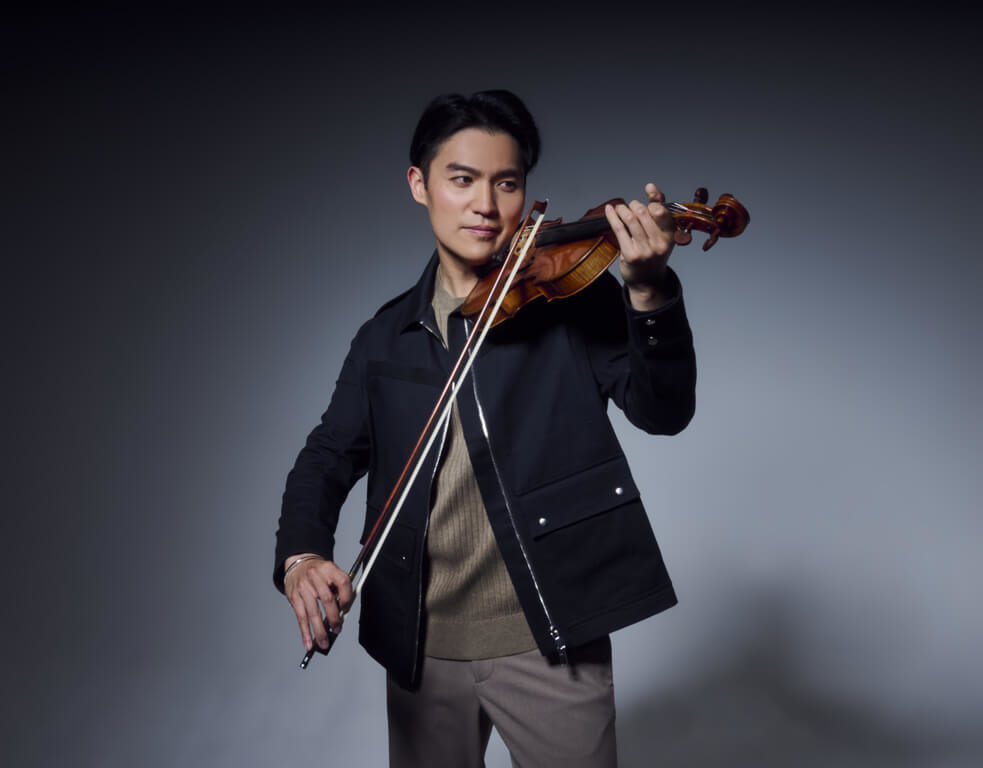
Taiwanese-American violinist and classical music influencer Ray Chen, who is based in the United States, frequently experiences broken strings on stage during his performances, keeping fans on edge. He says that breaking a string is never expected, explaining, "It might be because I give 200 percent of my effort when performing for my fans on stage."
When attending a Ray Chen concert, one never knows what might happen. He has snapped violin strings in the middle of performances multiple times, yet he always manages to calmly and swiftly swap violins with the concertmaster within seconds to continue playing. In an interview with CNA today, Chen mentioned that many people ask him if breaking strings is a "stage effect." He replied, "If I had a choice, I would hope to break the string on the final note and then give it to the audience."
Chen admitted that hearing such speculation actually feels a bit "weird" to him. "If it were intentional, I wouldn't choose to break strings during these specific movements. And some ask why other performers don't break their strings. All I can say is, I don't know how much force others use when they play, but my performance is definitely giving a full 200 percent."
Chen will hold recitals at the National Concert Hall in Taipei and the National Kaohsiung Center for the Arts (Weiwuying) on the 13th and 14th, with tickets having sold out long ago. Discussing the upcoming recitals, Chen said the first half will feature Mozart's Violin Sonata in B-flat Major. "When Mozart submitted this piece, he had only written the violin part and didn't have time to write the piano part. So, before going on stage, he placed blank sheets of paper to serve as sheet music. This kind of mischievousness is very much like me."
The second half of the recital will be themed around dance, featuring works such as the "Prelude - Loure - Gavotte en Rondeau" from Bach's Partita No. 3 in E Major for Solo Violin, and Sarasate's "Carmen Fantasy." Chen hopes that when fans come to his concerts, they will hear a variety of musical styles, "just like tasting a menu with different flavors."
Beyond his identity as a musician, Ray Chen has also made a name for himself in the tech startup scene. He founded the "Tonic" platform, allowing more violin enthusiasts to practice at home using the app. This year, he introduced a brand-new "AI-Assisted Music Lesson Feature," which can automatically summarize an hour-long music lesson, highlight key points, and even replay segments, helping teachers, students, and parents find areas to focus on more efficiently.
"It was after starting a business that I learned to be grateful and cherish my role as a musician even more," Chen said. He explained that entrepreneurship made him realize that every performance and project is the result of teamwork. "If I were just a musician, I might not have seen this. I might have been short-sighted and even taken the care and dedication of the staff and fans for granted."
As for whether the AI wave will replace live concerts, Chen remains unfazed. He pointed out that from the invention of the radio to the rise of the internet, "every time, people would worry that concert halls would go out of business, but in fact, these advancements expanded the classical music market." Chen emphasized that the stage of classical music is incredibly cruel, where only the best can survive. "So there is no need to worry about the emergence of AI. As long as you underestimate the competition or get lazy, you will be replaced even if AI doesn't come."
FACT BOX
- Source: CNA (Central News Agency)
- Category: 文化
- Organizations: Tonic