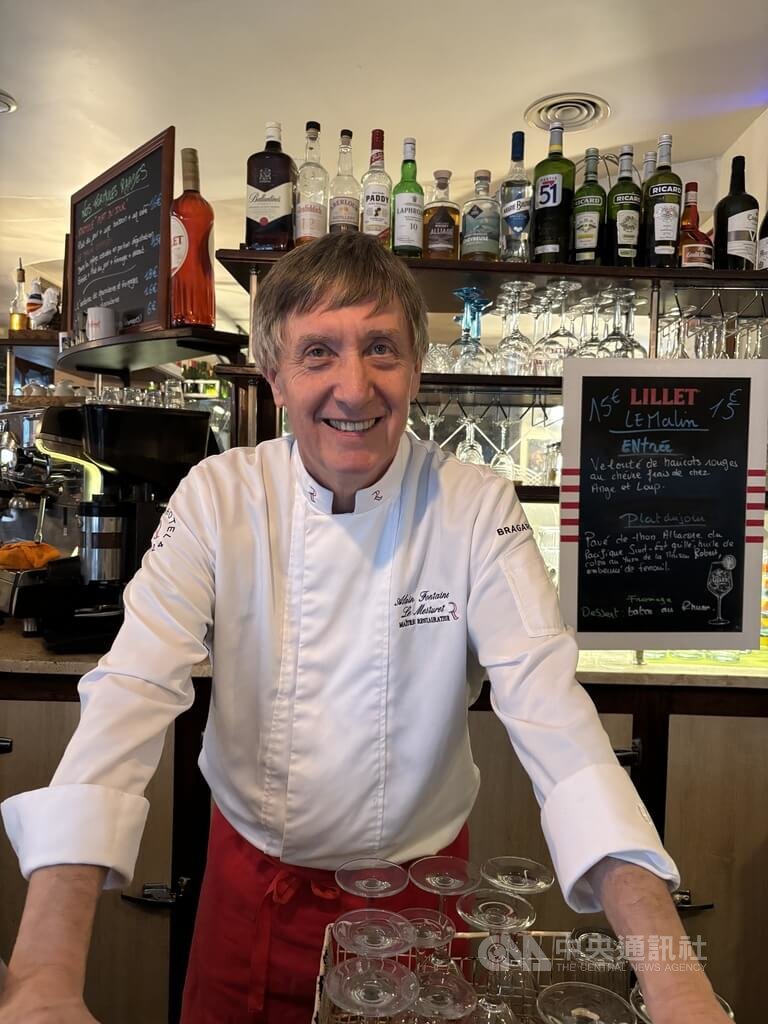
(Central News Agency reporter Tseng I-Hsuan, Paris, 12th - Special Report) French business operators are advocating for bistros and cafes to be listed as Intangible Cultural Heritage by the United Nations Educational, Scientific and Cultural Organization (UNESCO). Industry representative Alain Fontaine stated that bistros and cafes embody the French values of liberty, equality, and fraternity.
Traditional French bistros (bistrot) and cafes (café) differ from regular restaurants in that they are not limited to mealtime operations, nor do they only serve coffee, desserts, or light meals. They operate continuously from morning to late night, offering breakfast, lunch, afternoon tea, dinner, and late-night snacks. They serve home-style dishes and alcoholic beverages, while also allowing customers to simply order a cup of coffee and linger. Prices are relatively affordable.
Alain Fontaine, president of the Association des bistrots et cafés en France (Association of Bistros and Cafes in France), told Central News Agency reporters that bistros and cafes are places where the republican values of liberty, equality, and fraternity are practiced and embodied.
He pointed out that 'liberty' lies in the freedom to debate or sing, with unrestricted speech and no issue with slightly louder voices. 'Equality' is reflected in affordable pricing, making the spaces accessible regardless of social status or financial ability—'before coffee, all are equal.'
Fontaine runs Le Mesturet bistro in Paris's 2nd arrondissement. Holding up a boiled egg from the bar, he said, 'This egg sells for just 1 euro (about 37 New Taiwan dollars), while in trendy modern cafes, it would cost around 3 euros.'
Pierre-Christophe Hantz, who runs Le Vaudésir bistro in Paris's 14th arrondissement, also emphasized that 'liberty' is a precious feature of French bistros. In his establishment, people from all professions, ethnicities, and religions freely converse. Sometimes discussions become so intense that he must step in as a 'moderator,' gently steering conversations away from sensitive topics or lightening the mood with a joke.
As for 'fraternity,' he explained that bistros sometimes serve as sanctuaries, allowing modern urban dwellers a place to process loneliness and anxiety, while creating opportunities for human connection.
One homeless man used to come every day as soon as Fontaine opened his shop, saying, 'When I see your light on, I know last night’s anxiety is over.' Later, through an introduction by another regular customer, the man became a building caretaker, found a place to live, and reconnected with his family.
On another occasion, a large man sat drinking for four hours, beginning to disturb other guests. Fontaine, as owner, risked being punched and approached the man, shaking his hand in greeting. 'Looking into his eyes, I saw sadness,' he recalled.
With Fontaine’s guidance, the man slowly opened up, revealing he was from Nantes and had been notified by police the previous day to come to Paris to identify his daughter’s body. Fontaine spent two hours talking with the grief-stricken man. 'I can’t say his pain eased… but at least his burden was lightened a little,' he said.
French President Emmanuel Macron publicly supported the bid for French bistros and cafes to be listed on UNESCO’s Intangible Cultural Heritage list in January this year, though there are other contenders.
The craftsmanship and culture surrounding the baguette, an indispensable part of French daily life, was inscribed in 2022. Fontaine hopes the uniquely French bistro and cafe culture will also receive recognition.
He explained that at the end of the 18th century, traditional bistros and cafes were venues for philosophers and the bourgeoisie to debate. During the 19th century, as urban planner Georges-Eugène Haussmann undertook the grand transformation of Paris, a large influx of laborers arrived, and these spaces gradually became social hubs for the working class—yet they retained their intellectual and cultural foundations. Their core spirit, he said, is 'living together and sharing.'
One hallmark of traditional bistros is the long bar counter, ideal for customers who want a quick drink or a casual chat. Since the bar allows both sitting and standing, without the clear boundaries of regular seating, it naturally encourages conversation.
Fontaine emphasized, quoting French writer Honoré de Balzac, that bistros and cafes are 'the people’s parliament,' where people of all classes discuss current affairs and draw inspiration. 'If politicians want to know what people are thinking, they should go to a bistro,' he said. (Editor: Tang Sheng-Yang) 1150612
FACT BOX
- Source: CNA (Central News Agency)
- Category: Taiwan