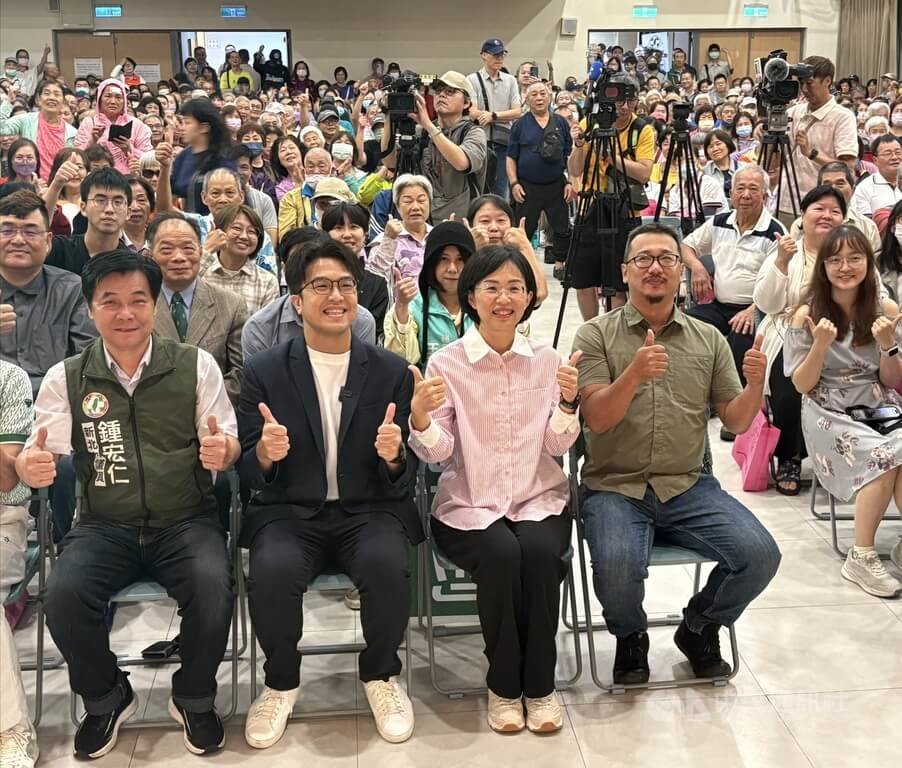
Democratic Progressive Party (DPP) mayoral candidates Su Chiao-hui (New Taipei) and Puma Shen (Taipei) joined forces on the 12th to support a city councilor in Xinzhuang. They announced plans to promote cross-city policies under the vision of "co-prosperity of Taipei and New Taipei." Meanwhile, Kuomintang (KMT) figure Lee Shu-chuan proposed countermeasures to address industrial exodus and soaring rents, aiming to help businesses keep their roots in New Taipei City.
On the evening of the 12th, DPP New Taipei mayoral candidate Su Chiao-hui and Taipei mayoral candidate Puma Shen attended a symposium in Xinzhuang to stump for New Taipei City Councilor Lin Ping-yu. Surrounded by borough wardens and local residents, the three made a grand entrance amidst continuous applause and chants of "Dongsuan" (get elected).
On stage, Shen recalled how Lin had pushed him into politics. In 2023, when the president asked if he was willing to serve as a DPP at-large legislator, he initially declined due to a busy schedule. After telling Lin about this, Lin spent a full hour persuading him, encouraging him to carry on the legacy of his predecessors. It was only then that he accepted the nomination to become an at-large legislator, eventually standing there as a candidate for Taipei mayor. "If it weren't for him, I wouldn't be here today," Shen said.
In a media interview, Shen mentioned that he and Su had previously discussed the policy vision of "co-prosperity of Taipei and New Taipei." While each region has its own characteristics, "our roots are connected," so policies must share commonalities. The most crucial part is how to connect and allow the cities to share their vitality. He hopes to work together to turn the twin cities into the best cities and bring changes to the country.
Su stated that attending the rally with Shen to support Lin highlighted that they are all partners and comrades who have fought together for a long time. She also hoped that this connection would move Taipei and New Taipei further toward the "twin cities co-prosperity" plan.
Su pointed out that many of the policies she and Shen proposed are remarkably similar. For instance, Shen's forest and mountain policy and her "Diamond Mountain City" concept share many common directions in trail planning, yet they achieve these goals through different methods. This, she explained, is a blend of competition and cooperation, which is the essence of co-prosperity.
On the other hand, Lee Shu-chuan attended the board of directors and supervisors meeting of the New Taipei City Commercial Association on the evening of the 12th. Regarding the problems of land shortage and high land costs faced by the industry, he stated that he would use his practical experience to help the industry solve problems, keep its roots in New Taipei, and create more job opportunities for young people.
Lee said that New Taipei City has development advantages ranging from traditional industries to high-tech industries. However, in recent years, many enterprises have faced difficulties in acquiring land and rising rents, forcing many to relocate to Taoyuan or other counties. In the future, he plans to organize industrial spaces through zone expropriation and urban land consolidation. The government will also build standardized or customized factories and lease them to enterprises at reasonable rents, encouraging more businesses to stay in New Taipei City.
Speaking on the layout of high-tech industries, Lee reiterated the plan to build the Luzhou-Shezi Bridge. This bridge would connect the Nangang Software Park, Neihu Technology Park, and Beitou-Shilin Technology Park with industrial clusters in New Taipei, including Luzhou, Wugu, Banqiao, Tucheng, and Xindian. The goal is to create an "AI Technology Corridor" to attract more high-tech industries to New Taipei and drive regional development.
FACT BOX
- Source: CNA (Central News Agency)
- Category: 政策