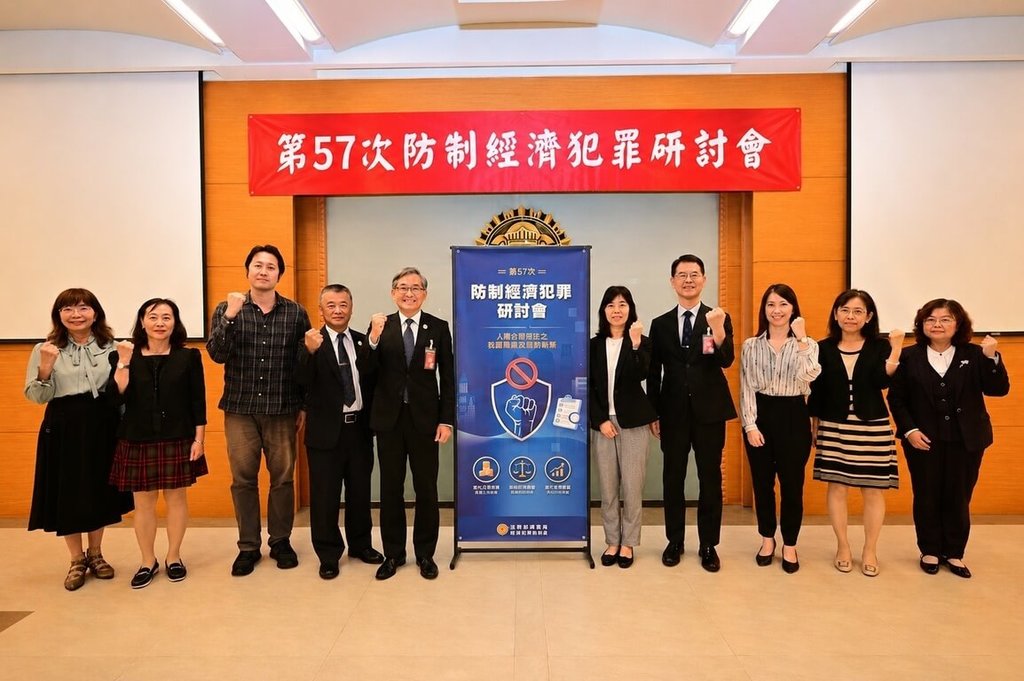
(Central News Agency, Reporter Xie Junlin, Taipei, June 12) The Investigation Bureau stated today that, in response to shell companies evolving into tools for telecommunications fraud and other criminal activities, it held a symposium on the 10th to discuss how to establish a comprehensive prevention system covering prevention, supervision, and investigation through enhanced public-private collaboration and cross-departmental coordination.
According to a press release from the Ministry of Justice Investigation Bureau, in response to shell companies evolving into tools for telecommunications fraud, underground remittance, tax evasion, trade secret infringement, securities crimes, and infiltration by hostile foreign forces, the Bureau held a symposium on "Crime Issues Arising from Shell Companies and Countermeasures" on the 10th. The event gathered representatives from cross-agency departments and used the case of the third-party payment platform "Taiwan Li" (台灣里) involving money laundering for relevant discussions.
Investigation Bureau Director-General Chen Bai-li stated in his address that shell companies have gradually evolved into tools for fraud groups, money laundering organizations, underground remittance, tax evasion, and infiltration by hostile foreign forces. Their high degree of concealment, cross-border nature, and organized characteristics have severely impacted financial order, industrial security, and social trust.
The Investigation Bureau invited Professor Chang Hsin-ti from the College of Law at National Taipei University to serve as the moderator, and also invited Taipei District Prosecutors Office Chief Prosecutor Chou Fang-yi and others as panelists. They discussed with frontline investigators handling economic crime cases at the Investigation Bureau topics such as the characteristics of shell company registration and establishment, the bank review process during the legal person preparation period, the tax authority's invoice issuance process, and how to revoke registrations or order dissolutions of discovered shell companies, aiming to fundamentally curb the rampant problem of shell companies.
Chang Hsin-ti stated that from the "Taiwan Li" money laundering case shared by the Investigation Bureau, the "industrial chain" characteristics of shell company crimes are evident. These include intermediaries seeking figureheads, acquiring dormant companies with operational track records to lower bank scrutiny difficulty, and professionals accompanying and guiding account openings. These methods already exhibit "industrial chain" characteristics. If only couriers are arrested or nominee accounts are investigated, it is difficult to truly ascertain the full picture of the crime. It is necessary to fill the loopholes through judicial or administrative means.
Chou Fang-yi stated that the Taipei District Prosecutors Office's Early Warning Center has already cooperated with company registration authorities, tax authorities, and financial institutions. However, there are currently confidentiality regulations such as the Tax Collection Act and the Banking Act. If data on company registration, business tax, warning accounts, and final criminal judgments could be integrated, it would help frontline investigators identify abnormal patterns.
Hsiao Hsu-tung, Section Chief of the Company Registration Division at the Department of Commerce, Ministry of Economic Affairs, stated that the Department is strengthening review loopholes by enhancing "contact person information." Since February of this year, it has required mandatory filling of contact person names and contact methods. It plans to launch a new mechanism on July 1 of the same year, requiring the disclosure of the identity of specialized professionals and their relationship with the company, to break the previous limitations of only document-based reviews.
Lin Pei-hsuan, convener of the Account Opening Group of the Bankers Association, stated that the banking industry has already implemented on-site verification for abnormal addresses and conducts real-time inquiries through the "Anti-Fraud Joint Prevention Platform" of financial companies.
Lai Miao-chu, Chairperson of the National Union of Professional Bookkeepers, reiterated the determination of bookkeepers to act as "gatekeepers." By strengthening anti-money laundering education and training and Know Your Customer (KYC) procedures, she called on judicial authorities to promptly notify when illegal activities are discovered, to facilitate self-regulation by professional associations and prevent unscrupulous practitioners from becoming "strategists" for criminal groups.
Chang Hsin-ti concluded that preventing shell company crimes cannot rely on a single agency alone. It is necessary to break down the silo mentality of each unit. Only through cross-agency information integration and close public-private cooperation can the rampant development of shell companies be effectively curbed, safeguarding national financial order and social security. (Editor: Chang Ming-kun) 1150612
FACT BOX
- Source: CNA (Central News Agency)
- Category: Event