US-Iran War Key News
(London, 12th - Central News Agency, compiled international news) BBC Verify has analyzed satellite imagery and found that over 50 Iranian military facilities have been damaged by US and Israeli offensives since the outbreak of the US-Iran war, including air and naval bases and the headquarters of the Islamic Revolutionary Guard Corps (IRGC).
Satellite images verified by BBC Verify show that US airstrikes have caused severe damage to various bases across Iran. Experts have identified damage to fighter jets, naval vessels, and ballistic missile facilities.
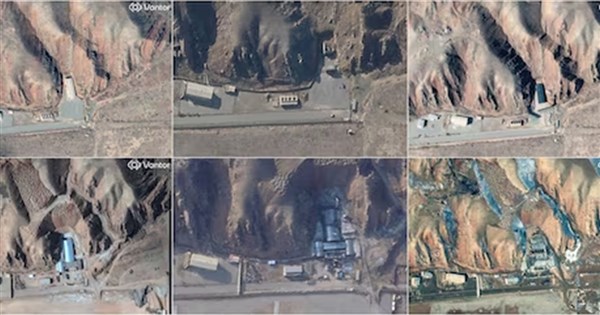
Despite this, some images suggest that Tehran may be taking advantage of the fragile ceasefire period to repair tunnel entrances at key missile sites.
By comparing earlier satellite images with photographs from other international satellite providers, BBC Verify has documented damage to 51 military facilities across Iran, including air bases, naval installations, and IRGC outposts.
Due to the high level of secrecy surrounding many Iranian military sites, this analysis may only reflect a portion of the actual damage. Janes, an international defense and security analysis firm, estimates that Iran has a total of 197 military and IRGC bases.
Satellite images show that runways and aircraft at over a dozen locations have been hit, which experts believe helps the US military gain air superiority over Iranian airspace.
On March 7, an airstrike destroyed at least 17 aircraft in the military section of Mehrabad International Airport. US and Israeli attacks between April 2 and 17 hit at least 13 aircraft at Shiraz Airbase.
The strikes have also targeted Iran's naval fleet. At the outbreak of war, several ships and buildings at Bandar Abbas Naval Base, the headquarters of the Iranian Navy, were damaged in the offensive.
Satellite imagery also shows thick smoke rising from a damaged vessel and port administrative facilities on March 4. Multiple ships at the Konarak Naval Base were also severely damaged.
Meanwhile, satellite images indicate that the IRGC headquarters on the eastern outskirts of Tehran and its naval headquarters appear to have been heavily damaged. IRGC Navy Commander Alireza Tangsiri was also killed in an Israeli military operation at the end of March.
However, experts told BBC Verify that despite repeated damage to Iran's air and naval forces, Tehran still retains the capability to harm the United States and its regional allies.
Zev Faintuch of Global Guardian, a US-based international security services company, said: "Iran's defensive capability stems less from conventional forces like its air force and more from its ability to retaliate using missiles or drones."
Tehran has used small, low-cost drones to attack infrastructure across the Middle East, including several US military facilities, and has long exported its Shahed-series drones to allies such as Russia.
Raphael Cohen, Director of the National Security Program at the RAND School of Public Policy, stated that Iran's 'mosquito fleet' of small speedboats continues to pose a threat to US military and commercial vessels in the Strait of Hormuz.
In addition, satellite imagery shows Tehran appears to be repairing at least four ballistic missile bases during the fragile ceasefire period.
Debris on roads within the Tabriz missile base appears to have been cleared, and tunnels damaged by US and Israeli airstrikes appear to have been excavated, with construction vehicles and heavy machinery suspected of entering and exiting the site.
However, Kamran Bokhari, Senior Analyst at the Middle East Policy Council, pointed out that Iran was already facing economic difficulties before the war, which could hinder Tehran's ability to fully rebuild its military capabilities.
BBC Verify also noted that in addition to military bases, many civilian buildings across Iran have been hit. According to the Human Rights Activists News Agency (HRANA), based in the US, over 1,700 civilians have died since the conflict began. However, General Brad Cooper, head of US Central Command (CENTCOM), questioned claims that thousands of civilians had been killed.
On the other hand, US military offensives have also targeted internal security forces loyal to Iran's theocratic government, including IRGC outposts and the hardline militia group Basij. The Basij, controlled by the IRGC, is frequently deployed to suppress dissent and protests on the streets.
Satellite imagery shows that the Basij command center in Tehran was damaged around March 4, with adjacent buildings completely leveled.
At the beginning of the war, US President Donald Trump hinted that one of his goals was to assist anti-government protesters in overthrowing the theocratic regime, though he later downplayed this.
Lewis Smart, Chief Analyst at Janes, said: "It is almost certain that the primary purpose of these attacks is to create conditions more favorable for regime change—this is Israel's goal, and while the US also intends to push for it, the urgency is lower."
(Translation: Hung Pei-ying) 1150612
Stand with the truth. Your support is a force in defending press freedom.
Download the CNA 'First News' app to stay updated with the latest news.
Text, images, and videos on this website may not be reproduced, broadcast, or transmitted without authorization.
FACT BOX
- Source: CNA (Central News Agency)
- Category: Taiwan
- Organizations: BBC Verify / Janes / Global Guardian