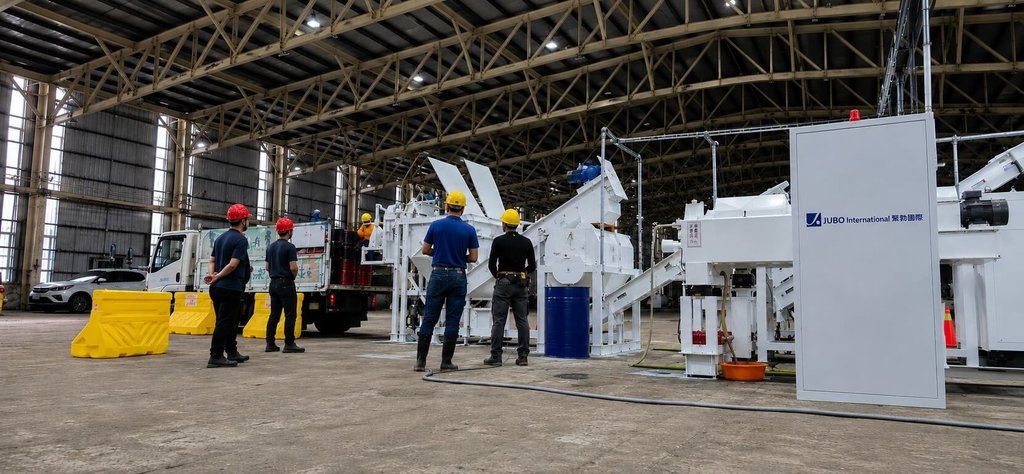
(CNA, Taipei, June 18) With the ban on using kitchen waste for pig farming set to take effect in 2027, facing the increasingly challenging issue of kitchen waste disposal, domestic catering group Yujing International announced today a four-party collaboration with Formosa Biomedical, Julee Intelligent, and Jubo International. This initiative pioneers a circular industry chain for kitchen waste, from "source recycling and efficient decomposition" to "resource reuse."
Yujing stated that Taiwan is currently facing a severe test in kitchen waste treatment. Following the implementation of the policy to ban kitchen waste for pig farming to prevent African Swine Fever, kitchen waste has become a major issue for local governments, catering businesses, and educational institutions in environmental hygiene management.
Yujing said that the majority of kitchen waste not currently entering the recycling system is processed through traditional incineration or landfill. However, due to its high water content and high chlorine characteristics, kitchen waste can cause operational difficulties, equipment wear, and increased air pollutant emissions during incineration.
Yujing International, which owns catering brands such as The Crystal, Din Tai Fung (Tainan), and Straits Exchange, faces the significant challenge of dealing with the large amount of kitchen waste generated daily by the catering industry. Sun Zhengqiang, Chairman of Yujing International, proactively sought cooperation with the other three parties, initiating a division of labor among the four companies to solve the intractable problem of kitchen waste.
Yujing explained that Yujing provides waste from the catering and food industries. Formosa Biomedical specializes in the circular economy field and possesses expert and extensive practical experience in treating wastewater or waste catalysts for precious metals. Julee Intelligent excels in kitchen waste decomposition technology, while Jubo International is responsible for overall operational integration and project implementation.
Yujing pointed out that the collaborative project utilizes three-phase separation technology to efficiently separate oil and fat components from kitchen waste, thereby enhancing the resource utilization efficiency of kitchen waste. The recovered oils and fats can subsequently be used as raw materials for low-carbon circular reuse, for downstream industries to apply in biofuels and sustainable aviation fuel (SAF) and other green energy fields.
Yujing further explained that the project is currently planned to commence demonstration sites in Taichung and Penghu. In the future, as the operational model matures, it will gradually expand nationwide. Potential future priority partners include county and city environmental protection bureaus' cleaning teams, private kitchen waste recycling operators, schools, large communities, and major food districts. (Editor: Chang Chun-mao) 1150618
Stand with facts, your every donation is a force to protect press freedom.
Download CNA's "One-Stop News" APP to get the latest news in real-time.
Text, images, and videos on this website may not be reproduced, publicly broadcast, publicly transmitted, or used without authorization.
FACT BOX
- Source: CNA (Central News Agency)
- Category: 合作