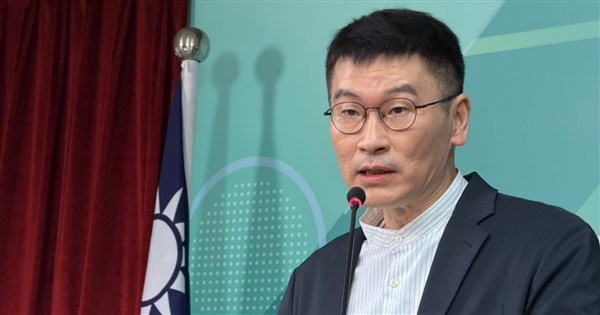
(CNA) Mainland Affairs Council (MAC) Deputy Minister and Spokesperson Liang Wen-chieh reiterated today that the Straits Forum is a large-scale united front platform organized by the Chinese Communist Party (CCP). This positioning was established during the Ma Ying-jeou administration, and all government officials at all levels should maintain a consistent stance against the CCP's offensive, as the government's mainland policy should not differentiate between central and local authorities.
Taitung County Magistrate Rao Ching-ling participated in the Straits Forum via video conference, and the government will investigate and handle the matter in accordance with Article 33-1 of the Cross-Strait Act. Liang Wen-chieh stated at a regular press conference today that during the fourth Straits Forum in 2012, when the Ma Ying-jeou administration was in power, the Straits Forum was already established as a large-scale united front platform. This positioning has not changed for the MAC over the years.
He emphasized that when the other side sets up a stage for united front activities, government officials at all levels should not cooperate. Whether Rao Ching-ling attended in person or via video conference, it constitutes cooperation. As the government has not yet fully grasped the specifics of her statements, it will ask the Ministry of the Interior to investigate. It should be emphasized that Rao Ching-ling claimed she was pleading for Taitung's sugar apples and stated that the government does not consider farmers' needs. However, Taiwanese people hardly eat sugar apples, and there is almost no domestic market for this product. Over 90% of its production relies on purchases from mainland China, so this statement is entirely dependent on the CCP's whims.
He stated that for such agricultural products, the CCP can cut off supplies at any time depending on cross-strait political conditions. Sugar apples are different from products like pomelos, because Taiwan's pomelo domestic market is very large, with only 3% relying on exports. Therefore, if the CCP cuts off supplies, farmers will not suffer as much. Allowing farmers to be held hostage by the mainland in the long term, and consequently holding the government hostage, is not a sustainable solution. As for specific policy responses, it is believed that agricultural authorities will consider them.
When asked by the media whether the government will further list which activities and behaviors fall under the category of united front work, Liang Wen-chieh pointed out that the CCP's methods are very flexible, with various tricks emerging year after year. Although the government wants to provide specific guidelines, these guidelines will never be exhaustive and will instead lead the other side to create more methods. Therefore, listing guidelines is of little significance.
He emphasized that if the government has already declared an activity as a united front activity, then participation is prohibited, especially for government officials. Private enterprises or organizations are another matter, but government officials are subject to legal regulations.
When the media asked again why Rao Ching-ling's behavior is defined as united front work, while President Lai Ching-te, when he was the mayor of Tainan, and former Kaohsiung Mayor Chen Chu, had visited the mainland to market fruits or engage in exchanges, Liang Wen-chieh responded that these examples all occurred before 2016. At that time, the CCP was using a strategy of co-opting DPP officials. After 2016, the CCP's policy changed: if the "1992 Consensus" was not recognized, there would be no interaction, and even agricultural product exports would be blocked.
He said that the changes have accumulated to this day, resulting in different outcomes. The government does not oppose local leaders engaging in simple exchanges or marketing products. However, in occasions like the Straits Forum, sitting there and listening to high-ranking CCP officials speak about "jointly promoting national reunification" is tantamount to tacitly approving the mainland's actions towards Taiwan. This is why the government explicitly prohibits government officials from attending "lectures."
When asked again by the media if President Lai's invitation to CCP General Secretary Xi Jinping for bubble tea and chicken cutlets was an act of goodwill exchange that could be considered united front work, Liang Wen-chieh responded that he could not understand the question. "I also frequently extend goodwill to the other side from this podium; this is a normal part of bilateral interaction." As of now, the full content of Rao Ching-ling's remarks has not been ascertained, and the matter is still under investigation, with no conclusion yet reached.
Regarding the KMT's Facebook post of an AI-generated image depicting Liang Wen-chieh holding a large sugar apple, which netizens pointed out was a "big-eyed sugar apple" and not a "sugar apple" (pitaya), and claimed that the MAC was blocking sugar apples from being sold to China. Liang Wen-chieh stated that this issue has been ongoing for two weeks, with many accounts criticizing the MAC. The government's stance is clear: it does not block the export of fruits and agricultural products, and emphasizes that cross-strait policies should be consistent between the central and local governments. (Editor: Chen Kai-yu) 1150618
Stand with the facts, and your every donation is a force to protect press freedom.
Download the CNA "One-Stop News" APP for real-time updates.
The text, images, and videos on this website may not be reproduced, publicly broadcast, publicly transmitted, or used without authorization.
FACT BOX
- Source: CNA (Central News Agency)
- Category: 政治