Central News Message
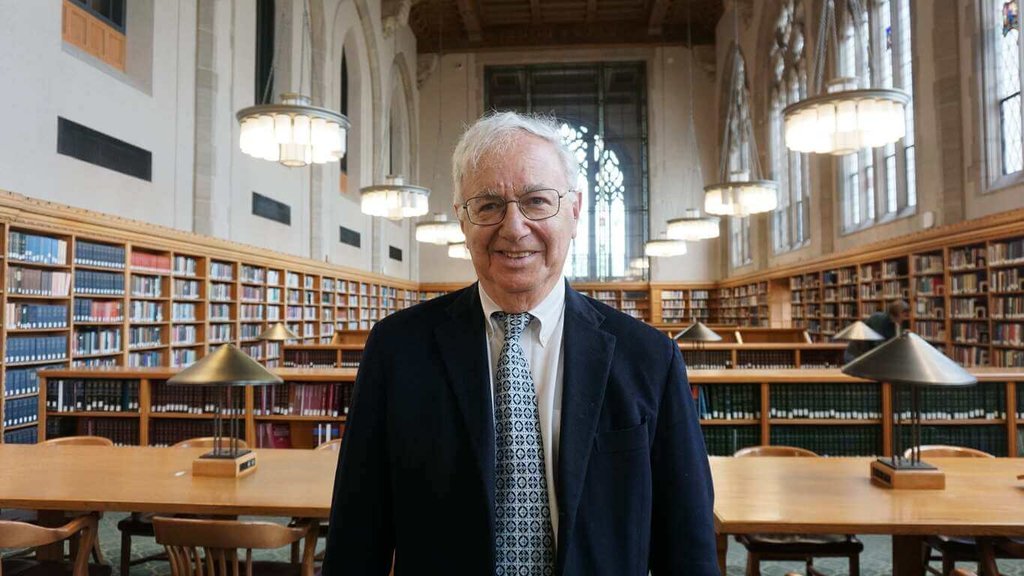
(Central News Agency reporter Hsieh Chun-lin, Taipei, June 18) The recipient of the 7th Tang Prize in Rule of Law for 2026 was announced today: American law professor Bruce Ackerman. Ackerman said in a video message: "This is truly a great honor. You chose me precisely because many other scholars have chosen compromise. I cannot achieve that kind of balance."
Born in 1943 and raised in the Bronx, New York, Ackerman graduated from Yale Law School and served as a law clerk for Judge Henry J. Friendly of the U.S. Court of Appeals and Justice John Marshall Harlan of the U.S. Supreme Court, launching his legal career. He then entered academia, teaching at the University of Pennsylvania, Columbia University, and Yale University.
The Tang Prize Foundation held a press conference today to announce the 7th Rule of Law awardee. The announcement was jointly made by Yeh Jhun-jung, convener of the Rule of Law Selection Committee and Distinguished Professor at National Taiwan University's College of Law; Chang Wen-chen, Distinguished Professor at NTU's College of Law; and Chen Chen-chuan, Executive Director of the Tang Prize Foundation. The 7th Tang Prize in Rule of Law is awarded to Bruce Ackerman, Sterling Professor of Law and Political Science at Yale University.
The selection committee specifically highlighted in its citation that the award honors Ackerman's exceptional intellectual leadership, which has not only introduced innovative ideas regarding constitution-making, judicial review, and the foundational institutions of democratic constitutional governance, but also provided theoretical and practical pathways for defending the rule of law at a time when contemporary republics face multiple crises.
The committee stated that Ackerman's passionate, cross-national exploration of constitutional legitimacy and popular sovereignty, carried forward across generations, has deeply inspired constitutional practitioners worldwide who pursue social justice and the rule of law.
Chang Wen-chen emphasized that Ackerman's most significant contribution to the rule of law lies in his pioneering theories of "dualist democracy" and the "constitutional moment." These theories offer a crucial analytical framework for understanding the challenges currently facing the U.S. constitutional order and contemporary democratic nations.
Chang noted that Ackerman has proposed numerous innovative ideas. He advocates for a national holiday before elections to institutionally encourage public deliberation on critical issues, and for distributing small amounts of political capital to all citizens so they can anonymously donate to candidates, preventing democratic systems from being monopolized by large political donations. The concept of a "deliberation day" has already inspired civic deliberation practices in the United States and Mongolia.
Chang stated that Ackerman's academic research integrates perspectives from law, politics, history, and economics. He is committed to bridging theoretical breakthroughs with institutional innovation, and his proposed theories and solutions have had broad real-world impact, especially in addressing contemporary challenges to the rule of law.
Chang added that Ackerman's relentless pursuit of popular sovereignty and constitutional legitimacy constantly reminds us: "The Constitution is an ongoing conversation." In this era of intersecting crises, Ackerman's ideas continue to inspire constitutional workers across generations and regions, driving the pursuit of a more inclusive and resilient rule-of-law society.
In his video message, Ackerman said: "This is truly a great honor. No American scholar or lawyer has ever received this award before, and you chose me at precisely this moment—when the threats to American democracy are more severe than ever. Why an American? And why now, when President Trump is dismantling the international order the U.S. built after World War II?"
"I think you chose me because many other scholars have chosen compromise. They may not support everything Trump does, and they may offer criticism, but overall, they maintain a posture of 'balance.' I cannot do that. American democracy, in its 250-year history, has never been as endangered as it is today."
Ackerman believes that everyone who truly cares about democracy, regardless of their disagreements on other issues, has a responsibility to speak out—to say 'no' in the name of the 'American people' to what is currently happening.
Regarding Ackerman's remarks, Yeh Jhun-jung stated that Ackerman recognizes the constitutional democratic order is in crisis. He sees it clearly, remains sensitive and uncompromising toward reality, and always has his own convictions. Ackerman is never radical; he is a profoundly thoughtful scholar who, at critical moments, clearly articulates major directions without ambiguity. "He is a scholar who lives in the present, not in the past."
From June 15 to 18, the Tang Prize Foundation announced the recipients of the 7th Tang Prize across four categories: Sustainable Development, Biopharmaceutical Science, Sinology, and Rule of Law. Each award carries a prize of NT$50 million. The foundation plans to hold the award ceremony on September 18 at the Taipei Performing Arts Center. (Editor: Lin Shu-hui) 1150618
FACT BOX
- Source: CNA (Central News Agency)
- Category: Taiwan