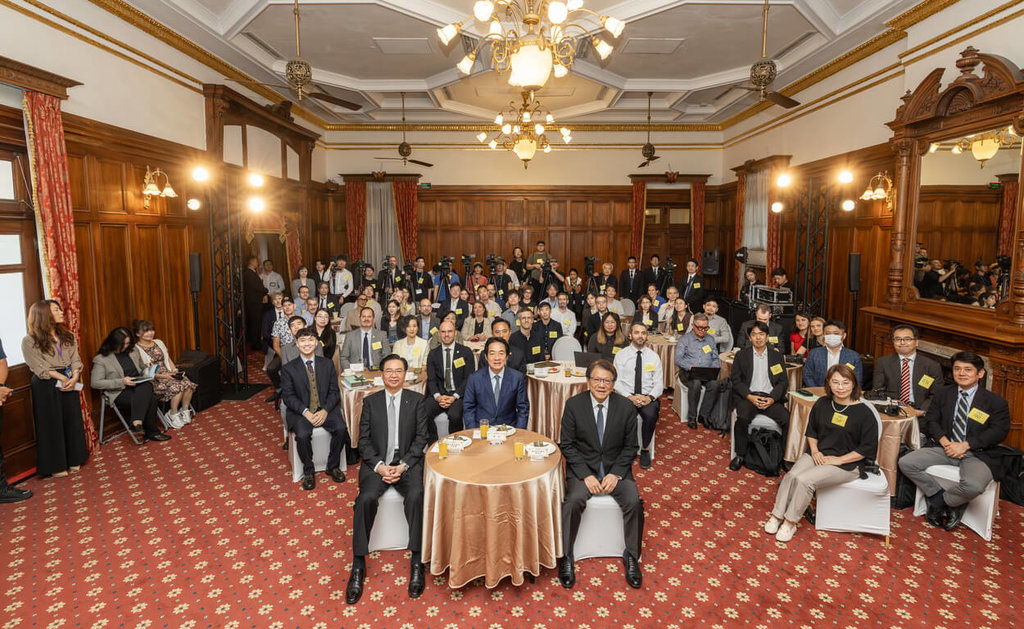
Taipei, June 18 (CNA) President Lai Ching-te said on Tuesday that Taiwan and Japan are not only geographically close but also share similar values and are partners bound by destiny. Facing regional security challenges and the restructuring of global supply chains, Taiwan and Japan should deepen cooperation in three areas: security resilience, economic technology, and people-to-people exchanges. Together, they can build a trustworthy democratic supply chain and jointly safeguard peace and stability in the Indo-Pacific.
Speaking at a press conference with international media this morning, the President was asked about his assessment of Taiwan-Japan relations. He stated that Taiwan and Japan are geographically close, share similar values, and are partners bound by destiny. Over the past year, exchanges between the two sides have continued to heat up, from parliamentary and local government levels to industry, culture, and tourism. Japan has also repeatedly emphasized the importance of peace and stability in the Taiwan Strait on international occasions, which is very important to Taiwan.
The President emphasized that Taiwan-Japan friendship is a strength built on long-term trust. Peace in the Taiwan Strait is not just a Taiwan issue; it is a shared responsibility for Indo-Pacific security and global prosperity. The more united democratic partners are, the stronger the region will be in maintaining peace and stability.
Regarding future cooperation between Taiwan and Japan, the President believes there are three areas to actively promote. First, security and resilience. Both Taiwan and Japan have been affected by natural disasters such as earthquakes and typhoons, and they also face challenges from gray zone threats, disinformation, and cognitive warfare. The two sides can continue to strengthen cooperation in areas such as disaster prevention and relief, maritime security, humanitarian assistance, critical infrastructure protection, and whole-of-society defense resilience, establishing institutionalized cooperation channels.
The President said that second, economic security and technological cooperation. Taiwan has advantages in semiconductor and AI supply chains, while Japan has strengths in materials, equipment, precision manufacturing, and energy technology. If the two sides deepen cooperation in areas such as semiconductors, artificial intelligence, cybersecurity, drones, quantum computing, and energy transition, they should be able to build a trustworthy and resilient democratic supply chain, which would be very beneficial to both Taiwan and Japan.
He added that third, people-to-people and local exchanges. Approximately 6 million people travel from Taiwan to Japan for tourism and business activities annually, and nearly 2 million people visit Taiwan from Japan. Promoting exchanges between people, such as in youth, education, tourism, regional revitalization, agriculture, sports, and cultural exchanges, can lead to better cooperation plans for the next generation.
The President stated that Taiwan and Japan are the two most mature democracies in Asia, possessing common values and interests. The cooperation between Taiwan and Japan will be a cornerstone of security and stability in the Indo-Pacific region and the most important driving force for jointly realizing the vision of a free and open Indo-Pacific. He looks forward to strengthening cooperation with Japan. (Editor: Hsieh Chia-chen) ichen) 1150618)
Stand with facts, your every donation is a force to protect press freedom
Download CNA's "One-Stop News" APP for real-time updates
The text, images, and videos on this website may not be reproduced, broadcast, transmitted, or used without authorization.
FACT BOX
- Source: CNA (Central News Agency)
- Category: 政治