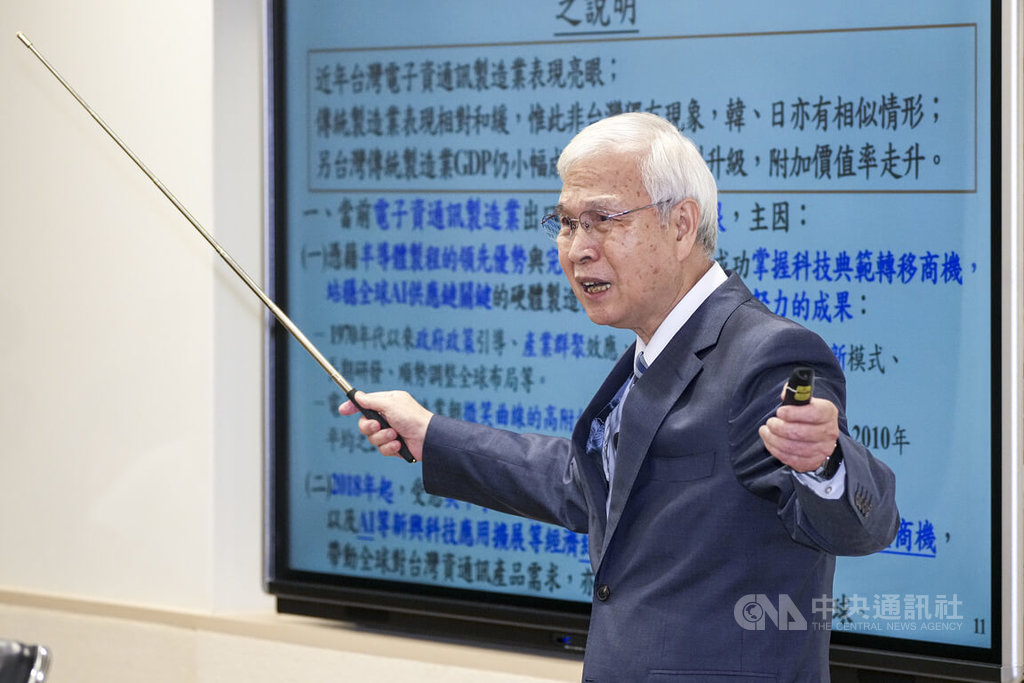
(CNA) - The Central Bank held its second-quarter board meeting today, deciding to keep interest rates unchanged for the ninth consecutive time and maintaining property market controls. However, Central Bank Governor Yang Chin-long revealed that two directors, considering the robust economy and inflationary pressures, advocated for an interest rate hike. Although the policy rate ultimately remained unchanged, the Central Bank's monetary policy stance leans hawkish, and it will closely monitor inflation trends.
The press release from the Central Bank's board meeting stated that domestic inflation outlook remains moderate, and domestic economic growth momentum is expected to be stable. Considering the need for prudent response to uncertainties in the global economic and financial outlook, and the potential impact of Middle East conflicts on domestic prices and the economy, the board believes that maintaining the policy interest rate unchanged will contribute to the stable development of the overall economy and financial system.
The Central Bank's decision to keep interest rates unchanged for the ninth consecutive time, as anticipated by the market, means the rediscount rate, the rate on accommodations for secured loans, and the short-term accommodation rate remain at 2%, 2.375%, and 4.25% per annum, respectively.
However, Yang Chin-long admitted at the post-meeting press conference that the decision on interest rates was not unanimous, with two directors advocating for a hike. Their reasoning was based on the Central Bank's forecast that although the annual consumer price index (CPI) growth for the full year would be below 2% at 1.91%, the year-on-year CPI growth from the second to the fourth quarter would exceed 2%. Furthermore, economic growth is also quite strong.
The directors also pointed out that even though oil prices have fallen, it will take time for crude oil supply capacity to recover, and the future trend of oil prices remains uncertain, with inflationary pressures still present.
Yang Chin-long stated that a 2% annual CPI increase is a medium-to-long-term indicator, and if it only temporarily reaches 2%, it is still acceptable. However, he agreed that even if current CPI data appears manageable, inflationary pressures must be closely monitored, and changes in economic data should serve as the basis for policy judgments.
Media also inquired about Taiwan's high economic growth with inflation below 2%, and whether the issue of "K-shaped economy" affects the Central Bank's monetary policy considerations.
Yang Chin-long explained that Taiwan's economic growth rate has exceeded 8% for two consecutive years, yet inflation remains around 2%, which has puzzled observers. He noted that during today's meeting, some directors offered an explanation: the strong economic growth in recent years has been primarily driven by external demand, not domestic demand. If the economy were booming due to strong domestic demand, inflation would rise.
Regarding the challenges posed by the K-shaped economy, the Central Bank had previously stated that relying solely on macroeconomic and financial indicators might mislead policy decisions, and interest rate tools alone might not suffice, possibly requiring more precise policy measures.
Yang Chin-long further elaborated today, saying that while many people talk about the K-shaped economy, "traditional industries are not performing poorly; it's the electronic components sector that is too strong," while the service sector is performing slightly worse.
Yang Chin-long stated that if the economic structure were closer to a normal distribution, the effects of monetary policy would be relatively uniform. However, in an M-shaped economy, the impact on different groups and industries varies significantly, increasing the challenges for the Central Bank's decision-making. In such a situation, the Central Bank's monetary policy must be more cautious. Raising interest rates solely based on strong electronic component exports would be unfair to industries with weaker economic conditions and lower revenues.
Therefore, looking only at the economic growth rate might overlook the uneven performance across industries. Yang Chin-long pointed out that inflation is a more comprehensive indicator, and the Central Bank's monetary policy will primarily focus on inflation. (Editor: Yang Kai-hsiang) 0618
FACT BOX
- Source: CNA (Central News Agency)
- Category: 經濟金融