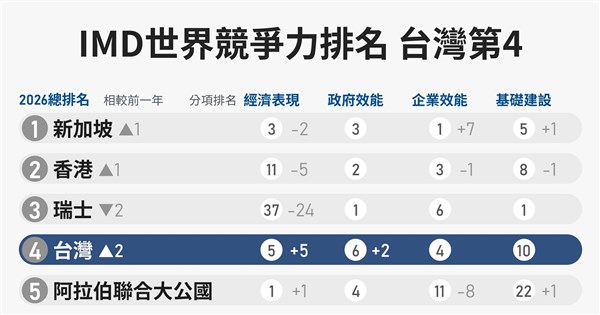
Taipei, June 18 (CNA) The 2026 IMD World Competitiveness Ranking, released by the International Institute for Management Development (IMD) in Lausanne, Switzerland, places Singapore at the top, followed by Hong Kong in second and Switzerland in third. Taiwan, bolstered by strong GDP and export growth and a decade of institutional stability, has climbed to fourth place globally, marking its best performance since its inclusion in the rankings.
The IMD World Competitiveness Ranking is a key indicator for global industry, government, and academia, evaluating 70 economies across four major aspects: economic performance, government efficiency, business efficiency, and infrastructure. The 2026 rankings, released on June 18, indicate that as geopolitical tensions escalate, robust institutions and the ability to adapt to volatility and absorb shocks are crucial for economic success.
Taiwan has made significant progress in all four competitiveness aspects, driven by strong Gross Domestic Product (GDP) and export growth, while maintaining stability. This has propelled its ranking from sixth place last year to fourth globally, its highest achievement to date.
Wang Ssu-wei, Taiwan's Representative to Switzerland, told CNA that the return of Taiwanese businesses, talent, and capital, coupled with the manufacturing and R&D momentum, recently boosted by AI, has positioned Taiwan in active collaboration with the world's leading companies. These positive factors are driving Taiwan's upward trajectory. This year's high ranking is the collective result of the government and people's efforts over the past decade.
According to the report's analysis, Singapore, the top-ranked economy, benefited from its business efficiency, jumping from second place in 2025 to reclaim the top spot it held in 2024. This highlights the importance of agile economies that can quickly recover and resume growth.
Hong Kong, continuing its upward trend for three consecutive years, secured second place this year. The improved ranking reflects its consistent performance across the four competitiveness indicators: government efficiency, infrastructure, economic performance, and business efficiency. Government efficiency remains its primary competitive advantage, ranking second for the second year in a row.
Last year's leader, Switzerland, slipped to third place, primarily due to a deterioration in foreign direct investment. This indicates that even strong economies are not immune to the impacts of geopolitical events and investment fluctuations. Furthermore, high living and operating costs continue to affect businesses, and employment performance has weakened, with the employment rate declining in line with long-term growth trends.
Arturo Bris, Director of the World Competitiveness Center, stated at a press conference that as geopolitical situations worsen and global divisions deepen, countries with mature legal systems and credible institutions will gain a greater advantage. When the international system fails to meet demands effectively, such institutional foundations help ensure the normal functioning of business activities.
The report's analysis suggests that in 2026, competitiveness will depend less on cost, scale, or even innovation, and more on the credibility of institutions. The more divided the world becomes, the more important predictable rules, enforceable commitments, and legitimate state capacity will be.
Following Taiwan, the United Arab Emirates ranked fifth, benefiting from high employment growth and long-term investment. Denmark, Ireland, the Netherlands, Sweden, and the United States followed in the rankings. (Editor: Tang Pei-chun) 1150618
Stand with facts, and your every contribution is a force to protect press freedom.
Download the CNA "One-Stop News" APP for real-time updates.
The text, images, and audio on this website may not be reproduced, publicly broadcast, publicly transmitted, or used without authorization.
FACT BOX
- Source: CNA (Central News Agency)
- Category: 經濟排名