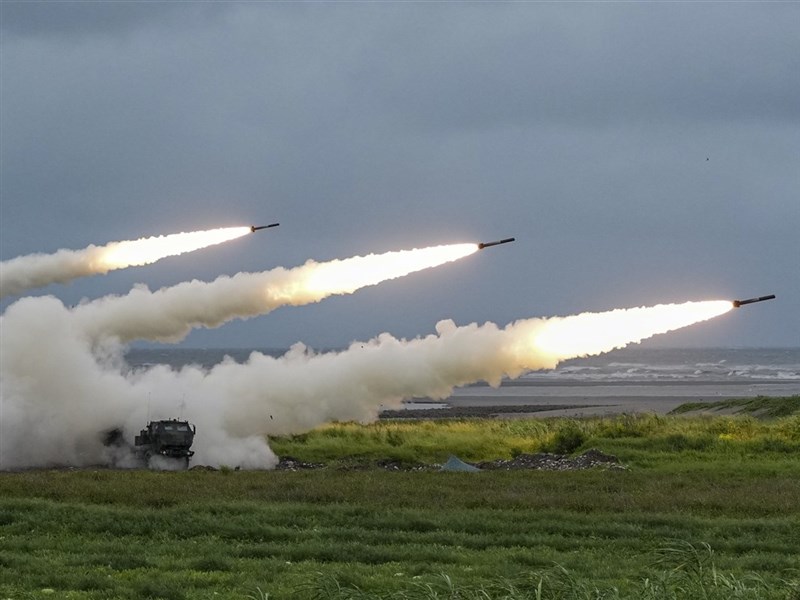
WASHINGTON (CNA) - The U.S. Senate Armed Services Committee recently passed the National Defense Authorization Act for Fiscal Year 2027, which includes a plan to establish a war reserve stockpile for Taiwan. A retired U.S. general analyzed that this is an "excellent deterrent" that sends a signal to China: if it invades Taiwan, Taiwan will not only have its own weapons but also access to U.S. military weapons.
"The National Defense Authorization Act (NDAA)" is considered a major annual law in the United States. The Senate and the House of Representatives must "iron out" a unified version, and after each passes it, it will be signed into law by the president.
The Senate Armed Services Committee passed the National Defense Authorization Act for Fiscal Year 2027 on the 11th, and it will subsequently be sent to the full Senate for deliberation.
According to the publicly released text of the bill, it includes a plan to establish a War Reserve Stock Program for Taiwan. Items that the U.S. can transfer to Taiwan include humanitarian and medical supplies, armor, artillery, ammunition for automatic weapons, missiles, and other munitions for Taiwan's reserve stockpile, stored in reserve warehouses within Taiwan.
In response, retired U.S. Navy Rear Admiral Mark Montgomery recently told CNA in an interview that he has advocated for a Taiwan war reserve stockpile program for many years and is pleased to see this content included in the Senate bill, hoping it will eventually pass smoothly.
He believes, "This is an excellent deterrent" and sends a signal to China: if it takes inappropriate aggressive action against Taiwan, Taiwan will not only have its own weapons but also access to U.S. military weapons.
Montgomery, now a senior fellow at the Washington-based think tank Foundation for Defense of Democracies, pointed out that in a war or crisis situation, "it is crucial that any supplies and ammunition we intend to transfer to Taiwan are already stored locally." If necessary, the U.S. can directly transfer weapons stored in warehouses to Taiwan for use.
In addition, the bill also includes renaming the "Taiwan Security Cooperation Initiative" to the "First Island Chain Security Cooperation Initiative (FICSCI)" and making the Philippines eligible to receive assistance under this authorization.
Rupert Hammond-Chambers, president of the U.S.-Taiwan Business Council, replied to reporters via email, stating that he welcomes this move. "We should think of Taiwan within the context of the First Island Chain, which will promote deeper cooperation and important interoperability between the U.S., Japan, Taiwan, and the Philippines."
Zack Cooper, a senior fellow at the American Enterprise Institute (AEI) and an expert on Asian security issues, also said that U.S. lawmakers are trying to strengthen security cooperation throughout the First Island Chain to maintain deterrence, especially in response to potential situations in Taiwan. "In my view, this is a good thing." (Editor: Tian Ruihua) 06/21/2027
Stand with facts, your every donation is a force to protect press freedom
Download CNA's "One-Stop News" APP for real-time updates
The text, images, and videos on this website may not be reproduced, publicly broadcast, publicly transmitted, or used without authorization.
FACT BOX
- Source: CNA (Central News Agency)
- Category: 国防