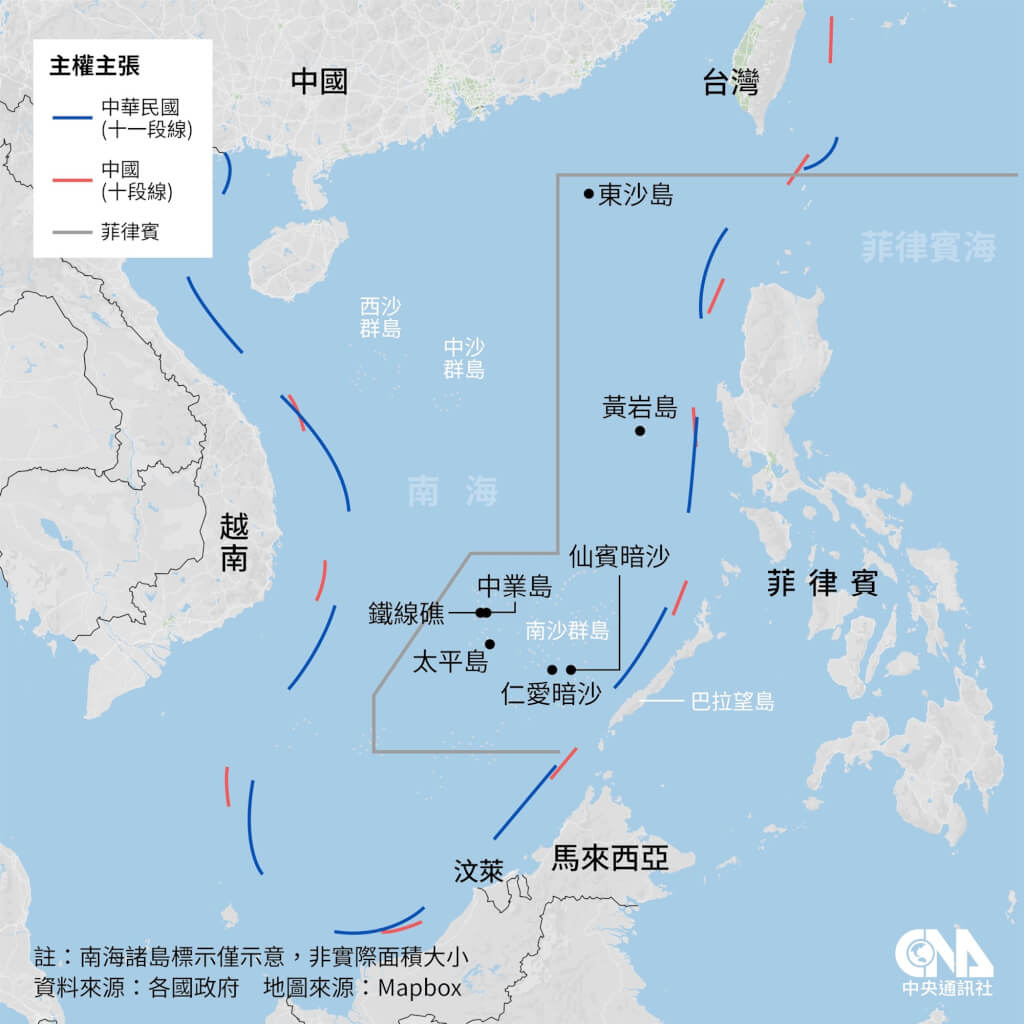
(Central News Agency, Manila, June 21, Comprehensive Foreign News) The Financial Times reported that the Philippines is concerned that China may be preparing to permanently control Scarborough Shoal, a disputed reef in the South China Sea and one of the most dangerous flashpoints in the Indo-Pacific region.
Philippine Defense Secretary Gilberto Teodoro said Manila is concerned about China's recent activities around Scarborough Shoal (called Demiao Reef in Taiwan). Scarborough Shoal is located within the Philippines' exclusive economic zone, 200 kilometers west of Luzon.
Teodoro told the Financial Times, "The level of concern is much higher (than before)."
Since 2012, China has maintained de facto control of Scarborough Shoal through the continuous deployment of naval vessels. However, there are concerns that China may attempt to permanently control Scarborough Shoal, following its actions in other disputed areas of the South China Sea, paving the way for possible construction and militarization.
Earlier this week, China removed floating platforms that Manila claimed were "illegal" from the vicinity of Scarborough Shoal. However, Teodoro stated that China subsequently dispatched a maritime research vessel into the area. Beijing has previously used research vessels to conduct activities in disputed waters in this region that could facilitate the construction of artificial islands.
Ten years ago, an international tribunal rejected Beijing's claims to most of the South China Sea.
Teodoro said, "If they... lied before, they will lie now. This might also be a tactic to provoke us on the 10th anniversary of the arbitration ruling, but since they have already entered and started 'research activities,' why take such a risk if they don't intend to act? You have to prepare for the worst."
Beijing recently imposed sanctions on Teodoro, including a ban on his travel to China, Hong Kong, and Macau, citing his "irresponsible remarks" about China, without specifying them. Teodoro dismissed these actions, viewing them as catering to domestic audiences and stating they do not affect efforts to strengthen military deterrence against China.
Although US President Trump has sometimes made sharp remarks about alliances, causing concern among many US allies, Teodoro stated that in the Indo-Pacific region, "alliances are becoming more solid."
The United States and the Philippines recently held their annual Balikatan joint military exercises, with a record number of participating allies, including Japan, Australia, New Zealand, and Canada.
Teodoro emphasized the importance of Manila and its allies taking more action to "enhance (military) interoperability to strengthen deterrence against China."
He revealed that Manila hopes to purchase more weapons from the United States, including Tomahawk cruise missiles and the Typhon system, which can launch Tomahawk and SM-6 missiles to strike aircraft, ships, and ballistic missiles.
Teodoro pointed out that the Philippines is in talks with Tokyo to acquire five Abukuma-class destroyers after their retirement. The Philippines is also interested in Japan's Type 88 surface-to-ship cruise missile, which made its debut at the Balikatan joint military exercises.
In 2024, Manila and Tokyo signed a Reciprocal Access Agreement, allowing their troops to train and exercise in each other's countries, a move aimed at strengthening deterrence against China.
When asked if the Reciprocal Access Agreement paves the way for Japan to rotate troops in the Philippines, Teodoro replied, "Of course, this also applies to the Philippines rotating troops in Japan and Australia."
Teodoro stated that Manila also intends to acquire the extended-range version of the BrahMos supersonic missile from India, which would give the Philippines greater power projection capabilities in the South China Sea.
In addition to acquiring weapons, Teodoro said that Manila has also begun integrating artificial intelligence (AI) into its military systems to enhance its ability to detect Chinese activities and predict future actions.
When asked about the extent of discussions between the US and the Philippines regarding a potential war over Taiwan, he replied, "The United States and the Philippines have not had any dialogue regarding a Taiwan emergency."
However, he said that the two allies have discussed global contingencies that could affect the Philippines during their annual talks under the Mutual Defense Treaty.
He said, "Any responsible defense exchange will discuss these contingencies... and conduct exercises for these situations. This is also why AI is being used, AI can provide predictions, making various scenarios more realistic and feasible, and making contingencies more up-to-date." (Compiled by Zhang Xiaowen) 1150622
Stand with facts, your every sponsorship is a force to protect press freedom
Download the CNA "One-Stop News" APP for real-time updates
The text, images, and videos on this website may not be reproduced, publicly broadcast, publicly transmitted, or used without authorization.
FACT BOX
- Source: CNA (Central News Agency)
- Category: 国際関係
- Organizations: Financial Times / Tomahawks / Typhon