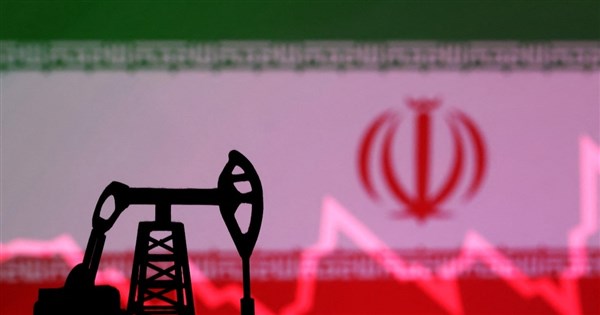
Zurich, Switzerland (CNA) - The U.S. Treasury Department has temporarily suspended sanctions for two months, allowing Iran to sell oil in U.S. dollars. This marks the first time in decades that Iran's banks are permitted to directly receive dollar payments for oil sales, and it temporarily legalizes Iran's "shadow tanker fleet."
Meanwhile, U.S. Vice President JD Vance, who is in Switzerland for negotiations with Iran, stated that Iran has agreed to allow International Atomic Energy Agency (IAEA) inspectors to return to Iran. However, Iran has not confirmed this; Iranian state media also quoted officials as saying that Tehran has not yet negotiated its nuclear program.
The Wall Street Journal reported that the U.S. Treasury Department announced today a temporary lifting of oil sanctions against Iran, which will allow Iran to produce, sell, and transport crude oil and related products until August 21. The U.S. also stated that both sides are continuing negotiations on reopening the Strait of Hormuz, addressing Iran's nuclear program, and further expanding sanctions relief.
Before the outbreak of this war, Iran's oil exports were a core target of U.S.-led international economic sanctions, aimed at pressuring the Iranian regime to abandon uranium enrichment and the ability to develop nuclear weapons. As the conflict escalated and Iran retaliated by blockading the Strait of Hormuz, the U.S. further imposed a blockade on Iranian ports in May, attempting to force a compromise.
However, in a memorandum of understanding reached between the U.S. and Iran last week, the U.S. lifted the port blockade on Iran and agreed to allow Iran to sell oil and receive related revenue. The exemption measures officially issued by the U.S. Treasury Department today further stipulate that Iran can settle in U.S. dollars, meaning Iranian banks can directly receive payments from overseas, making it easier for the Iranian government to repatriate oil revenue. This is a significant benefit for Tehran, which is in urgent need of foreign exchange.
The scope of this exemption also goes beyond the temporary measures issued by the U.S. Treasury Department in March of this year; at that time, the U.S. only allowed Iran to sell oil that was already at sea but did not permit dollar transactions for Iran.
The Wall Street Journal believes that today's exemption provides a temporary reprieve from the severe sanctions Iran has endured for decades. For years, Western sanctions have forced Tehran to rely on a secret network of its aging "shadow fleet" of oil tankers to export crude oil, much of which has flowed to Chinese refineries.
Miad Maleki, a former senior official at the U.S. Treasury Department responsible for sanctions policy, stated that this exemption will also allow Iranian entities, including the Central Bank of Iran, to be exempt from sanctions related to terrorist activities, not just those related to Iran's nuclear program.
Maleki, now with the Foundation for Defense of Democracies, said, "This represents a fundamental change in the Iranian sanctions framework that the United States has built over the past 20 years."
Hamid Hosseini, spokesperson for the Iranian Oil Exporters' Guild, stated that after the U.S. announced the exemption measures, European traders have proactively contacted them expressing interest in purchasing Iranian crude oil, but no U.S. companies have contacted them yet. (Compiled by Chen Yi-wei) 1150623
Stand with facts, your every donation is a force to protect press freedom
Download the CNA "One-Stop News" APP for real-time updates
The text, images, and audio on this website may not be reproduced, publicly broadcast, or publicly transmitted and used without authorization.
FACT BOX
- Source: CNA (Central News Agency)
- Category: 国際経済