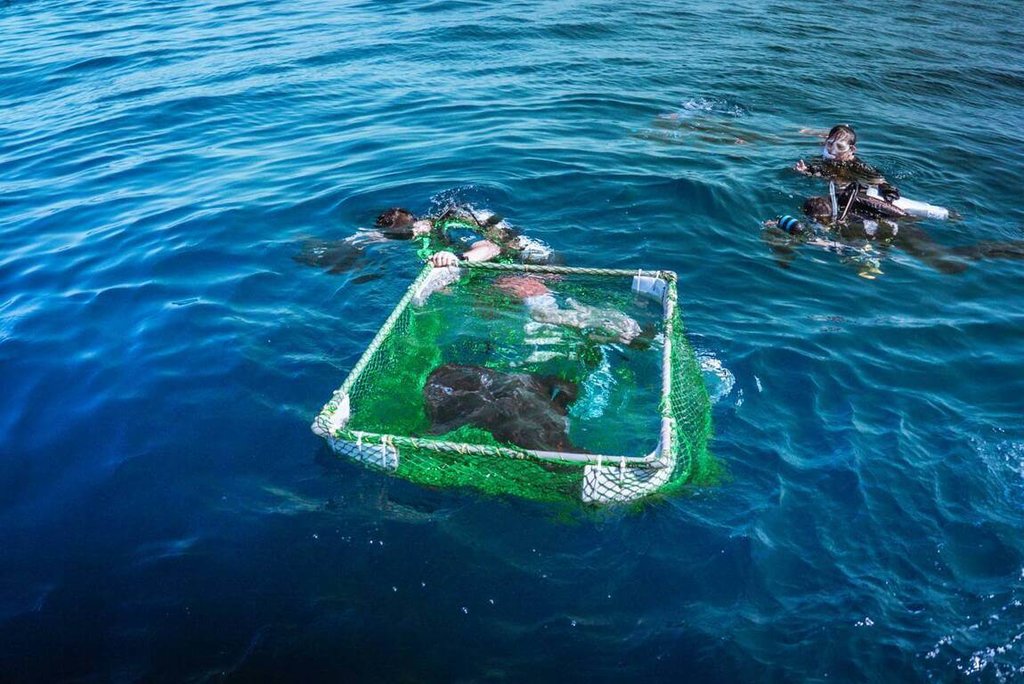
(Central News Agency, Reporter Chang Yi-lien, Kaohsiung, June 23) The Fisheries and Conservation Administration (FCA) received a juvenile "Rhynchobatus australiae" (also known as a guitarfish) from the S.E.A. Aquarium in Singapore. With the collaboration of various teams, a satellite tag was successfully attached, and the juvenile was released into the waters off Taitung. The aim is to supplement wild populations and track its survival status and habitat utilization patterns.
The Fisheries and Conservation Administration (FCA) of the Ocean Affairs Council explained today that the S.E.A. Aquarium in Singapore had been breeding a juvenile Rhynchobatus australiae originating from the waters off eastern Taiwan. Several juveniles were born in 2025, and the aquarium provided one of them to the FCA for tagging and release.
The FCA stated that the intention is to utilize offspring bred from Rhynchobatus australiae kept in large aquariums. Through professional care, they will be assisted through their low survival rate early stages before being transported to suitable habitats for release.
According to an FCA press release, the juvenile arrived at Taoyuan International Airport on the 4th. After water exchange procedures at "Xpark" in Taoyuan City, it was transported south to the National Museum of Marine Biology and Aquarium for temporary care. Once its condition was confirmed to be stable, a satellite tag was attached by various teams. Yesterday, the juvenile was transported to Chenggong Fishing Harbor in Taitung and released into offshore waters by a research vessel.
The FCA pointed out that this transnational restoration project involved the joint efforts of multiple domestic and international teams. The FCA primarily commissioned the National Museum of Marine Biology and Aquarium to assist with animal transportation and pre-release temporary care, and entrusted the National Kaohsiung University of Science and Technology team with the tagging and release.
FCA Director Lu Hsiao-chun stated that this action is an attempt at off-site restoration for "Rhynchobatus australiae" and aims to acquire information on the species' behavior and habitat environment by attaching a satellite tag, providing a reference basis for future conservation and restoration planning and implementation.
According to information provided by the FCA, "Rhynchobatus australiae" is named for its wave-like mouth and the arc-shaped edge of its head resembling a horseshoe crab, and is also known as "round-snouted guitarfish." It also has common names such as "fan-shaped shark," "horseshoe shark," and "fang zai." However, it actually belongs to the ray family (gill slits located ventrally).
"Rhynchobatus australiae" is widely distributed from India to the Indo-Pacific. In Taiwan, it is mostly found in the waters off the east coast and Penghu. Its main food source is crustaceans, and it often hunts lobsters from rock crevices in rocky reef or coral reef areas. It is ovoviviparous, with each litter producing approximately 2 to 11 pups. The birth length is about 46 to 48 cm, and the maximum length is about 270 cm. The International Union for Conservation of Nature (IUCN) currently lists it as Critically Endangered (CR). (Editor: Lin Shu-hui) 1150623
Stand with facts, your every donation is a force to protect the freedom of the press
Download the CNA "One-Stop News" APP for real-time updates
The text, images, and videos on this website may not be reproduced, publicly broadcast, publicly transmitted, or used without authorization.
FACT BOX
- Source: CNA (Central News Agency)
- Category: 環境保育