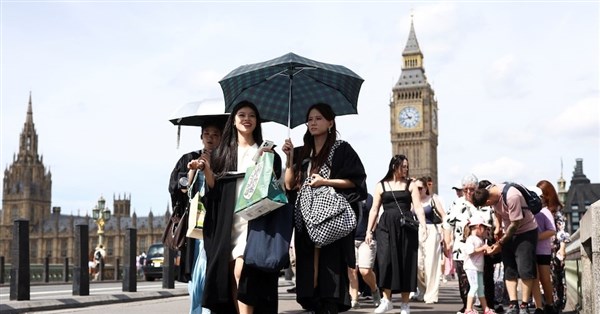
(CNA London, July 22, Comprehensive Foreign News) Several European countries have recently been hit by temperatures exceeding 40 degrees Celsius. The UK Met Office has issued a rare red high-temperature warning, effective from the 24th; Germany has issued a warning for wildfire risks; and Madrid, Spain, has set up "climate shelters" for the homeless and vulnerable populations.
Heatwaves are often called "silent killers." While they may not cause as much visible destruction as hurricanes, floods, or wildfires, they are the deadliest type of extreme weather. Extreme heat, especially when combined with high humidity, makes it difficult for the body to sweat and other cooling mechanisms to function effectively.
Heat and humidity are increasingly testing the limits of human endurance. According to the World Health Organization (WHO), heatwaves have claimed over 200,000 lives in the EU and related countries in the past four years.
● UK Issues Second-Ever Red Alert in History
According to Agence France-Presse (AFP) and CNN, the UK Met Office has issued its highest-level red extreme heat warning, signifying a threat to life and the potential for disruption to essential services, including transport links such as roads and railways.
This is only the second time in the Met Office's history that such an alert has been issued. The warning is in effect from 9 a.m. on July 24th to 9 p.m. on July 25th, covering large parts of central and southern England, including major cities like London and Birmingham.
The Met Office forecasts temperatures could reach 39 degrees Celsius (102.2 degrees Fahrenheit) on the 24th, potentially breaking the June record of 35.6 degrees Celsius (96.08 degrees Fahrenheit) set in 1976. High humidity will also make the heat feel more oppressive.
Schools in southwest England have announced plans to close early, and one railway company has announced cancellations or alterations to some trains departing from London, citing "severe weather."
Scientists have warned about the severity of this heatwave in the UK. Liz Bentley, Chief Executive of the Royal Meteorological Society, stated that this means the UK has significantly rewritten its high-temperature records for two consecutive months, with a difference of over 2 degrees Celsius (3.6 degrees Fahrenheit).
Akshay Deoras, a senior research fellow at the National Centre for Atmospheric Science at the University of Reading, said, "This is not just a heatwave, but a high-temperature furnace driven by a high-pressure 'heat dome' that will cover much of southern England, with temperatures reaching extremely rare levels."
● Rising Temperatures in Germany Increase Wildfire Risk
According to Deutsche Welle, the German Weather Service (DWD) has stated that temperatures are rising, particularly in the southern and eastern regions, leading to an increased probability of forest fires.
In the wildfire risk classification, which ranges from 1 to 5, some areas have already reached level 4 (high risk), including Brandenburg, Bavaria, and Baden-Württemberg.
The German Weather Service predicts that from the 24th onwards, the risk of forest fires will further increase in most parts of southern and eastern Germany, and the situation may worsen in the future.
Meteorological experts estimate that on the 25th and 26th, several regions, including areas west of Berlin, will reach the highest danger level.
While high temperatures alone cannot cause fires, conditions of high heat, dryness, and low humidity can cause fires to spread rapidly. Some forest fires are also linked to human factors, including negligence or arson.
● Madrid Reaches 40 Degrees Celsius, Opens Climate Shelters
According to AFP, in Madrid, the Spanish capital, temperatures soared to 40 degrees Celsius today. The city government has set up "climate shelters" for the homeless and vulnerable populations, open from noon to 8 p.m., providing drinking water, food, and sanitary facilities.
Camilo, a homeless person seeking refuge at the facility, told regional television station TeleMadrid, "The pressure is immense, very immense. For those who are not used to living on the streets, not being able to shower, not being able to eat, it's really tough. The heat outside is unbearable."
In Córdoba, a southern tourist hotspot, temperatures also climbed to 40 degrees Celsius, with some streets nearly deserted as people either used umbrellas for shade or ate ice cream to cool down.
Clarisa Arismendi, a 38-year-old doctor from Mexico, told AFP, "It feels terrible. The heat right now is really, really, very uncomfortable." (Compiled by Tsai Chia-min) 1150623
Stand with facts, your every donation is a force to protect press freedom
Download the CNA "One-Stop News" APP for real-time updates
The text, images, and videos on this website may not be reproduced, publicly broadcast, or publicly transmitted and used without authorization.
FACT BOX
- Source: CNA (Central News Agency)
- Category: 自然災害
- Organizations: CNN / TeleMadrid