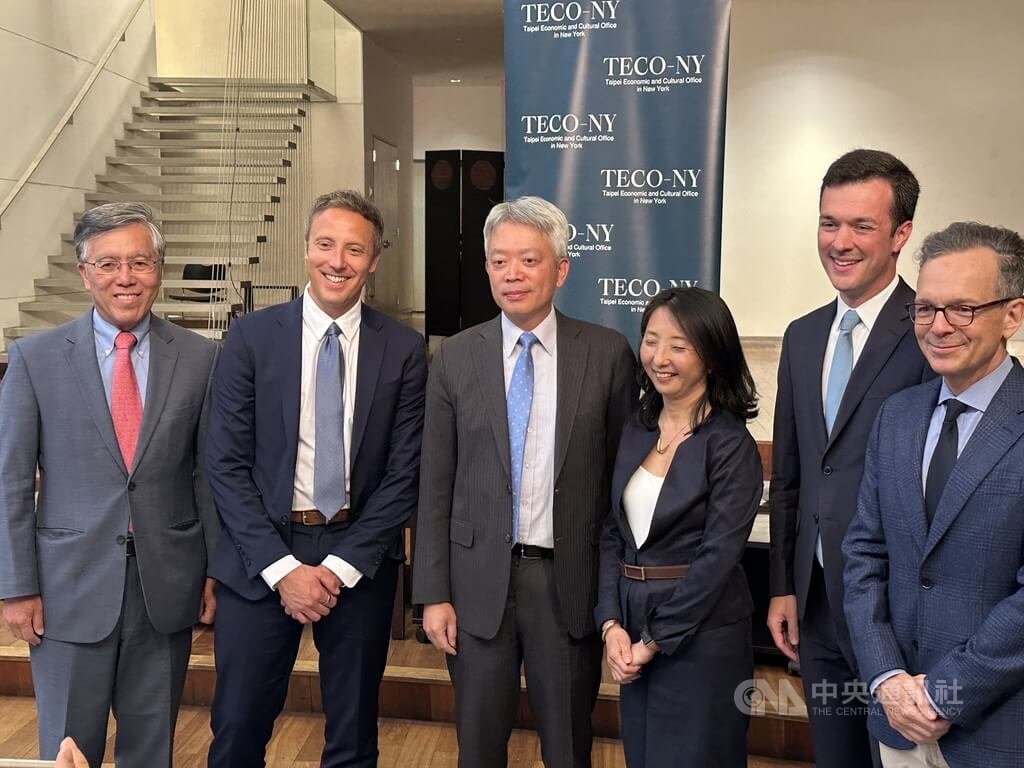
(CNA) - A closer partnership and cooperative relationship between the United States and Taiwan remains a crucial element for balancing relations among the US, China, and Taiwan, according to Chris Estep, former National Security Advisor to the Vice President, speaking at a seminar in New York today. While signals from the US administration regarding support for Taiwan have been inconsistent, the strong bipartisan support from Congress is the key takeaway.
Estep, a researcher at the Philadelphia-based think tank Foreign Policy Research Institute (FPRI) and former National Security Advisor to Vice President Kamala Harris, made these remarks at the "Taiwan's Strategic Outlook and the Future of US-Taiwan Relations" seminar held at the Taipei Economic and Cultural Office in New York on the 22nd.
Estep noted that US policymakers commend Taiwan's recent actions to increase its defense spending, which is significant. Given the security situation in the Taiwan Strait and Beijing's habitual military spending, it is clear that a closer US-Taiwan partnership and cooperation remain an important part of the balance among all parties.
He emphasized that if US support for Taiwan is to gain the support of (the American public), explaining it in this manner to (American) swing voters will, he believes, lead them to understand that the US still plays an important role in the defense capabilities of its key partners.
Estep analyzed that for countries with traditional military advantages, transforming those advantages into acceptable political conclusions will only become more difficult in future forms of warfare, with examples seen in the Middle East and in Ukraine and Russia. The difficulties and challenges faced by policymakers in Taipei and Washington are the same ones that Beijing must also confront.
He believes that in the coming years, Chinese President Xi Jinping and Beijing officials will have to deal with issues related to military operations, and the long-standing problems of the People's Liberation Army will not resolve themselves. Policymakers in the US, Taiwan, and China will all have to consider where the difficulties lie and assemble different puzzle pieces, incorporating existing pieces of various shapes and sizes. This will be even more challenging for Beijing.
Estep stated that while signals from the US administration regarding support for Taiwan have been inconsistent, strong bipartisan support from Congress for Taiwan remains the key takeaway. US tools have also expanded from arms sales to military financing, presidential drawdown authority, and Taiwan security cooperation agreements.
He also stressed that the key to deterring China is to make the decision to invade Taiwan more difficult, not through traditional chess-like thinking, but through a puzzle concept that requires Beijing to solve more problems, thereby increasing the cost of an invasion.
The seminar was co-organized by the Taipei Economic and Cultural Office and the Foreign Policy Research Institute. Speakers included Rupert Hammond-Chambers, President of the US-Taiwan Business Council, and Wang Wei-cheng, Dean of the College of Arts and Sciences and Professor of Political Science at Adelphi University. Lee Chih-chiang, Director of the Taipei Economic and Cultural Office, and diplomatic officials were also in attendance. (Edited by Tang Sheng-yang) 1150623
Stand with facts, your every donation is a force to protect press freedom
Download CNA's "Firsthand News" APP to get the latest news in real-time
The text, images, and videos on this website may not be reproduced, publicly broadcast, publicly transmitted, or used without authorization.
FACT BOX
- Source: CNA (Central News Agency)
- Category: 政治
- Organizations: Foreign Policy Research Institute