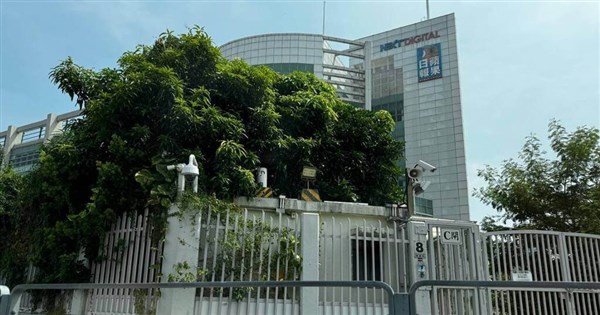
(CNA, Taipei, June 23) June 23, 2021, marked the announcement of Apple Daily's closure. For former Apple reporter Michael (pseudonym), "the world changed after that day." Long-time readers, finding mainstream media reporting increasingly monolithic, have turned to online outlets. Media scholar Lee Chin-fai points out that despite the establishment of numerous online media outlets in recent years, they have struggled to fully fill the void left by Apple Daily. Five years have passed, and Hong Kong's media ecosystem has quietly transformed.
On June 23, 2021, Apple Daily announced its closure; on June 24, it published its final edition, printing a record 1 million copies to bid farewell to Hong Kongers.
● Former Reporter Recalls the Disappearance of the News Atmosphere
Michael, who worked as a reporter at Apple Daily for about 10 years until its final day, told CNA reporters that Apple Daily, which started as a newspaper and later developed online news, was once one of Hong Kong's most influential mainstream media outlets.
He recalled that in the past, people would check the front page of newspapers at convenience stores or newsstands to see what was being reported. Due to its high circulation, Apple Daily was often placed in the most prominent position, and its reporting and angles easily entered public discourse, fostering an atmosphere of social discussion.
"Even when more people started reading news on their phones, you would still see people in restaurants flipping through Apple Daily newspapers. You'd see what the A1 (front page) story was. That atmosphere is gone now," Michael said.
Michael also stated that those who disliked Apple Daily called it sensationalist, while admirers called it critical and having its own perspective. Now, mainstream media report news from similar angles. "You walk past a newsstand and see the same thing everywhere; you lose interest."
In Michael's view, Apple Daily's existence is worth commemorating. "I think it's not just commemorating Apple Daily, but commemorating Hong Kong of that era."
Many online media outlets have been established in Hong Kong over the past five years. Michael believes they are making efforts to produce analytical reports, but these are limited to the internet. Readers have to actively visit their websites to see the news, making their influence difficult to compare with Apple Daily's.
Michael also observed that many people now read news through social media platforms like Threads. However, this content often mixes personal opinions and emotions, and may not present the full context of events in an organized manner. Social media algorithms actively push information, and over time, the content readers are exposed to may become increasingly narrow.
● Long-time Reader Shifts to Online Media
Mr. Liu, a long-time reader of Apple Daily, has also changed his news consumption habits over the past five years. He told reporters that he became a loyal reader of Apple Daily around 2016, appreciating its critical reporting. "Criticism is necessary to point out policy loopholes and push the government to improve; 'hitting both sides equally' is actually unhelpful."
Mr. Liu stated that after Apple Daily's closure, mainstream media reporting became more uniform in its angles, so he turned to reading online media outlets established in recent years, even subscribing and paying to support their operations to compensate for the shortcomings of mainstream media.
He cited the case of Hong Kong Economic and Trade Office staff in London being accused of violating the UK's National Security Law. Mainstream media reported very little on this, and it was through online media that comprehensive information could be obtained.
Mr. Liu lamented that the media, as the "fourth estate," should be responsible for monitoring the government and speaking for the citizens, but this function has gradually disappeared in recent years.
Interestingly, he now reads pro-China media more often than before. He picks up a simplified free daily edition from one pro-China newspaper almost every day. He chuckled, "I see what propaganda they want to create, what Hong Kong story they want to tell."
● Scholar Points to Narrowing Voices and Spectrum
Lee Chin-fai, a professor at the School of Journalism and Communication at the Chinese University of Hong Kong, told CNA that Hong Kong's media landscape has indeed been gradually changing since the closure of Apple Daily and Stand News.
Lee Chin-fai said that first, the voices in the media have narrowed. Although individual mainstream media outlets can still produce quality reports, overall, investigative reporting has decreased compared to the past, and reporting models are gradually leaning towards "factual reporting," especially on political issues.
Lee Chin-fai believes this is related to media risk management, and the sources for commentary have also decreased compared to the past. "Who is willing to speak, and what can they say?" Previously, a significant source of commentary was Legislative Council members, but voices within the council are now narrower than before. Even on livelihood issues, critical voices are gradually decreasing.
Lee Chin-fai also pointed out that besides the political environment, resources are also a problem facing mainstream media today. It is difficult for outsiders to determine whether some news is not reported by mainstream media because they dare not, or because they lack the resources to cover it.
In addition to the restriction of voices, the media spectrum has also changed.
Lee Chin-fai explained that in the past, one end of Hong Kong's media spectrum was the traditional left-leaning newspapers, and the other end was Apple Daily and Stand News, with other media outlets distributed in between. With the closure of Apple Daily and Stand News, the original spectrum has narrowed, and online media outlets established in recent years are gradually becoming new sources of voices.
However, Lee Chin-fai believes that online media still struggles to fully fill the void left by Apple Daily. This is because the reader base that online media can reach is limited, and their resources and manpower are not comparable to Apple Daily's. Reporters now face more restrictions than before when accessing public information and conducting investigative reporting.
Lee Chin-fai stated that another worrying point is that fewer Hong Kongers are willing to pay for news in recent years. If citizens are unwilling to pay to support online media, it will increase their operational pressure, "even making their survival questionable."
Five years have passed, how many people will remember Apple Daily? Michael said that whenever a major event occurs in Hong Kong in recent years, someone will always say, "If Apple Daily and Stand News were still around, how would the news be reported?"
Michael believes that as time passes, people's feelings may gradually fade, but he believes everyone will not forget Apple Daily. "Apple's disappearance represents the end of an era and the beginning of another." (Editor: Chiu Kuo-chiang) 1150623
Stand with facts, your every contribution is a force to protect press freedom.
Download the CNA "First Hand News" APP for real-time updates.
This website's text, images, and videos may not be reproduced, publicly broadcast, or publicly transmitted and used without authorization.
FACT BOX
- Source: CNA (Central News Agency)
- Category: 分析
- Organizations: Threads