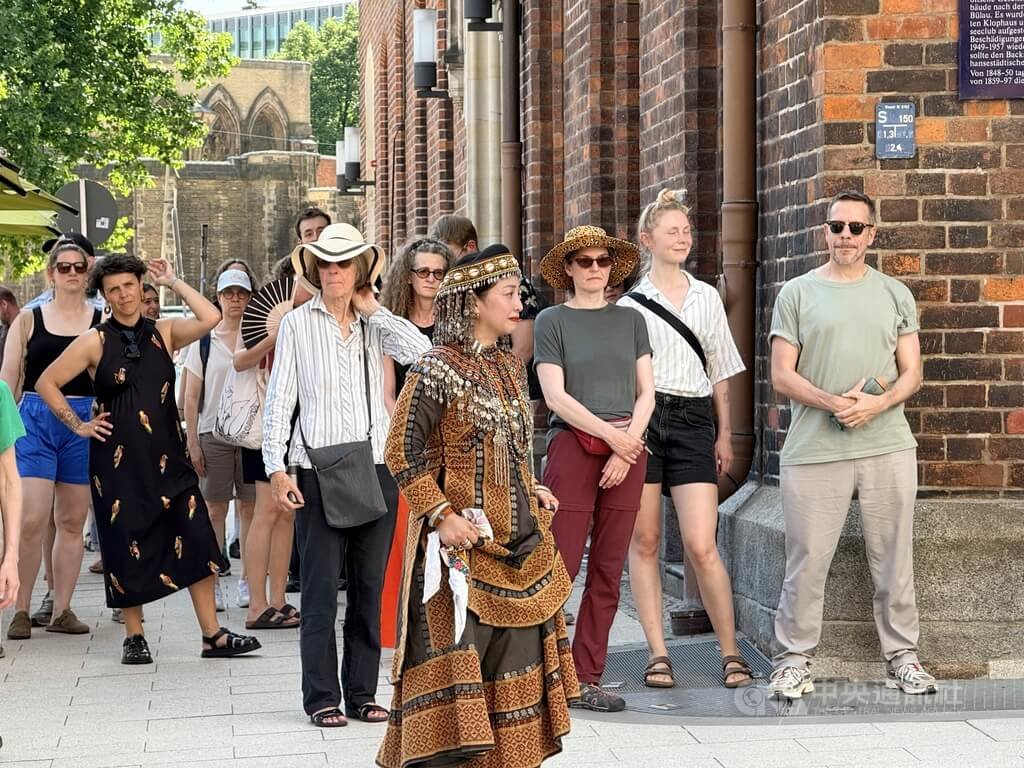
(Central News Agency, reporter Lin Shang-ying, Hamburg, 22nd) Lu Chih-hsin, artistic director of the Paiwan indigenous dance troupe Tjimur Dance Theatre, performed "The Path of Lu Chih" in Germany. Wearing traditional Paiwan attire, she walked barefoot in high temperatures through the ruins of St. Nicholas Church in Hamburg, a World War II site. In an interview, she stated that the work originated from her personal healing journey, and that walking is not only about self-reflection but also about re-establishing connections with the land, history, and others.
Tjimur Dance Theatre, a Paiwan indigenous dance troupe, was invited to participate in the three-year festival (Tanztriennale) in Hamburg, Germany, bringing their new work "Living Cultural Body" and their long-term art project "The Path of Lu Chih," which deeply moved the local audience.
"The Path of Lu Chih" is a mobile performance art without a fixed stage. Creator Lu Chih leads the audience through city streets, experiencing the stories of the land, history, and people through walking. This project has been developing for over 10 years, having been presented in cities across Taiwan and Europe, including Germany and Norway.
The performances in Hamburg on the 21st and 22nd started from the Mahnmal St. Nikolai (St. Nicholas Church Memorial). This church, which was the world's tallest building from 1874 to 1877 (147 meters), was destroyed by Allied air raids during World War II. After the war, the church was not restored to its original state but was preserved as ruins as a war memorial.
In an interview with CNA after the performance, Lu Chih said that before the performance, the organizers took her to walk the route and introduced the history along the way. She was deeply touched when she learned that St. Nicholas Church was bombed and destroyed during World War II but was chosen to be preserved as ruins for remembrance.
"Everyone walks a different path, and always carries different wounds," said Lu Chih. When people face pain, they often think about demolition, reconstruction, or forgetting. However, sometimes, what's important is not reconstruction, but finding understanding within the pain and learning to coexist with it.
Lu Chih recalled that over 10 years ago, her long-term dedication to creation, managing the dance troupe, and caring for her family gradually led to an imbalance in her physical and mental well-being, even causing her to faint several times. It was only after seeking medical help that she realized she was the one who needed care.
She then conceived the performance art project "The Path of Lu Chih," through which she slowed down her pace by walking, re-experiencing her breath, body, and the land, and learning to be with herself in the process.
However, as "The Path of Lu Chih" traveled to different cities, Lu Chih gradually discovered that she was not the only one who needed healing. Some audience members gained strength through hugs during the walk, which also showed her the natural companionship and connection that arises between people. Today, "The Path of Lu Chih" has evolved from an initial self-healing journey into a journey of mutual companionship between the performer and the audience.
"I know I will encounter difficulties, but I also believe that those who accompany me will be willing to walk with me on different paths." On the day of the performance, it was a heatwave in Germany, and Lu Chih walked barefoot on the cobblestone and asphalt roads of Hamburg in temperatures over 30 degrees Celsius. Blisters formed on the soles of her feet after the performance.
Lu Chih said she felt joyful in her heart because she could always feel the kindness and warmth of strangers through this performance art project, time and time again. Afterwards, she discovered from photos taken by staff that as she prepared to cross the road, a stranger on a bicycle stopped beside her, deliberately blocking oncoming traffic to let her pass.
She also shared this feeling of kindness with the accompanying audience. At the end of the walk, Lu Chih invited the Hamburg audience to hold hands and form a circle, and together they performed the Paiwan circle dance, commonly seen at weddings and harvest festivals, symbolizing the gathering of tribal members, sharing joy and blessings. (Editor: Tang Shen-yang) 1150623)
FACT BOX
- Source: CNA (Central News Agency)
- Category: 文化藝術