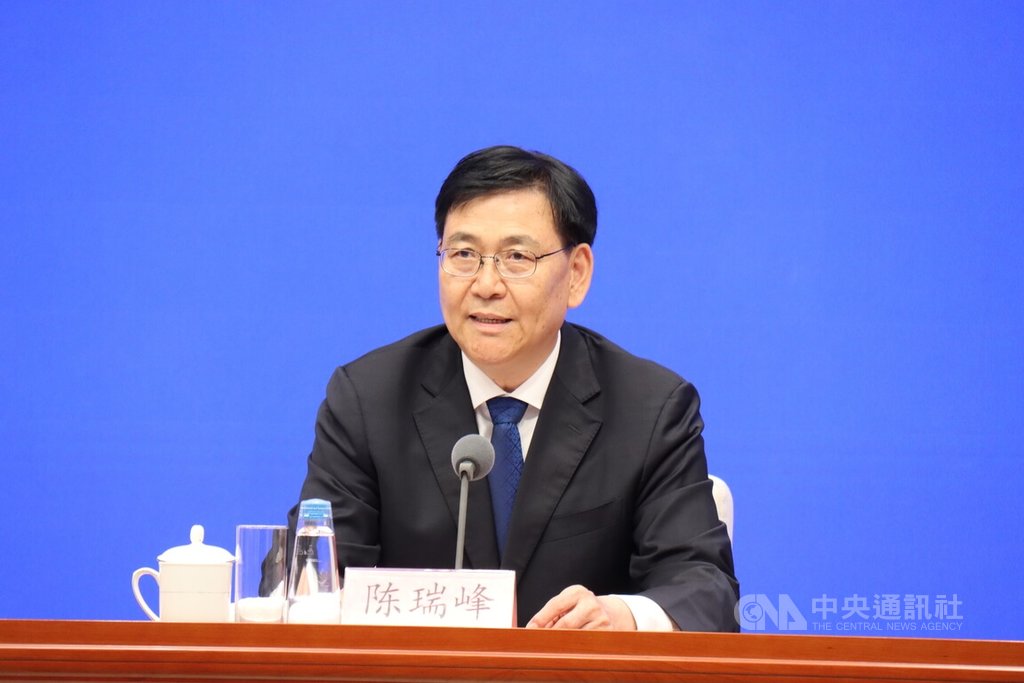
(CNA, Beijing, June 24) The "Law of the People's Republic of China on the Promotion of Ethnic Unity and Progress" has attracted high attention overseas. Officials emphasized the law's importance at a press conference today, while also using the opportunity to counter Western media, refuting allegations of forced labor in Xinjiang, boarding schools in Tibet, and the impending demise of minority languages and scripts.
The State Council Information Office of China held a press conference on this law today. Approximately 60-70 reporters were present, but only one foreign media outlet, Dubai-based A&N TV, was given the opportunity to ask questions. Other questions related to overseas doubts about the law were handled by other mainland Chinese media and Phoenix TV, with officials providing "clarifications" to various external accusations in their responses.
Chen Ruifeng, Deputy Minister of the United Front Work Department of the CPC Central Committee and Director of the National Ethnic Affairs Commission, first introduced that the "Law on the Promotion of Ethnic Unity and Progress" is an important law that declares the major policies and guidelines of the Party and the state on ethnic work. It is the only newly enacted law since the 18th National Congress of the CPC with a separate preamble, fully reflecting its fundamental legal status as a unifying and programmatic document.
He stated that this law transforms General Secretary Xi Jinping's important thoughts on strengthening and improving ethnic work, especially the major concept of "forging a strong sense of community for the Chinese nation," into state will. It emphasizes "forging a strong sense of community for the Chinese nation" and promoting the "construction of a community for the Chinese nation," thereby adjusting ethnic relations nationwide.
Bayinqolu, Chairman of the NPC Nationalities Committee, said during his introduction to the legislative process that the legislative work for the Law on the Promotion of Ethnic Unity and Progress began in November 2023. In August 2025, Xi Jinping presided over a meeting of the Political Bureau of the CPC Central Committee to discuss the draft of the law, "This is the first legal case discussed by the Political Bureau of the CPC Central Committee in over 30 years."
In response to external doubts, Chen Ruifeng said that Article 25 of the Law on the Promotion of Ethnic Unity and Progress protects the legitimate rights and interests of citizens who are employed or start businesses across regions, adhering to the core principles of "complete voluntariness, two-way selection, legality and compliance, and freedom to come and go."
He claimed that all Xinjiang residents who go out for employment have voluntarily registered based on their personal desire to improve their family's livelihood and enhance their skills. "There is absolutely no so-called 'forced migration' or 'forced labor,'" he said, calling such claims "absurd and laughable." He also pointed out that in the past five years, Xinjiang's urban areas have seen a cumulative increase of 2.392 million new jobs, agricultural laborers have made 16.1 million outward work trips, and the per capita disposable income of urban and rural residents has grown annually by 5.3% and 8.1% respectively.
There is also external concern about whether the languages and scripts of China's ethnic minorities will be suppressed. Article 15 of the Law on the Promotion of Ethnic Unity and Progress stipulates that "the state shall comprehensively promote the popularization of the national common language and script. No organization or individual shall hinder citizens from learning and using the national common language and script," and requires schools and other educational institutions to use the common language and script as the basic language and script for education and teaching.
Lei Jianbin, Deputy Director of the Legislative Affairs Commission of the NPC Standing Committee, said that these provisions are coordinated with the "Law on the National Common Language and Script" revised at the end of last year. The promotion and popularization of the national common language and script, and the guarantee of ethnic minorities' use of their own languages and scripts, are both provisions of the Constitution and laws. "Both are legally guaranteed and should not be placed in direct opposition to each other."
When asked about recent statements by overseas organizations claiming that the Law on the Promotion of Ethnic Unity and Progress is intended to "assimilate ethnic minorities" and calling for human rights sanctions against China, and how this issue is viewed, Bayinqolu stated that the relevant statements ignore the tremendous achievements made in China's ethnic regions and ethnic work, and that pointing fingers and making groundless accusations against China's ethnic policies and rule of law construction "is a gross interference in China's internal affairs, and we express our strong dissatisfaction and firm opposition."
Official media outlet China Tibet Online asked how to comment on foreign media reports about boarding schools in Tibet that claim "forced assimilation, mandatory boarding, and human rights violations," and "how to comment on such remarks that link educational assistance measures with 'forced assimilation'?"
Duan Yijun, Deputy Minister of the United Front Work Department of the CPC Central Committee, said that these foreign media reports "are completely inconsistent with objective facts." He stated that China's boarding system is not a closed school, let alone militarized management. Boarding schools are voluntary, and "boarding students can return home on weekends, holidays, and during winter and summer vacations, and parents can visit their children at school at any time."
He also said that the Tibet Autonomous Region is vast and sparsely populated, and "the desire of farmers and herdsmen in Tibet to send their children to boarding schools is very strong."
Article 63 of the Law on the Promotion of Ethnic Unity and Progress stipulates that "organizations and individuals outside the People's Republic of China who engage in acts that undermine ethnic unity and progress or create ethnic separatism within the People's Republic of China shall be investigated for legal responsibility according to law." This has been interpreted as "long-arm jurisdiction," causing unease and controversy among overseas individuals.
Hu Weilie, Vice Minister of Justice of China, said that this is a legislative provision that aligns with the jurisdiction principles stipulated in China's relevant laws, using legal means to resist various illegal acts related to ethnic affairs from abroad. "It targets illegal acts, and the pursuit of responsibility will be strictly, prudently, and normatively handled in accordance with laws and regulations." He added, "It does not affect normal Sino-foreign cultural exchanges, academic discussions, economic cooperation, and other activities."
He criticized some Western media for distorting its interpretation, "smearing it as extraterritorial jurisdiction or long-arm jurisdiction," and called it a "normal legislative practice" carried out by a sovereign state in accordance with the law. (Editor: Lu Jia-rong) 1150624
Stand with the truth, and your every donation is a force to protect press freedom.
Download the CNA "One-Stop News" APP for real-time updates.
The text, images, and audio on this website may not be reproduced, publicly broadcast, publicly transmitted, or used without authorization.
FACT BOX
- Source: CNA (Central News Agency)
- Category: 政治