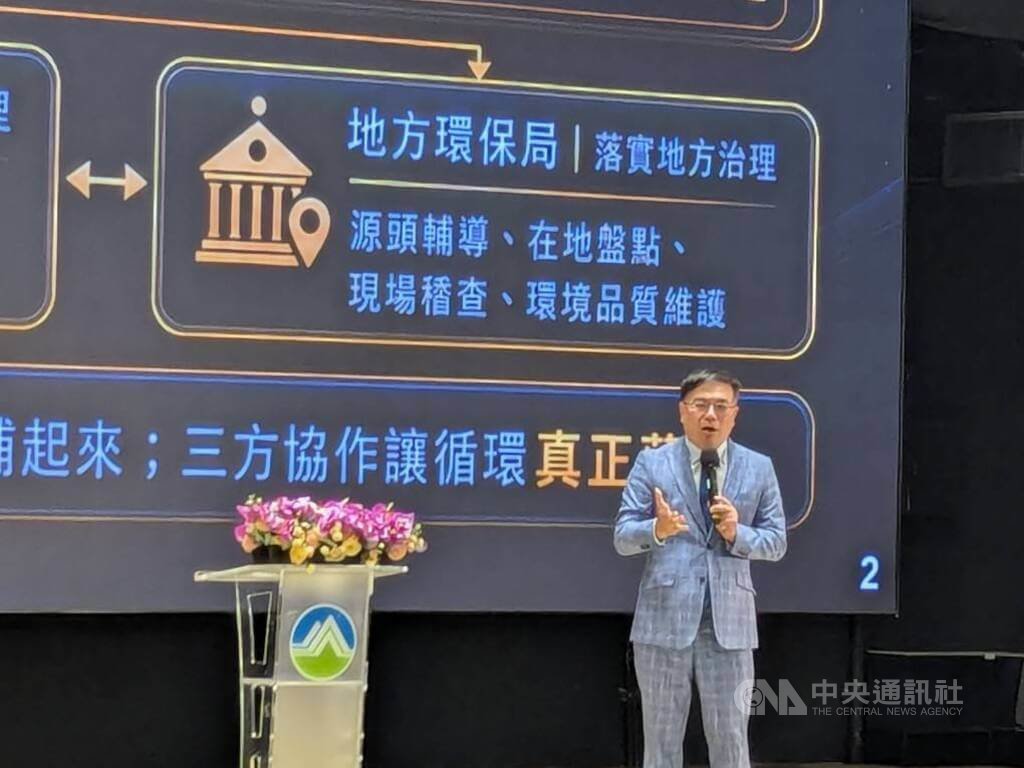
(CNA) The Waste Disposal Act was recently amended and passed in its third reading, strengthening the central government's ability to dispatch local incinerators. Environmental Protection Administration Minister Peng Chi-ming stated today that the amendment aims to enhance regional dispatch, and despite some local public pressure, he still calls on all counties and cities to embody the spirit of "one island, one fate."
The Legislative Yuan recently passed amendments to certain articles of the Waste Disposal Act in its third reading. This confirms that the central competent authority, the Environmental Protection Administration, may, when necessary, uniformly dispatch and utilize existing waste removal and treatment facilities, and those dispatched cannot refuse.
The Environmental Protection Administration held the "114th Annual Joint Award Ceremony for Waste-to-Energy (Thermal Treatment) Plants, Incinerated Recycled Aggregate, and Kitchen Waste Recycling Operations Evaluation" today. Speaking to reporters before the ceremony, Peng Chi-ming explained that the amendment strengthens the concept of "regional dispatch." If some counties or cities' incinerators are undergoing preparation or renovation, or are temporarily unable to operate due to maintenance, dispatch issues will arise.
Peng Chi-ming appealed that although some areas may face public pressure, they should embody the spirit of "one island, one fate." He added that they will discuss with each county and city one by one to increase the space for central dispatch.
Peng Chi-ming gave examples, stating that Taipei City is only willing to accept 3% of waste from other counties, while counties like Miaoli, Changhua, and Chiayi have cooperated very well and actively offered assistance. He also mentioned that some counties face difficulties in waste treatment, such as Nantou, where garbage piles up like mountains, and expressed hope for better dispatch.
Additionally, Peng Chi-ming mentioned in his speech that there were previously 50 exposed open-air garbage mountains, and now only over 30 remain, with efforts still underway to clear them by the end of the year.
The Environmental Protection Administration stated that the evaluation criteria for this award include operational management of waste thermal treatment plants, the circular use of incinerated recycled aggregate, and the diversified recycling of kitchen waste.
For example, Changhua County, which received a special award, has actively implemented source control and comprehensively promoted waste grading inspection and return mechanisms, achieving a significant reduction of 30.3% in household waste. Taoyuan City has established the first bioenergy center for raw and cooked kitchen waste in Taiwan, collaborating with private enterprises to enhance kitchen waste recycling capacity.
The Environmental Protection Administration pointed out that last year, the average operating rate of waste thermal treatment plants nationwide exceeded 85%, with an annual processing volume of over 6.25 million tons. Electricity generation also reached a new high of 3.4 billion kilowatt-hours, sufficient to meet the annual electricity needs of approximately 830,000 households in Taiwan. Furthermore, to build a defense line against African Swine Fever, all plants have fully implemented guidelines for kitchen waste processing and initiated special dioxin monitoring. The test results also confirmed that overall operations and epidemic prevention safety are secure. (Editor: Chang Ming-kun) 1150624
Stand with facts, your every donation is a force to protect press freedom
Download the CNA "One-Stop News" APP for real-time updates
The text, images, and videos on this website may not be reproduced, publicly broadcast, publicly transmitted, or used without authorization.
FACT BOX
- Source: CNA (Central News Agency)
- Category: 政策