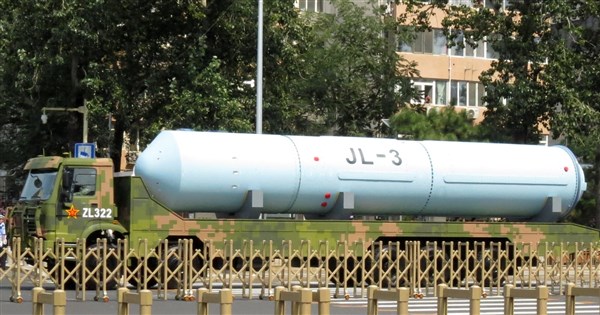
(CNA, reporter Chiu Te-chen, Sydney, July 6) Strategic expert Rajeswari Pillai Rajagopalan from the Australian Strategic Policy Institute (ASPI) told CNA that as Australia strives to strengthen security cooperation with Pacific island nations, China is conducting missile tests in the Pacific region. This not only highlights China's nuclear and military activities as a destabilizing factor in the Pacific but also poses a threat to the international order of global nuclear non-proliferation.
Earlier today, Australia signed the "Ocean of Peace Alliance" agreement with Fiji. Hours later, China immediately conducted a missile test in the Pacific. In response, Australian Minister for Defence and Acting Prime Minister Richard Marles stated that he does not believe China's missile test was retaliation for the Australia-Fiji "Ocean of Peace Alliance" agreement; however, he simultaneously criticized China's missile test for undermining regional stability.
Rajagopalan, a former visiting professor at the Graduate Institute of International Politics at National Chung Hsing University and currently a senior fellow at ASPI, told CNA via telephone today that as Australia works to strengthen security relations and promote regional stability with Pacific island nations, China has launched a missile, reportedly capable of carrying a nuclear warhead, into the Pacific, sowing seeds of instability in the region.
Rajagopalan pointed out that Australia has continuously sought to sign security cooperation agreements with Pacific island nations in recent years, striving to enhance regional security. However, China is clearly very dissatisfied with Australia's actions to maintain regional stability.
In 2024, Australia signed the "Nauru-Australia Security Treaty" with Nauru; in October last year, Australia signed the "Pukpuk Treaty" defense agreement with Papua New Guinea (PNG); and in June this year, Australia signed the "Nakamal Agreement" with Vanuatu.
Rajagopalan reminded that while Canberra is working to strengthen regional security and stability in the Pacific, China has repeatedly conducted missile tests in the region. For example, the last time was in 2024, when China test-fired an intercontinental ballistic missile into the Pacific, with its landing point in the Pacific Ocean near the exclusive economic zone of French Polynesia.
Regarding China's missile test in the Pacific region again today, Rajagopalan said, "What is important is that I believe these actions by China once again demonstrate its aggressive attitude towards small countries, neighboring countries, and other nations."
Rajagopalan further warned that China's actions have highlighted its aggressive nature. She said, "China's repeated missile tests are enough for countries in the Pacific region to recognize China's aggressive behavior; this is expected to help Pacific nations reach a consensus with countries like Australia to strengthen cooperation in responding to aggressive behavior."
Rajagopalan also warned that China's expansion of nuclear weapons at an unprecedented pace without providing proper justification will set a negative precedent for the international order of global nuclear non-proliferation, further posing a threat to global security. (Editor: Tien Rui-hua) 1150706
Stand with facts, your every donation is a force to protect press freedom
Download the CNA "One-Stop News" APP for real-time updates
Text, images, and videos on this website may not be reproduced, publicly broadcast, publicly transmitted, or used without authorization.
FACT BOX
- Source: CNA (Central News Agency)
- Category: 国际关系