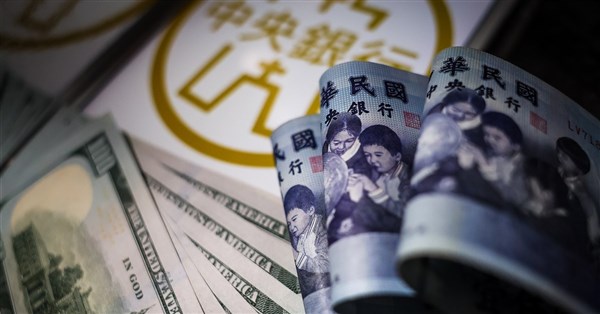
(CNA) - The US Federal Reserve's hawkish stance at its June interest rate meeting sent the dollar soaring and shifted market sentiment. The Central Bank announced today that foreign exchange reserves at the end of June stood at $597.152 billion, a significant decrease of $7.922 billion from the end of May, falling below the $600 billion mark. Both currency exchange rate fluctuations and the central bank's intervention to sell foreign currency and curb depreciation were major contributing factors.
Tsai Chiong-min, Director of the Central Bank's Foreign Exchange Department, stated that the changes in foreign exchange reserves in June were primarily influenced by three factors. While investment returns on foreign exchange reserves provided a positive contribution, the depreciation of major currencies against the US dollar and the central bank's intervention to sell foreign currency and curb depreciation led to a reduction in reserves.
Tsai explained that following the US Federal Reserve's June interest rate decision meeting, investors perceived Fed Chair Kevin Warsh's stance as more hawkish than expected. Coupled with the influence of the dot plot, market expectations for interest rate hikes intensified, leading to a strengthening of the international dollar. Most non-US currencies depreciated, causing a shrinkage in the scale of foreign exchange reserves after conversion. "Exchange rate fluctuations were a significant factor," he noted.
Additionally, the central bank reported that although foreign investors net remitted capital into Taiwan in June, after considering profit remittances and dividend payouts, foreign investors became net remitters of $17 billion. With the continued outflow of hot money, the New Taiwan Dollar weakened accordingly, depreciating by 4.53角 in June.
Tsai admitted that the central bank intervened by selling foreign currency to maintain order in the foreign exchange market in June, leading to a decrease in foreign exchange reserves. However, he added that the scale of intervention was relatively mild compared to March of this year when the US-Iran war broke out and hot money flowed out in large volumes.
Tsai also pointed out that while foreign investors have been adjusting their holdings in Taiwanese stocks recently, it is not a complete withdrawal. From the perspective of foreign capital inflows and outflows, some funds are still continuously flowing into Taiwan for investment. He suggested that some foreign investors are selling stocks to take profits and are adjusting their positions in line with global investment portfolios.
The recent strengthening of the international dollar, combined with the peak season for dividend payouts in July and August, has put downward pressure on the New Taiwan Dollar. However, Tsai believes that the trend of the international dollar is the key factor.
"The market is currently more bullish on the dollar," Tsai analyzed. He explained that the market interpreted the Fed's hawkish signals in June as increasing expectations for interest rate hikes. However, he believes that international oil prices have fallen back to around $70 per barrel, almost the level before the US-Iran war, indicating a significant decrease in inflationary pressure. Furthermore, US non-farm payroll data for June showed a moderate labor market. Considering these factors, he estimates that the US Federal Reserve will remain on hold in September and will not raise interest rates.
Tsai further stated that if the international dollar subsequently retreats, exporters might accelerate their foreign currency sales, providing support for the New Taiwan Dollar. The movements of foreign investors after receiving dividends will also depend on the performance of international stock markets, especially the trend in technology stocks. If the stock market continues to show upward momentum, it is not impossible that foreign investors will continue to invest in Taiwanese stocks.
When asked by the media if the recent sharp depreciation of the Japanese Yen would drag down the overall trend of Asian currencies and exacerbate depreciation expectations, Tsai responded that from the perspective of nominal effective exchange rates, the New Taiwan Dollar has remained very stable this year. He acknowledged that there will be some correlation between Asian currencies, but the most crucial factor remains the trend of the international dollar, influenced by supply and demand in each country's market and capital movements.
The central bank also announced its foreign exchange market intervention status for the first quarter, revealing a net sale of foreign currency amounting to $12.59 billion in Q1, marking the second consecutive quarter of net sales.
Additionally, as of the end of June 2026, foreign investors' holdings of domestic stocks and bonds, calculated at their market value on that day, along with their NT dollar deposit balances, totaled $1.8885 trillion, equivalent to 316% of foreign exchange reserves. (Editor: Huang Kuo-lun) 07062026
Stand with facts, your every donation is a force to protect the freedom of the press.
Download the CNA "One-Stop News" APP to get the latest news in real-time.
This website's text, images, and videos may not be reproduced, publicly broadcast, publicly transmitted, or used without authorization.
FACT BOX
- Source: CNA (Central News Agency)
- Category: 經濟