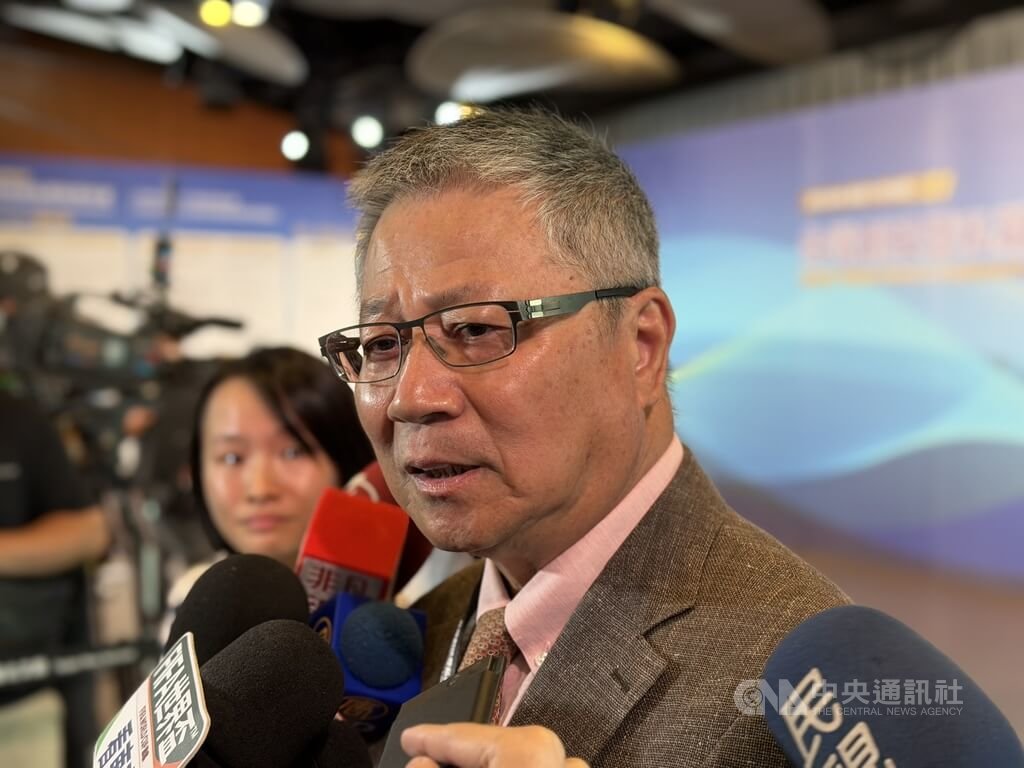
(CNA, Reporter Wu Chia-hao, Taipei, July 7) Wistron Chairman Lin Hsien-ming said in an interview today that the company's current internal operational status has not changed significantly from initial expectations. As consumers begin to pay for artificial intelligence (AI), the value generated by AI has been recognized by the market, ushering in a new era rather than the bubble some fear. Demand for AI in regions outside the United States is also "slowly emerging."
Lin Hsien-ming attended the Taiwan Venture Capital Association & Private Equity Investment Annual Meeting this morning, where he received a lifetime achievement award. He spoke to the media before the event.
When asked about his views on Wistron's ex-dividend date on the 8th, Lin Hsien-ming pointed out that the overall market trend will eventually return to fundamentals. Although stock prices and the market may experience short-term fluctuations, long-term development remains optimistic as long as the company's direction and foundation are sound. Wistron is not overly concerned with short-term volatility but rather with improving its own operational health.
Lin Hsien-ming stated that Wistron's growth in the first half of this year has been good. While high growth is positive, it also brings increased operational pressure. "We are aware that the chances of making mistakes also increase," he said, emphasizing the need to pay close attention to every operational detail and ensure smooth operations through technologies like AI, new methods, and Digital Twin.
Regarding shipments and market sentiment in the second half of the year, Lin Hsien-ming said that based on Wistron's monthly internal reports, "it appears there have been no major changes from our original estimates."
Secondly, Lin Hsien-ming analyzed market demand, noting that North America remains the largest market, but AI demand in other regions is "slowly emerging." He stressed that companies cannot rely on a single region's market long-term and need to diversify.
When asked if AI might repeat the dot-com bubble, Lin Hsien-ming believes that people are now seeing that "consuming tokens (the smallest unit of AI computation) requires payment, and it's not a small amount." This signifies that the value generated by AI has been recognized, consumers are starting to pay, creating a positive cycle where users want to use more as they use it more.
Lin Hsien-ming further explained that there are now many benchmarks for tokens, indicating competition, and competition implies a market. "It's unlikely to be a bubble; it should be a new era." He cited AI company Anthropic as an example, whose high revenue is precisely because its benchmarks are excellent, leading the market to be willing to pay. This phenomenon is continuing to occur. (Editor: Chang Liang-chih) 1150707
Stand with facts, your every donation is a force to protect press freedom
Download the CNA "First News" APP for real-time updates
Text, images, and videos on this website may not be reproduced, broadcast, transmitted, or used without authorization.
FACT BOX
- Source: CNA (Central News Agency)
- Category: 企業
- Organizations: Anthropic