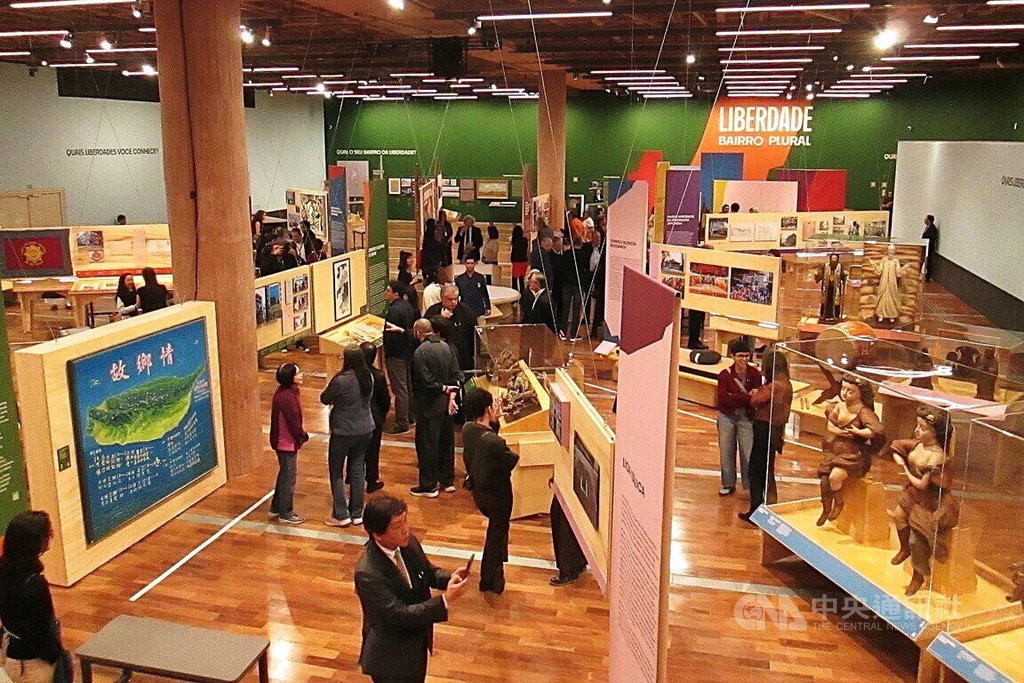
(CNA, São Paulo, July 7) - The Museu do Ipiranga at the University of São Paulo launched a special exhibition, "Liberdade: bairro plural" (Liberdade: a plural neighborhood), on July 7th. The exhibition runs until January 31, 2027, and aims to recreate the historical culture of São Paulo's Liberdade district over the past century from a new perspective.
The exhibition, co-curated by museum director Paulo Garcez Marins and researcher Mônica Raisa Schpun from the Paris Institute of Social Sciences, is divided into three major sections. Through artifacts, photographs, clothing, musical instruments, furniture, architectural designs, and artworks, it reveals how Liberdade became a microcosm of a "plural neighborhood" through the interweaving of different ethnic groups.
Marins pointed out that although Liberdade is often seen as a "Japanese immigrant settlement," its cultural landscape is actually the result of the interweaving of multiple ethnic groups. Schpun emphasized that culture is not static but dynamic and constantly changing, with each wave of immigrants leaving its mark, forming today's plural neighborhood.
The exhibition brings together representative organizations from immigrant communities from Taiwan, Japan, Lebanon, Russia, Portugal, and Germany, as well as organizations such as the Brazilian Black Front and the Salvation Army. From Taiwan, the Overseas Community Affairs Council's São Paulo Taiwanese Cultural Center and the Taiwanese Presbyterian Church in São Paulo have lent precious artifacts including calligraphy, paintings, sculptures, and photographs, bearing witness to the 70-year journey of Taiwanese immigrants deeply rooted in Brazil.
São Paulo's Liberdade district, located in the city center, was a former prison site in the 19th century and got its name from the word "liberty." In the early 20th century, a large number of Japanese immigrants settled there, gradually forming the impression of "East Asian Street." However, with the addition of immigrants from Lebanon, Taiwan, China, Korea, Portugal, Germany, Russia, and Africa, Liberdade gradually became a microcosm of multiculturalism. Today's Liberdade is not only a symbol of Asian culture but also a miniature of Brazilian immigration history, with restaurants, religious buildings, cultural centers, and shops on its streets collectively constructing a unique urban landscape.
The grand opening ceremony on July 6th was unprecedented, with over 300 representatives from the Taiwanese diaspora and Brazilian cultural figures gathered, including Director-General of the Taipei Economic and Cultural Office in São Paulo, Trudy Su-ching Chu; Japanese Consul General Yoriko Suzuki; Provost of the University of São Paulo, Aluísio Augusto Cotrim Segurado; Director of the São Paulo Taiwanese Cultural Center, Yu Cheng-tsai; President of the Brazilian Chinese Association, Maria Helena S. B. de Oliveira; Founder of Brazil Chinese Information Network, Huang Hsiu-li Chih; Chairman of the Hakka Association of Brazil, Chang Yung-hsi; Overseas Community Affairs Consultant, Liao Shih-ping; and President of the Taiwan-Brazil Arts and Culture Exchange Association, Hsieh Ju-hsin.
The event began with a rhythmic drum and dance performance by the Center for African Cultural Studies, with the resounding drums symbolizing the coexistence and shared prosperity of different ethnic groups.
Trudy Su-ching Chu stated that this is the first collaboration between the Taipei Economic and Cultural Office and the Museu do Ipiranga, which is of great significance. Last year marked the 70th anniversary of Taiwanese immigrants arriving in Brazil, and this exhibition, through carefully selected artifacts, allows Brazilian society to better understand the story and contributions of Taiwanese immigrants who have deeply rooted themselves here. She emphasized that Taiwan is not only an internationally renowned technology island but also possesses a profound cultural heritage; culture is the sum of collective memory and ways of life, encompassing language, religion, diet, art, and social systems. Through the exhibition, Taiwan and Brazil can find more understanding and resonance in cultural exchange.
The multiculturalism of Liberdade is a microcosm of Brazilian society, where different ethnic groups meet, interact, and collectively shape new cultural landscapes. The exhibition, through concrete artifacts and artworks, allows visitors to understand how culture is expressed in daily life and how it continuously evolves through cross-ethnic interactions.
Amidst the drums and calligraphy, between sculptures and religious buildings, through "Liberdade: bairro plural," visitors can deeply experience the diversity and inclusiveness of culture and witness the historical traces of Taiwanese immigrants in Brazil. This is not just an exhibition, but a collection of stories about memory, identity, and coexistence. (Editor: Chang Chih-hsuan) 1150707
Stand with facts, your every sponsorship is a force to protect press freedom
Download CNA's "One-Stop News" APP for real-time updates
The text, images, and videos on this website may not be reproduced, publicly broadcast, publicly transmitted, or used without authorization.
FACT BOX
- Source: CNA (Central News Agency)
- Category: 文化展覽
- Organizations: Museu do Ipiranga