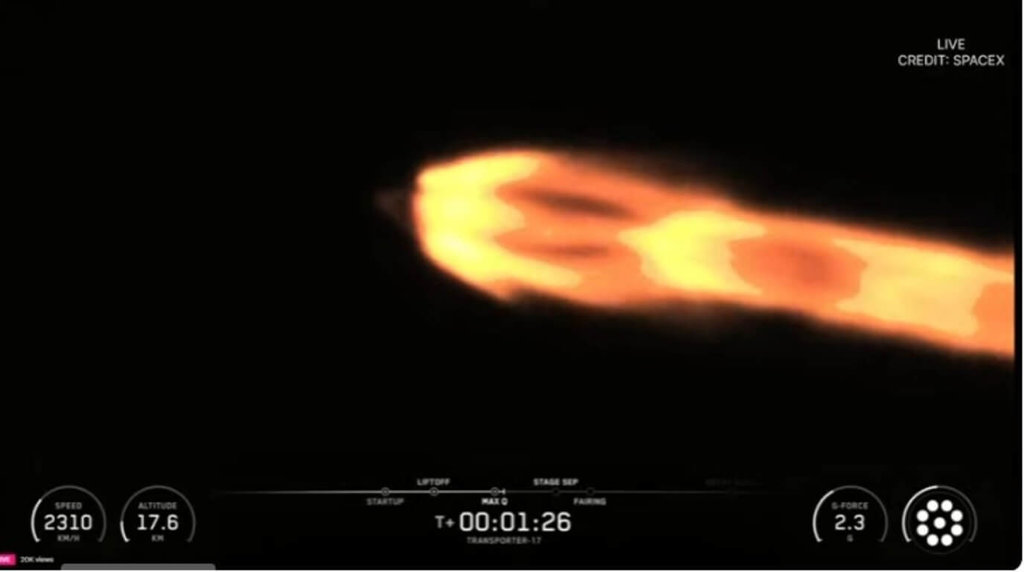
(Central News Agency, Taipei, July 7) The Ministry of Education's "Intelligent Leadership Program for Cross-disciplinary Talents in Digital Humanities" and the National Central University's space team, in collaboration with the Pingtung County Government, Donggang Donglong Temple, and others, jointly promoted the "Lord Wangye into Space" test mission, which officially ascended at 3:12 PM today.
The Ministry of Education issued a press release today stating that the "Lord Wangye into Space" test mission was launched aboard a rideshare rocket from Vandenberg Space Force Base in California, USA. The mission carried leftover wood from the Donggang Welcoming Peace Festival's "Wang Chuan" (King's Boat) into an orbit via a Taiwan-developed CubeSat. The launch officially took place at 3:12 PM on July 7 (Taiwan time), showcasing Taiwan's integrated capabilities in space technology, cultural translation, local development, and cross-disciplinary education.
The "Lord Wangye into Space" test mission is a cross-disciplinary practice that combines technology, humanities, culture, and local characteristics. It reinterprets local cultural elements through technological carriers, not only demonstrating educational innovation but also allowing the younger generation to cultivate cross-disciplinary integration and international perspectives through practical participation, laying the foundation for Taiwan's future technological talent.
On the day of the launch, the "Lord Wangye into Space" team also presented the "Heavenly River Watch" program. Messengers from National Central University, National Pingtung University, Providence University, and Ming Chi University of Technology conducted a live broadcast of the entire event. They were joined by teams from various fields including space science, cultural education, digital humanities, and popular science promotion, to help the public understand the mission's story, Taiwan's space development, and the cultural significance behind the Wangye faith.
Liu Kuo-wei, Vice Minister of Education, stated that artificial intelligence and space technology are rapidly changing global industrial development. Higher education in the future should place greater emphasis on cultivating interdisciplinary talents, enabling technology to be applied in various professional fields and social applications. The Ministry of Education has actively promoted AI and cross-disciplinary education in recent years, hoping that teachers, students, and talents from all fields can effectively utilize artificial intelligence and technology as tools for learning and innovation. (Editor: Chang Ming-kun) 1150707
Stand with facts, your every sponsorship is a force to protect press freedom
Download the Central News Agency "One-Stop News" APP for real-time updates
The text, images, and videos on this website may not be reproduced, publicly broadcast, publicly transmitted, or used without authorization.
FACT BOX
- Source: CNA (Central News Agency)
- Category: 科技教育