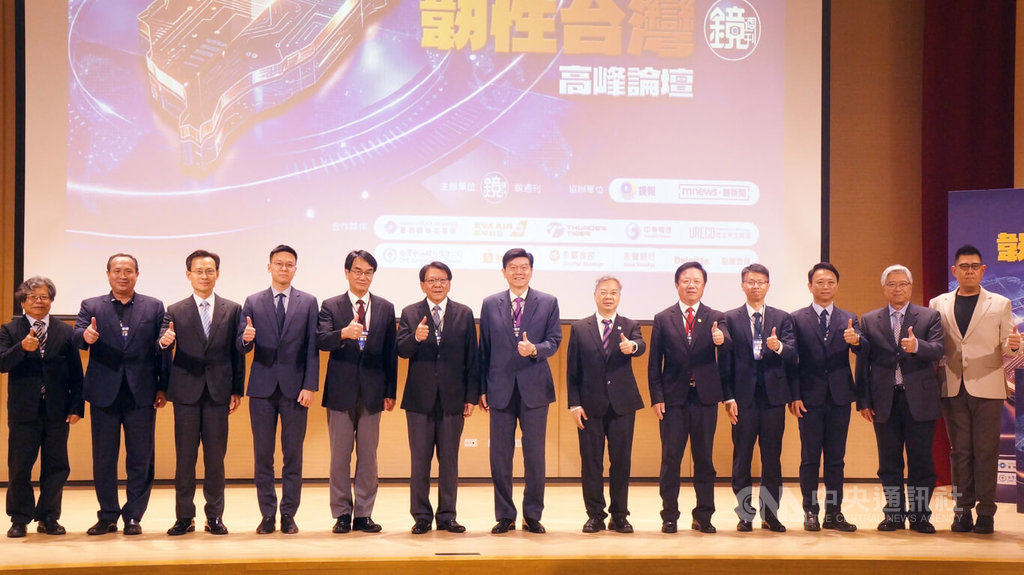
Taipei, Jul. 7 (CNA) Minister of Economic Affairs Kung Ming-hsin stated today that with the changing geopolitical landscape, de-Sinicized supply chains have become an international trend. The government aims to promote the de-Sinicization of five key industries, fostering closer supply chain links and even ecosystems with global democratic nations to enhance resilience.
The 2026 Resilient Taiwan Summit was held today, attended by Presidential Office Secretary-General Pan Men-an, Minister of Economic Affairs Kung Ming-hsin, Minister of Digital Affairs Audrey Tang, and Deputy Executive Secretary of the National Security Council and Deputy Secretary-General Lin Fei-fan, among others.
In his address, Pan Men-an emphasized that the government continues to deepen domestic economic foundations through the five key industries and maintain international connectivity to address the impacts of geopolitics. Taiwan's recent outstanding economic performance is not solely the government's effort but a foundation built by all sectors of society; facing the next wave of challenges, continued cooperation between the government and businesses is even more crucial.
Pan Men-an pointed out that amidst the AI wave, Taiwan must play a crucial role as a base in de-Sinicized supply chains, expanding into European, Asian, and American markets to enhance overall supply chain resilience. Simultaneously, the government is focusing on the transformation and innovation of traditional industries and small and medium-sized enterprises (SMEs), and will leverage the capacity of the technology industry to help all sectors advance together.
Kung Ming-hsin stated in his speech that in response to international geopolitical changes, de-Sinicized supply chains have become an international trend, presenting development opportunities for Taiwan, including in areas like drones and critical minerals, where Taiwan can deepen cooperation with global partners.
Kung Ming-hsin further elaborated that the government hopes to achieve closer supply chain cooperation, and even form ecosystems, with global democratic nations through the de-Sinicization of the five key industries. He also highlighted that SMEs, numbering 1.71 million and accounting for 98% of all enterprises, are a crucial foundation for Taiwan's resilience, and the government will continue to provide support.
Regarding digital resilience, Audrey Tang outlined the Digital Ministry's three major goals: uninterrupted internet access, continuous system operation, and no data loss. She stated that Taiwan, situated on the front lines of geopolitical conflict and frequently facing natural disasters like typhoons and earthquakes, prioritizes multiple redundancies. For internet connectivity, diverse redundancies have been established through sea, land, and air, while data employs dual redundancy with local and overseas cloud backups.
Audrey Tang noted that the Digital Ministry is integrating various systems across Taiwan, assessing priorities during normal and emergency situations. In emergencies with limited bandwidth, resource allocation and core facility defense will be involved. For instance, in a war scenario, the dispatch of medical resources and pharmaceuticals would become more critical. Furthermore, cybersecurity resilience is also a significant issue, and the Digital Ministry will continue to strengthen defensive measures.
Lin Fei-fan delivered a speech titled "Policy Initiatives to Comprehensively Enhance Taiwan's Resilience," stating that resilience is not innate but requires investment, construction, and practice, a capability that must be continuously strengthened through joint participation of the government and society.
Lin Fei-fan pointed out that China invests NT$8 trillion annually in military expansion, which is 11 times Taiwan's average annual defense budget. China is rapidly enhancing its military strength and combat readiness. He detailed China's recent actions that have disturbed Taiwan, stating, "A country that advocates for cross-strait kinship does not need to test missiles and rockets in the Taiwan Strait, nor does it need to use routine military exercises to oppress Taiwan."
He stated that the government is continuously building societal resilience, such as establishing disaster prevention collaboration centers in all 368 townships across Taiwan and training 150,000 disaster prevention personnel, with a goal of reaching 200,000 by the end of this year. The future aim is to train 2 million people as disaster prevention personnel capable of providing frontline emergency response.
Lin Fei-fan emphasized that Taiwan's goal is clear: to ensure that every morning when the adversary wakes up, they clearly realize that today is not a good day to invade Taiwan. This is the most important deterrence and the most crucial element in maintaining peace and security in the Taiwan Strait. (Edited by Lin Chia-hsien) 1150707
Stand with facts, your every donation is a force to protect press freedom
Download CNA's "One-Stop News" APP for real-time updates
The text, images, and videos on this website may not be reproduced, publicly broadcast, publicly transmitted, or used without authorization.
FACT BOX
- Source: CNA (Central News Agency)
- Category: 政策