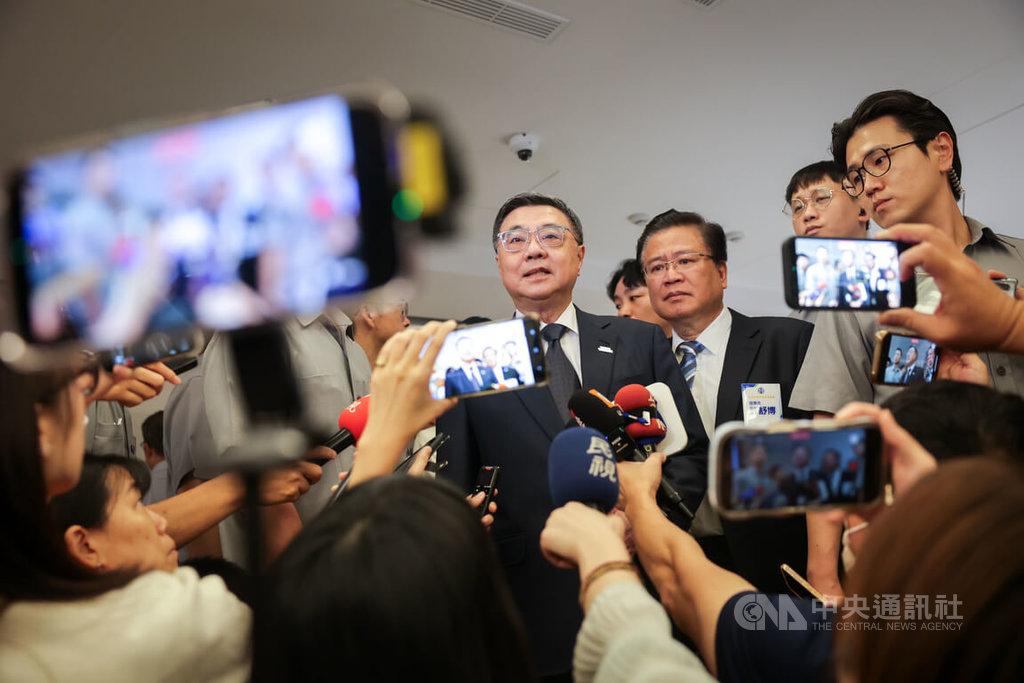
(CNA) Taipei, July 8 - Regarding the Chung-lien oil case where carcinogen levels exceeded standards, opposition parties have questioned the government's alleged cover-up and deliberate delay in announcing the downstream flow. Premier Cho Jung-tai explained today that the government's principle in handling food safety incidents is to "announce what is found, and remove what is problematic." The Ministry of Health and Welfare (MOHW), after an expert meeting in accordance with the law, set standards for problematic products. Considering the difficulty of inspecting each item individually, it was decided to remove all products, and there was never any "cover-up."
The exceeding of the carcinogen benzo(a)pyrene in Chung-lien oil has triggered a nationwide food safety storm. The MOHW on July 2 requested businesses to recall and remove the first tier of affected products; on July 4, it further requested the precautionary removal of original oils and processed foods using affected oils at a concentration of 20% or more; yesterday, it announced that processed foods with less than 20% content also needed to be preemptively removed.
In response, opposition parties further questioned the government's repeated changes and even alleged a cover-up. Speaking to reporters before attending the "12th Third Member Representatives Assembly of the General Chamber of Commerce" this afternoon, Cho Jung-tai responded that once food safety issues are found, they will be announced, and problematic products will be removed; this is the government's consistent principle.
Cho Jung-tai explained that the Food and Drug Administration and the MOHW are acting in accordance with the law and must clarify which products should be removed based on scientific evidence. Therefore, an expert meeting was convened to set standards, after which 360 downstream businesses identified 232 related products. Considering that individual inspections would be time-consuming and difficult to implement, it was decided to require the comprehensive removal of related products, not a "cover-up" as claimed by the outside world.
Cho Jung-tai stated that the government wishes to inform the public of food safety information as quickly as possible, but the premise is to grasp the most truthful and accurate content to make correct decisions. Currently, in addition to continuing to investigate the full picture of the incident, the government is also simultaneously addressing subsequent oil supply and price stability, and initiating judicial, administrative, and investigative probes into the involved businesses, hoping to provide a complete account of the incident to the public as soon as possible.
Cho Jung-tai later stated in his speech that relevant ministries are continuously assessing whether the suspension of supply of affected oils will impact the supply and demand of oil for national manufacturers and daily consumption, to prevent market imbalances or price surges.
He further pointed out that the government has begun a comprehensive review of subsequent supply and demand order, and has requested the Fair Trade Commission to closely monitor market prices. Simultaneously, it has tasked investigative units to thoroughly investigate whether upstream oil suppliers involved in the case have engaged in illegal activities. In addition, a final review will be conducted at the Executive Yuan meeting tomorrow, after which comprehensive measures will be announced to the public to reduce anxiety among the public and businesses, and to ensure that illegal operators face due legal investigation.
Regarding the impact of the incident, Hsu Shu-po, Chairman of the General Chamber of Commerce, stated before the meeting that food safety is a concern for all citizens, and toxic damage is often cumulative over the long term. The government has an undeniable responsibility to maintain food safety. Regardless of the degree of contamination, any problematic oil should be comprehensively removed and strictly supervised to prevent similar incidents from recurring.
Regarding the impact on many chain restaurant operators, Hsu Shu-po said that most restaurant operators cannot know whether the upstream oil is legal and can only rely on product labels and government oversight. As long as products bear a qualified label, the government should bear the responsibility of supervision and should not shift the responsibility to vendors or restaurant operators. (Editor: Chai Szu-chia) 1150708
Stand with facts, your every donation is a force to protect press freedom
Download CNA's "First Hand News" APP to get the latest news in real-time
Text, images, and videos on this website may not be reproduced, broadcast, publicly transmitted, or used without authorization.
FACT BOX
- Source: CNA (Central News Agency)
- Category: 政治